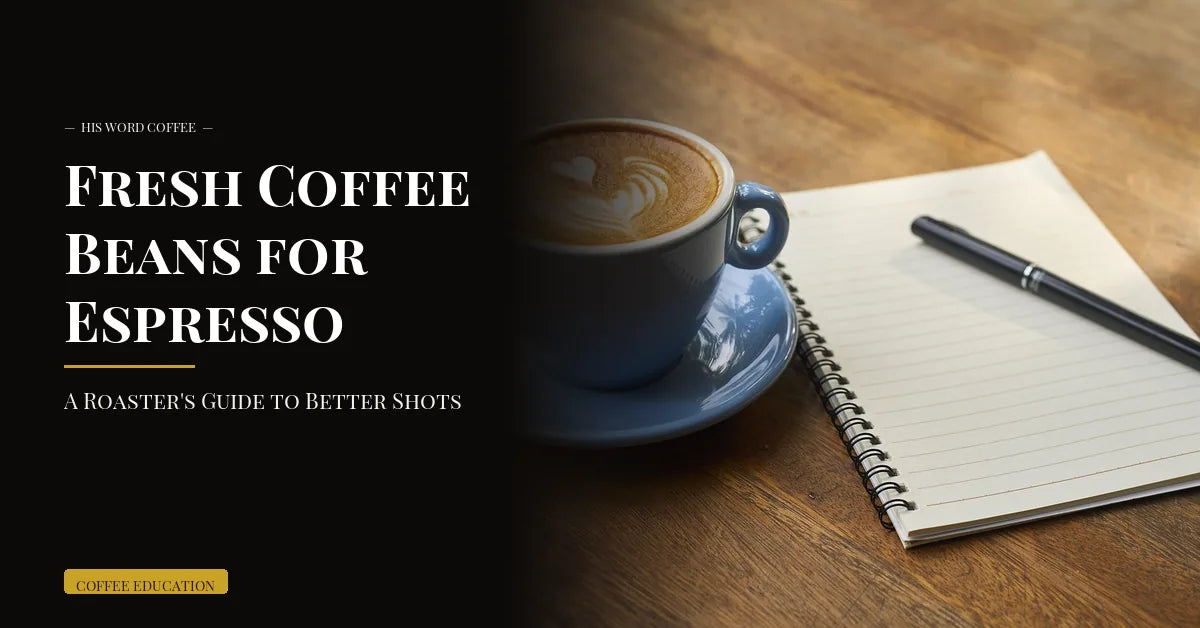
Here's a secret most coffee companies won't tell you: there's no such thing as an "espresso bean." Any coffee bean can be used for espresso. What really matters is how fresh it is, how it's roasted, and how you dial in your machine.
We pull espresso shots every day at His Word Coffee. Here's what we've learned about getting the best possible shot from fresh beans.
Key Takeaways

- Any coffee bean can be used for espresso, there's no special "espresso bean"
- Freshness is the single biggest factor in great espresso
- Beans need 5-14 days of rest after roasting for the best espresso
- Medium to medium-dark roasts are the easiest to work with for espresso
- Grind size, dose, and timing matter more than the beans themselves
- Air-roasted beans give a cleaner, more balanced shot
In This Article
The "Espresso Bean" Myth
Walk into any grocery store and you'll see bags labeled "espresso roast" or "espresso blend." It sounds official. But all it really means is the roaster thinks those beans work well in an espresso machine.
Espresso is a brewing method, not a type of bean. It's made by forcing hot water through finely ground coffee at high pressure. You can do that with any bean from any country at any roast level.
That said, some beans do work better for espresso than others. The high pressure and short brew time (about 25-30 seconds) extracts flavors very intensely. So beans with smooth, balanced flavors tend to shine, while beans with harsh or uneven roasts can taste really rough.
"Whatever your hand finds to do, do it with all your might."Ecclesiastes 9:10
Why Freshness Changes Everything

If there's one thing we could tell every home espresso maker, it would be this: buy fresh beans. It matters more than the brand, the origin, or the roast level.
Fresh beans have CO2 trapped inside from the roasting process. This CO2 helps create crema, that golden layer on top of a good espresso shot. As beans get older, they lose CO2 and your shots come out flat and thin.
But there's a sweet spot. Beans that are too fresh (just roasted yesterday) have too much CO2. The gas gets in the way of extraction and makes your shots taste sour and uneven. We've found that 5-14 days after roasting is the ideal window for espresso.
Freshness Window for Espresso
Days 1-4: Too gassy, shots will be uneven. Days 5-14: Sweet spot for the best crema and flavor. Days 14-30: Still good, but crema starts to fade. After 30 days: Time for a new bag.
Best Roast Levels for Espresso
You can use any roast level for espresso. But if you're just getting started, medium to medium-dark roasts are the most forgiving.
Here's why. Light roasts are denser and harder to extract evenly. They need finer grinds, higher temperatures, and precise timing. When you get it right, a light roast espresso can be amazing, with fruity, complex flavors. But when you get it wrong, it tastes sour and watery.
Medium and medium-dark roasts have more soluble compounds from the longer roasting time. They extract more easily and consistently. You get a balanced shot with chocolate, caramel, and nutty notes that most people love.
| Roast Level | Espresso Flavor | Difficulty | Best For |
|---|---|---|---|
| Light | Fruity, bright, complex | Hard to dial in | Experienced home baristas |
| Medium | Balanced, sweet, caramel | Moderate | Most home setups |
| Medium-Dark | Chocolate, nutty, rich | Easiest | Beginners, milk drinks |
| Dark | Smoky, bold, bitter | Easy | People who like it strong |
If you're making milk drinks like lattes or cappuccinos, go with a medium-dark. Those bold flavors cut through the milk nicely. For straight espresso or americanos, a medium roast gives you more interesting flavors to enjoy.
Dialing In Your Shot
Great beans are only half the battle. You also need to dial in your machine. Here are the basics that make the biggest difference.
Grind Size
Espresso needs a very fine grind, but not powder-fine. It should feel like table salt between your fingers. Too fine and the water can't push through (your shot takes forever and tastes bitter). Too coarse and it flows too fast (sour, watery shot).
Dose
Start with 18 grams of ground coffee in your portafilter. This is the standard dose for most double-shot baskets. Adjust by half a gram at a time until your shots taste right.
Yield and Time
Aim for about 36 grams of espresso out (a 1:2 ratio) in 25-30 seconds. If it's running too fast, grind finer. Too slow? Grind coarser. Small adjustments make a big difference.
The Simple Espresso Formula
18g coffee in, 36g espresso out, in 25-30 seconds. Start there and adjust to your taste. A kitchen scale that reads to 0.1g is your best friend for espresso.
Air-Roasted Beans for Espresso
We've pulled thousands of shots with our air-roasted beans, and we honestly think they make some of the best espresso you can get at home.
Here's why. Air roasting gives every bean a perfectly even roast. There are no scorched spots or underdeveloped patches. When you grind those beans and pull a shot, the water extracts flavor evenly across all the grounds. The result is a cleaner, more balanced shot.
With drum-roasted beans, uneven roasting can create a mix of bitter and sour flavors in the same shot. You can still make good espresso with them, but it takes more work to dial in. Air-roasted beans are more forgiving and consistent.
Our customers who pull espresso at home tell us they notice a real difference. The shots are smoother, the crema is better, and the flavors are more clear. We think you'll notice it too.
Fresh Beans for Better Espresso
Air roasted in small batches and shipped fresh. Your espresso machine will thank you.
Shop Espresso-Ready BeansFAQ
Do I need special beans for espresso?
No. Espresso is a brew method, not a bean type. Any coffee can be used for espresso. Look for fresh, evenly roasted beans and you'll get great results.
How fresh should my beans be for espresso?
The sweet spot is 5-14 days after roasting. Too fresh and the excess CO2 makes extraction uneven. Too old and you lose crema and flavor. Always check the roast date on the bag.
What grind size should I use for espresso?
Very fine, about the texture of table salt. You'll need a quality burr grinder to get a consistent espresso grind. Blade grinders don't cut it for espresso.
Why does my espresso taste sour?
Sour espresso usually means under-extraction. Try grinding finer, using hotter water, or extending your shot time slightly. Also make sure your beans aren't too fresh (less than 5 days off roast).
Can I use light roast for espresso?
Absolutely. Light roast espresso can be delicious, with fruity and complex flavors. But it's harder to dial in. You'll need a finer grind and may need to adjust your temperature. Start with medium roast if you're new to home espresso.
Sources: Specialty Coffee Association, Espresso Standards | Barista Hustle, Espresso Recipes

Leave a comment
This site is protected by hCaptcha and the hCaptcha Privacy Policy and Terms of Service apply.