
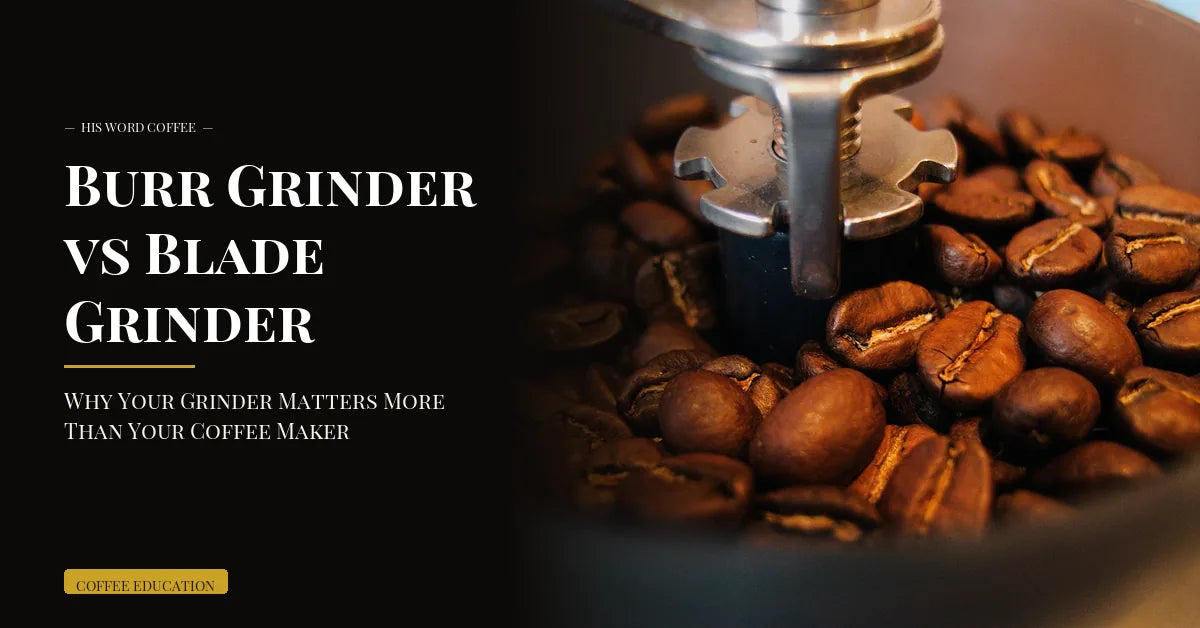
If you want to improve the coffee you drink at home, the grinder is the place to start. Not the coffee maker, not the water temperature, not an expensive pour-over setup. The grinder.
Here is why in one sentence: a burr grinder produces particles that are all approximately the same size, which means all of them extract at the same rate, which means your cup tastes like the coffee is supposed to taste. A blade grinder chops beans randomly, producing a wide mix of powder and chunks in the same batch. Those different-sized particles extract at dramatically different rates in the same brew, and the result is a cup that is simultaneously bitter and sour.
Key Takeaways
- Particle Size Is Everything: Burr grinders produce uniform-sized particles; blade grinders produce powder and chunks in the same batch, causing uneven extraction in every cup.
- Bitterness and Sourness Explained: Fine powder over-extracts (bitter, harsh) while large chunks under-extract (sour, weak) simultaneously, that is what you taste with a blade grinder.
- Grinder Beats Coffee Maker: A $40 hand burr grinder paired with a basic drip machine consistently outperforms a $200 coffee maker used with a blade grinder.
- Two Burr Types, Both Better: Flat and conical burrs both far outperform blade grinders; conical burrs are most practical for home use at every price point.
- Less Heat, Better Aroma: Burr grinders generate minimal friction heat, preserving the volatile aromatic compounds that blade grinders can degrade before brewing.
- Highest-Impact Upgrade: Of all coffee equipment changes a home brewer can make, upgrading from blade to burr grinder produces the most noticeable improvement per dollar spent.
In This Guide
- The Bottom Line Upfront
- How Blade Grinders Work
- How Burr Grinders Work
- Flat Burr vs. Conical Burr
- Why Grind Consistency Matters
- Heat and Your Beans
- Quick Comparison: Blade vs. Burr
- Types of Burr Grinders
- Practical Recommendation
- If You Must Use a Blade Grinder
- How This Connects to Grind Size
- Fresh Beans and a Good Grinder
- FAQ
The Bottom Line Upfront
The grinder is the single most impactful piece of equipment in your home coffee setup. Before you invest in a better coffee maker, a gooseneck kettle, or a pour-over stand, buy a burr grinder. Everything else you do to improve your coffee builds on that foundation.
Everything in this article is an explanation of why that one principle is true.
How Blade Grinders Work
A blade grinder uses a small metal propeller that spins at high speed inside a chamber. You put whole beans in, press a button, and the blades chop whatever they hit. The process is closer to chopping vegetables than grinding coffee.
The core problem is randomness. Beans that fall near the blade early in the cycle get hit repeatedly and become fine powder. Beans that stay at the edges get hit less and remain in large chunks. A single 30-second grind cycle produces particles ranging from sub-100 micron powder to 1,000+ micron chunks, all in the same container.
When you brew with that mixture, water cannot extract evenly. The fine powder extracts almost instantly, often crossing into over-extraction territory. The chunky pieces barely extract in the same time window, leaving under-extracted compounds behind. Those two extremes combine in your cup, not just bitter or just sour, but both, muddled together.
No brewing technique can fully compensate for inconsistent grind particle size. The problem is built into the tool.
How Burr Grinders Work
A burr grinder uses two abrasive surfaces, the burrs, positioned at a fixed, adjustable distance from each other. Whole beans are fed between those surfaces and crushed down to the size of the gap between them.
Because the gap is fixed and consistent, every particle that passes through ends up approximately the same size. A good burr grinder might produce particles clustered within plus or minus 100 microns of the target. A blade grinder produces a range ten times wider or more.
That narrow distribution is everything. It allows water to extract coffee compounds evenly from every particle in the batch, producing a cup with clarity, sweetness, and the specific flavor notes the roaster developed.
Burr grinders also let you adjust the gap between the burrs, giving you direct, predictable control over grind size. Want a coarser grind for French press? Widen the gap. Need an ultra-fine grind for espresso? Tighten it. The adjustment translates reliably to a change in extraction behavior.
Flat Burr vs. Conical Burr
Burr grinders come in two main configurations, and both are dramatically better than blade grinders.
Flat Burr
Flat burr grinders use two horizontal, ring-shaped burrs facing each other. Beans drop in from the top, are crushed as they travel outward across the flat surfaces, and exit the sides. Flat burrs produce an extremely tight particle distribution, which is why they dominate commercial espresso machines. They tend to be larger, more expensive, and louder. High-end home espresso grinders often use flat burrs for the precision they offer.
Conical Burr
Conical burr grinders use a cone-shaped inner burr that rotates inside a ring-shaped outer burr. Beans spiral downward between the two surfaces before exiting at the bottom. Conical burrs spin slower, which means less heat and slightly less noise. They are the most common configuration in quality home grinders because they are compact, efficient, and produce excellent consistency at every price point.
For most home brewers, a conical burr grinder is the right choice. Both types will produce results so far above a blade grinder that the comparison is almost unfair.
Why Grind Consistency Matters So Much
Coffee extraction is not a single event. It is a sequence. When hot water contacts a coffee particle, it extracts compounds in a specific order: first the light, bright, fruity or floral compounds, then the complex body compounds that add sweetness and depth, and last the heavier bitter compounds.
The goal is to capture most of the first two categories and stop before the bitter compounds dominate. For most brew methods, that window is roughly two to four minutes of contact time at 195 to 205 degrees Fahrenheit.
When all particles are the same size, they all move through that extraction sequence at the same pace, and the result is balanced. When particles are different sizes, fine particles complete their entire extraction sequence, including the bitter phase, in the same time it takes a large chunk to barely get started. You are not brewing a single batch of coffee. You are simultaneously over-extracting powder and under-extracting chunks.
Worth knowing: The Specialty Coffee Association's brewing protocols identify grind particle distribution as one of the primary variables controlling extraction yield and flavor balance. A narrower distribution consistently produces more predictable, higher-quality extraction regardless of brew method.
Heat and Your Beans
There is a secondary problem with blade grinders that does not get discussed as often: heat. The high-speed blade generates significant friction as it chops, and that friction can reach temperatures that begin to volatilize the aromatic compounds in the bean.
Coffee aroma is largely volatile, the compounds responsible for it evaporate at relatively low temperatures. Roasters invest significant effort developing those aromatics. A blade grinder can degrade them before the coffee ever reaches your cup.
Burr grinders, especially hand grinders and slower electric models, generate very little heat during grinding. The beans pass through the burrs quickly and with minimal friction heating. If you have ever noticed that blade-ground coffee smells faintly toasted or flat compared to coffee ground at a specialty shop, heat degradation is likely part of the explanation.
Quick Comparison: Blade vs. Burr
| Category | Blade Grinder | Burr Grinder |
|---|---|---|
| Particle consistency | Poor. Wide distribution of powder and chunks in every batch. | Excellent. Narrow distribution around a target size. Best |
| Flavor consistency | Unpredictable. Cup quality varies batch to batch. | Reliable. Same settings produce repeatable results. Best |
| Heat generation | High. Friction can degrade aromatics during grinding. Avoid | Low. Minimal heat, especially with hand or slower electric models. |
| Cost range | $10, $30 for most models. | $30, $300+. Quality entry-level options start around $40. |
| Grind size control | None. Coarser or finer depends only on how long you run it. Avoid | Full control. Precise, repeatable adjustment by setting. |
| Overall recommendation | Not recommended if coffee quality matters. Avoid | Recommended for every brew method from French press to espresso. Best |
Types of Burr Grinders and What to Expect
Hand (Manual) Burr Grinders
Manual burr grinders use a hand crank to rotate the inner burr. They are the most affordable entry point into burr grinding, with good options starting around $30 to $40. At $50 to $80, hand grinders from brands like Timemore, Hario, or 1Zpresso produce results that compete with electric grinders costing three to four times as much.
The tradeoff is time, grinding enough coffee for two cups takes two to four minutes of hand cranking. For most people this is a reasonable tradeoff for the quality and cost. Hand grinders are also compact and travel-friendly.
Entry-Level Electric Burr Grinders ($50 to $100)
This is the sweet spot for most home brewers. Brands like Baratza, OXO, and Breville offer conical burr grinders in this range that produce dramatically better results than any blade grinder. The Baratza Encore is the most recommended entry-level electric in the specialty coffee community. An electric burr grinder at this level handles drip, pour-over, French press, AeroPress, and cold brew with ease.
Mid-Range Electric Burr Grinders ($100 to $250)
Mid-range grinders add tighter particle distribution, wider grind range, and often the ability to grind fine enough for espresso. If you own or plan to own an espresso machine, this is the range to consider. The grinder is frequently the limiting factor for espresso quality, even more than the machine itself.

Practical Recommendation
If you are currently using a blade grinder, upgrading to a burr grinder will produce the most noticeable improvement in your coffee of anything you can do.
A $40 hand burr grinder combined with a standard drip coffee maker consistently outperforms a $200 coffee maker paired with a blade grinder. The grinder controls the quality ceiling of every cup you make. The coffee maker just delivers the extraction that the grinder made possible, or prevented.
Before you buy better beans, a new coffee maker, a gooseneck kettle, or any other equipment, buy a burr grinder.
If You Must Use a Blade Grinder
There are situations where switching immediately is not possible. If you are stuck with a blade grinder for now, there is one technique that produces slightly less inconsistency: pulse grinding.
Instead of running the grinder continuously, press and release the button in short one-second bursts. Between each burst, shake or tap the grinder to redistribute the beans, moving the chunks near the edges back toward the blade. Repeat this for the full grinding time instead of running the motor continuously.
This does not solve the fundamental problem of blade grinding. The result will still be inconsistent compared to a burr grinder. Use it as a bridge, not a solution.
Blade Grinder Pulse Technique
Pulse 1 second on, shake, pulse again. Aim for 10, 15 short bursts rather than one long run. You will still get inconsistent particle sizes, but the most extreme outliers will be reduced.
How This Connects to Grind Size
If you have read about coffee grind size and how it affects extraction, you already know that different brew methods call for different grind sizes. Those guides assume you have a grinder that can reliably hit a target size.
A burr grinder makes grind size guides useful. When you set your burr grinder to medium and brew with it, you can predict with reasonable accuracy how the extraction will behave, adjust if the result is off, and repeat the same outcome the next day. The settings are repeatable because the particle size distribution is consistent.
A blade grinder makes grind size guides almost meaningless. Grinding for "30 seconds" does not produce a predictable particle size. You cannot dial in a blade grinder because there is no actual dial. The only variable is time, and time does not control particle size distribution, only the average, which is a fraction of what matters.
A burr grinder is what makes the rest of your coffee knowledge actionable.
Fresh Beans and a Good Grinder: The Winning Combo
Fresh-roasted coffee matters. Coffee begins to lose its best qualities soon after roasting, significantly so within two to four weeks of the roast date. Buying fresh beans from a roaster who posts roast dates and brewing them within that window gives you access to the full range of flavors the roaster developed.
But fresh beans ground in a blade grinder still produce inconsistent extraction. The freshness is there in the bean. The grinder prevents much of it from reaching the cup cleanly.
We roast our beans to order using a fluid bed air roaster, which means every bag ships within days of roasting. Pair that freshness with a burr grinder and you close most of the quality gap between home brewing and what you get from a skilled cafe barista. Both variables that matter most, bean freshness and grind consistency, are achievable at home without professional-grade investment.
Start with a burr grinder. Then focus on sourcing fresh beans. Those two steps, in that order, will change what your morning coffee tastes like more than anything else you can do.
Fresh-Roasted, Ready to Grind
A good burr grinder unlocks everything a great coffee has to offer. Pair it with beans roasted to order and find out what your morning cup is actually capable of.
Shop His Word CoffeeYes, and the cost difference is smaller than most people assume. Entry-level burr grinders start around $30 to $40 for hand models, which is not far above a typical blade grinder price. The improvement in cup quality at that price point is significant and immediate. It is the best value upgrade available in coffee equipment.
Not reliably. Espresso requires an extremely fine, consistent grind, and the pressure of espresso extraction is highly sensitive to particle size variation. A blade grinder produces too much inconsistency for espresso to extract evenly. Even a mid-range burr grinder at $150 to $200 will produce dramatically better espresso than any blade grinder.
A hand grinder in the $40 to $70 range or an entry-level electric from Baratza, OXO, or Breville around $80 to $120 are both excellent starting points. Either represents a major step forward from blade grinding. Choose a hand grinder if budget is a priority; choose an electric if convenience matters more.
Yes. Drip coffee makers brew for several minutes, which gives extraction plenty of time to reveal grind inconsistency. A more consistent grind means a cleaner, more balanced cup from any drip machine. The improvement is noticeable even on inexpensive drip coffee makers.
Brush out the burr chamber every one to two weeks for daily use, and do a more thorough cleaning with grinder cleaning tablets or a full disassembly every one to three months. Coffee oils accumulate on the burrs over time and contribute stale or rancid flavors to fresh grinds. Keeping the grinder clean is part of keeping coffee quality consistent.
Both produce excellent results that far exceed blade grinding. Conical burr grinders are more practical for most home setups because they are compact, relatively quiet, and available at a wide range of price points. Flat burr grinders appear mainly in higher-end home espresso setups where extremely tight particle distribution is the priority. For home drip, pour-over, French press, or casual espresso, a conical burr grinder is the right choice.
That is likely heat degradation. The high-speed blade generates friction that can volatilize the aromatic compounds in your beans before brewing even starts. Roasters work hard to develop those aromatics during the roast. A blade grinder can strip them out in seconds. Switching to a burr grinder immediately preserves more of the aroma and flavor in your cup.
Sources: Specialty Coffee Association Brewing Protocols. Additional reference: Coffee Antioxidants and Volatile Compounds Review, PMC 2022.


Leave a comment
This site is protected by hCaptcha and the hCaptcha Privacy Policy and Terms of Service apply.