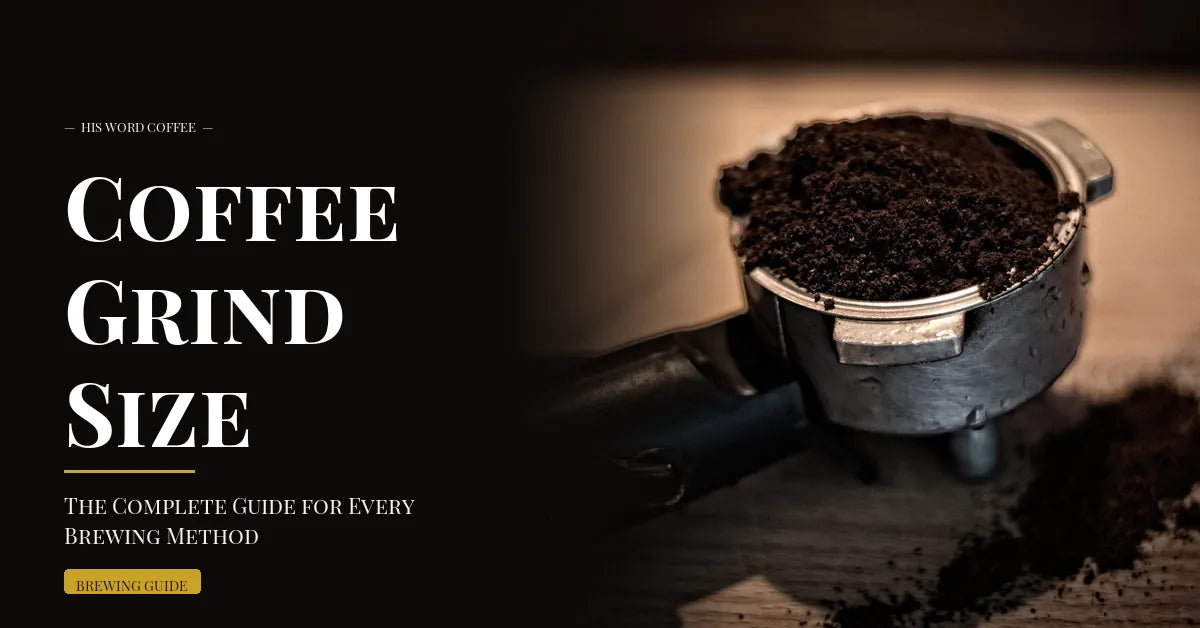
Grind size is the single biggest variable in home coffee. The same beans can taste sweet and balanced one morning, sour and watery the next, or bitter and harsh by lunch, and the only thing that changed was how fine you ground them. A good grind size chart turns that guesswork into a starting point you can trust.
This guide lists the right grind size for every common brewing method, along with exact grinder numbers for the three machines most home brewers use: the Baratza Encore, the Niche Zero, and the Comandante C40. We also explain how the grinder number scale works, why blade grinders ruin coffee no matter the setting, and how to dial in by taste when the chart gets you close but not perfect.
Match the grind to fresh coffee. Once the grind is dialed in, fresh-roasted beans make the difference. Browse our coffee beans collection and choose the flavor profile that fits your brew method.
Key Takeaways
- Cold Brew (extra coarse): Baratza Encore 30 to 40, Niche Zero 45 to 55, Comandante 30 to 35 clicks. Particles feel like kosher salt or peppercorns.
- French Press (coarse): Baratza Encore 28 to 30, Niche Zero 35 to 40, Comandante 26 to 30 clicks. Particles feel like coarse sea salt.
- Drip Coffee (medium): Baratza Encore 18 to 22, Niche Zero 25 to 28, Comandante 20 to 24 clicks. Particles feel like granulated sugar or coarse sand.
- Pour Over (medium fine): Baratza Encore 15 to 18, Niche Zero 18 to 22, Comandante 18 to 22 clicks. Particles feel like fine sand.
- AeroPress (fine to medium fine): Baratza Encore 8 to 15, Niche Zero 12 to 18, Comandante 14 to 20 clicks, depending on brew time.
- Espresso (fine): Baratza Encore 1 to 6 (limited), Niche Zero 10 to 18, Comandante 8 to 14 clicks. Particles feel like baker's sugar.
- Turkish (powder fine): Almost no home grinder reaches this. Particles feel like flour. Buy pre ground from a specialty shop.
In This Guide
Why Grind Size Matters
Coffee brewing is extraction. Hot water pulls flavor compounds, oils, and acids out of ground coffee, and grind size controls how fast that happens. Finer grinds expose more surface area, so water extracts faster. Coarser grinds expose less, so water extracts slower.
The right grind balances brew time and surface area for your specific method. A drip brewer running water through grounds for four minutes needs a medium grind. A French press steeping for four minutes needs a coarse grind because the longer contact time would over extract a finer grind. Espresso pushes water through in twenty five seconds at nine bars of pressure, so it needs a fine grind to slow the flow.
Get the grind wrong and you taste it immediately. Too fine for the method means bitter, harsh, dry coffee. Too coarse means sour, weak, watery coffee. The Specialty Coffee Association brewing protocols set 18 to 22 percent extraction as the target, and grind size is the easiest dial to turn when you miss that window.
Grind Size Chart by Brewing Method
Here is the grind level that matches each common brewing method, with the tactile comparison most home brewers use to check by feel before brewing.
| Brewing Method | Grind Size | Tactile Feel | Typical Brew Time |
|---|---|---|---|
| Cold Brew | Extra Coarse | Kosher salt, peppercorns | 12 to 24 hours |
| French Press | Coarse | Coarse sea salt | 4 minutes |
| Chemex | Medium Coarse | Rough sand | 4 to 5 minutes |
| Drip Coffee | Medium | Granulated sugar | 4 to 6 minutes |
| Pour Over (V60, Kalita) | Medium Fine | Fine sand | 2 to 4 minutes |
| AeroPress | Fine to Medium Fine | Table salt to fine sand | 1 to 4 minutes |
| Moka Pot | Fine | Baker's sugar | 4 to 6 minutes |
| Espresso | Fine | Baker's sugar | 25 to 30 seconds |
| Turkish | Powder Fine | Flour | 3 to 4 minutes |
The tactile feel column matters because grinder dials drift. Burrs wear, beans vary in density, and a setting of 20 on one Encore is not exactly a setting of 20 on the next one. Rub a few grounds between your fingers before you brew, and check the feel against the chart.
Grinder Number Chart: Encore, Niche Zero, and Comandante
Three grinders cover most home brewers. The Baratza Encore is the most common entry level electric grinder. The Niche Zero is the popular single dose grinder for espresso and filter. The Comandante C40 is the most common premium hand grinder. Here is the starting setting for each one across every common method.
| Brewing Method | Baratza Encore | Niche Zero | Comandante C40 |
|---|---|---|---|
| Cold Brew | 30 to 40 | 45 to 55 | 30 to 35 clicks |
| French Press | 28 to 30 | 35 to 40 | 26 to 30 clicks |
| Chemex | 20 to 25 | 28 to 32 | 24 to 28 clicks |
| Drip Coffee | 18 to 22 | 25 to 28 | 20 to 24 clicks |
| Pour Over | 15 to 18 | 18 to 22 | 18 to 22 clicks |
| AeroPress | 8 to 15 | 12 to 18 | 14 to 20 clicks |
| Moka Pot | 5 to 10 | 12 to 16 | 10 to 14 clicks |
| Espresso | 1 to 6 Limited | 10 to 18 Best | 8 to 14 clicks |
Encore vs Encore ESP
The standard Baratza Encore tops out around setting 1 for espresso and many shots will still run too fast. The Encore ESP model has 20 extra micro adjustments below the standard low end and is the right entry level pick for espresso. For drip, pour over, and French press the standard Encore is plenty.
How to Read Your Grinder Settings
Every grinder uses its own number scale, so a setting of 15 on one model is not the same as 15 on another. Two patterns cover most grinders.
The first pattern is the stepped dial used by the Baratza Encore, Capresso Infinity, and most entry level electrics. The dial runs from 1 (finest, near espresso) to 40 (coarsest, cold brew). Each step is a fixed change in burr distance, and you turn the dial while the grinder is running.
The second pattern is the click scale used by hand grinders like the Comandante C40, Kingrinder K6, and 1Zpresso JX Pro. The user turns an adjustment ring from zero (burrs touching) outward in numbered clicks, where each click opens the burrs a fixed amount. The Comandante uses 30 clicks per full rotation. The Kingrinder K6 uses 80 clicks per rotation, which gives you finer espresso control.
The Niche Zero falls between the two patterns. It uses a stepless dial with numbered marks at every five units. You turn the collar smoothly to any point on the scale, so you can land between marks for fine espresso adjustments.
Translate any grinder to this chart: If your grinder is not listed, use the tactile feel column from the first chart. Grind a small batch, rub it between your fingers, and compare to the salt, sugar, or sand reference. That is what the numbers on every chart are trying to approximate anyway.
Dialing In by Taste
The chart gets you close. Final adjustment comes from how the coffee tastes.
If your cup tastes sour, thin, or weak, the grind is too coarse. Water moved through the grounds too fast and missed the sweetness. Grind two to three clicks finer and brew again.
If your cup tastes bitter, harsh, or dry, the grind is too fine. Water sat on the grounds too long and pulled out the bitter compounds. Grind two to three clicks coarser and brew again.
If your cup tastes balanced and sweet with a clean finish, you found the right grind for your beans and your method. Write that setting down so you can return to it after a bean change.
Adjust two clicks, not five
Small grinder moves make big flavor changes. Two clicks finer can shift a pour over from sour to balanced. Five clicks finer often overshoots straight into bitter. Always adjust in twos, brew a full cup, and taste before moving again.
Blade vs Burr Grinders
The grind size chart only works with a burr grinder. Blade grinders chop beans randomly and produce a mix of dust and boulders in the same batch. The dust over extracts and tastes bitter, the boulders barely extract at all and taste flat. Every cup fights itself.
A burr grinder crushes beans between two precision cutting surfaces and produces a uniform particle size. That uniformity is the single biggest variable in home coffee quality, ranked higher by most baristas than water temperature, dose, or brew ratio. Research published in Nature Scientific Reports on espresso reproducibility found that grind size variation was the dominant factor in shot-to-shot inconsistency.
Entry level burrs start around 40 dollars for the Hario Skerton Pro hand grinder and around 170 dollars for the Baratza Encore. Both produce a cleaner cup than any blade grinder at any price.
Beans That Match Each Method
Grind size is half the equation. Roast level and origin character matter just as much. Here is what we reach for at His Word Coffee for each common method.
For French press and cold brew, we like a medium to medium dark roast with a heavier body, since the immersion brew time amplifies texture. Our Brazil Santos and our Colombia work well at a coarse grind. For drip and pour over, we like a medium roast that lets origin character come through, like our Ethiopia Sunrise or our Costa Rica Tarrazu.
For espresso, single origin medium roasts with chocolate or caramel notes pull cleaner shots than darker roasts. Our Evening Grace blend was built for that purpose. For folks with sensitive stomachs, our Haiti Hope Rising low acid coffee works at any grind size from cold brew to espresso, since the low acid profile holds up well across extraction times.
"Whatever you do, work at it with all your heart, as working for the Lord, not for human masters."
Colossians 3:23Find Beans Built for Your Brewer
The right grind size matters less when the beans were stale before you opened the bag. We air roast in small batches and ship within a few days of roasting.
Shop Fresh BeansThe standard Baratza Encore reaches espresso grind only at settings 1 to 6, and many shots still pull too fast at setting 1. The Encore ESP model adds 20 micro steps below the standard low end and is the right pick if espresso is your main method. For everything coarser than espresso (drip, pour over, French press, cold brew), the standard Encore works well.
For a Baratza Encore, settings 18 to 22 are the right range for drip coffee. For a Niche Zero, settings 25 to 28. For a Comandante C40, 20 to 24 clicks. The target grind feels like granulated sugar between your fingers, with particles uniform in size and no visible dust.
Espresso needs a fine grind that feels like baker's sugar between your fingers, finer than table salt and coarser than flour. On a Baratza Encore ESP, that lands around settings minus 5 to plus 6. On a Niche Zero, around 10 to 18. On a Comandante C40, 8 to 14 clicks. The exact number depends on the bean, the basket, and the dose, but those ranges get you close enough to dial in by taste.
Bitter coffee usually means over extraction. Even if your grind matches the chart, water temperature above 205 degrees, brew time longer than the method calls for, or stale beans can push extraction past the sweet spot. Grind two clicks coarser and brew again. If it still tastes bitter, check water temperature and roast date.
You can, but the cup will taste unbalanced. Blade grinders cannot produce uniform particle size, so every cup contains dust that over extracts and boulders that under extract. A 40 dollar hand burr grinder like the Hario Skerton Pro produces a cleaner cup than any blade grinder.
Often yes. Light roasts are denser than dark roasts, so the same grinder setting produces slightly different particle sizes. Many baristas grind light roasts one or two clicks finer than dark roasts to compensate. The simpler rule is to brew a test cup after a bean change, taste it, and adjust by two clicks if it leans sour or bitter.
Using one grind setting for every brew method. Drip grind in a French press gives you a muddy, bitter cup. French press grind in a pour over gives you a thin, sour cup. Match the grind to the brewer, not the other way around. The chart above gives you the right starting point for every common method.
Beans within four to six weeks of roast date give you the most predictable extraction. After that, beans lose carbon dioxide and the same grind setting starts behaving differently. Buy from roasters who print a roast date on the bag, and grind right before brewing rather than buying pre ground.
Sources: Specialty Coffee Association Brewing Protocols, Nature Scientific Reports on espresso extraction reproducibility, PubMed research on extraction variables. Method-specific guides: French press grind size guide, pour over grind size guide, drip coffee grind size guide.
The Complete Coffee
Grind Size Reference Card
Every brew method. Every grind setting. One printable card. Never brew a bitter, over-extracted cup again. Yours free when you join our list.
We'll also send weekly brewing tips. Unsubscribe any time.
Need the right grind for your brew method?
Pick the best grinder setup and coffee profile in one place, then scale your taste fast without guessing.

Leave a comment
This site is protected by hCaptcha and the hCaptcha Privacy Policy and Terms of Service apply.