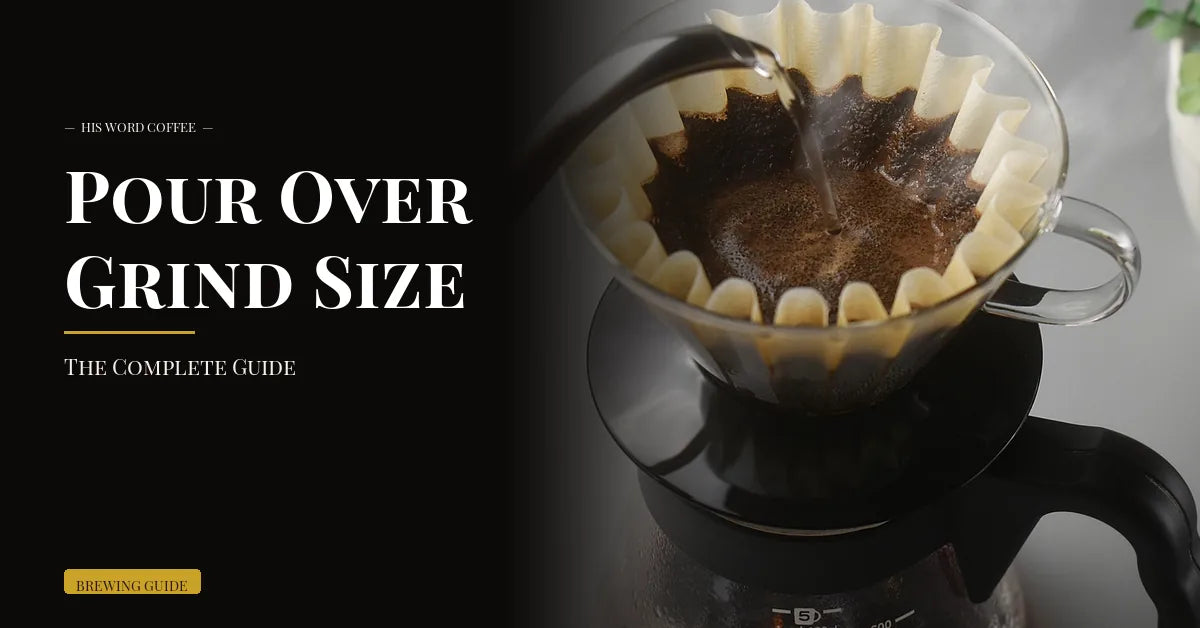
Pour over coffee needs a medium-fine grind, finer than drip but coarser than espresso. On a 10-point scale, that is typically 4-6. The right grind allows water to flow through in 2.5 to 4 minutes total brew time. Too coarse and water races through without extracting flavor. Too fine and it stalls into a muddy overextracted mess.
Key Takeaways
- Pour over grind size: medium-fine, setting 4-6 on a 10-point scale (table salt texture)
- Total brew time (including bloom): 2.5 to 4 minutes depending on dose and brewer
- Bloom phase: 2x coffee weight in water, 30-45 second wait before continuing
- V60 and Kalita Wave: medium-fine (4-5 on 10-point scale)
- Chemex: slightly coarser (5-6 on 10-point scale) due to thicker filter
- Sour/underdeveloped = grind finer; bitter/astringent = grind coarser
- A burr grinder is essential for pour over, blade grinders create inconsistent particles
In This Guide
What "Medium-Fine" Looks Like
The best reference point for a medium-fine grind is table salt. Pick up a pinch of your ground coffee and compare it to a pinch of table salt, the particles should be close in size, maybe a touch finer. You want distinct, separate grains, not a powder. If your grounds clump together or feel like flour, you have gone too fine.
Particle size is the single biggest lever you have in pour over brewing. Paper filters allow water to pass through at a specific rate, and the grind determines how much resistance the water meets inside the coffee bed. A finer grind compacts more tightly, slowing the water and extending contact time. A coarser grind lets water pass more freely, shortening contact time. Contact time drives extraction, and extraction determines whether your cup tastes sweet and full or sour and hollow.
Pour over sits in the middle of the grind spectrum by design. It is not as fine as espresso (which needs pressure to push water through in 25-30 seconds) and not as coarse as French press (which steeps for 4 minutes with no filter). The medium-fine sweet spot gives you enough contact time for full extraction while letting gravity do the work cleanly. Once you recognize that texture, you will have a reliable benchmark to calibrate against every time you try a new grinder or a new bean.
Grind Settings by Pour Over Brewer
Not every pour over brewer wants the exact same grind. Filter thickness, bed shape, and flow hole size all affect how fast water moves through. The table below gives you a starting point for the most common pour over brewers, referenced against a generic 10-point scale and the Baratza Encore, one of the most widely used entry-level electric burr grinders.
| Brewer | Grind Level | 10-Point Scale | Baratza Encore |
|---|---|---|---|
| Hario V60 | Medium-fine | 4-5 | 15-20 |
| Kalita Wave | Medium-fine | 4-5 | 15-20 |
| Chemex | Medium-slightly coarser | 5-6 | 20-25 |
| Clever Dripper | Medium | 5-6 | 20-25 |
| Melitta cone | Medium-fine | 4-5 | 15-20 |
The Chemex stands out from the group. Its bonded paper filters are 20-30% denser than standard pour over filters, which dramatically slows the flow rate through the filter itself. If you grind for a V60 and then use that same setting in a Chemex, the brew will likely run long and taste over-extracted. Dial it one notch coarser than you would for a V60 and you will be in range. For a deeper look at how grind size interacts with every brewing method, see our complete coffee grind size chart.
The Bloom Phase and Why It Matters
Before you pour the main body of water, you need to bloom the grounds. Pour twice the weight of coffee in water over the bed, so for 20g of coffee, pour 40g of water. Pour slowly and evenly to saturate all the grounds. Then stop and wait 30 to 45 seconds before continuing with the rest of your water. This step is not optional if you want a well-extracted cup.
Freshly roasted coffee releases CO2 as it ages, and a significant amount of that gas is still trapped inside the bean when you grind it. When hot water hits the grounds, CO2 escapes rapidly. If you do not pause to let it off-gas, that CO2 creates an uneven extraction, it physically pushes water away from the grounds and creates channels where water flows through without touching the coffee. The bloom evacuates the gas so your pour water can make full, even contact with every particle in the bed.
You can use the bloom to gauge your coffee's freshness. Fresh-roasted coffee (within two to three weeks of roast date) will swell dramatically, sometimes doubling in volume, as the CO2 rushes out. Coffee that has been sitting on a shelf for months will barely react at all. If your bloom is flat and lifeless, no grind adjustment will fix the underlying problem. You need fresher beans. A good grind setting is only as good as the coffee it is grinding.
Freshness and the Bloom
The bloom is where freshness shows. Coffee from our roaster typically ship in 1–3 business days, you will see a full, aggressive bloom every time. Coffee that sat on a warehouse shelf for months produces almost nothing. If you want the bloom experience, start with fresh beans.
Pour Over Brew Time and Flow Rate
Your target total brew time, measured from when you start the bloom pour to when the last drop falls through the filter, is 2.5 to 4 minutes. V60 and Kalita Wave brews tend to land at the shorter end of that range, around 2.5 to 3 minutes, because their filters are thinner and the flow rate is faster. Chemex brews typically run 3.5 to 4 minutes because of the denser filter. These are targets, not hard rules, dose size affects brew time too, and a 30g dose will naturally take longer than a 15g dose.
Flow rate is the most useful real-time feedback signal you have during a brew. Watch the coffee as it drains. If water pools on top of the grounds and sits there without moving, your grind is too fine, the bed has compacted and is blocking drainage. If the water streams through and the whole brew is done in under two minutes, your grind is too coarse and water is moving too fast to extract properly. In both cases, your cup will reflect it: too slow means bitter and heavy, too fast means sour and thin.
You do not need to chase a precise number every single time. What you want is a brew that flows steadily and finishes within the target window. Once you find a grind setting that produces that result consistently, write it down. Note the bean, the dose, the grinder setting, and the brew time. Pour over rewards the same discipline that any craft skill does, repeatability comes from keeping records, not from guessing every morning.
Get Better Coffee Every Week
Brewing tips, coffee science, and gear guides. No spam, just useful stuff.
When Your Grind Is Wrong (and How to Fix It)
Pour over gives you clear feedback when the grind is off, and learning to read it saves you a lot of frustration. The key is to adjust only one variable at a time. If you change your grind and your water temperature and your pour speed simultaneously, you will not know which change fixed the problem. Pick one, dial it, and then brew again before making another change.
Here are the most common symptoms and what they tell you:
- Tastes sour, weak, or underdeveloped: Grind finer to increase contact time, or slow your pours to let water dwell longer in the bed.
- Tastes bitter, harsh, or drying on the finish: Grind coarser to reduce contact time, or speed up your pour rate to move water through faster.
- Water stalls and pools on top of the grounds: Grind significantly coarser, the bed is clogged and water cannot pass through at all.
- The whole brew finishes in under 90 seconds: Grind significantly finer, water is moving through the bed without doing any real extraction work.
- The brew tastes simultaneously sour and bitter: This usually points to uneven particle size from an inconsistent grinder. Upgrade your grinder before adjusting the setting.
Most grind adjustments for pour over are small. On a Baratza Encore, you are often talking about moving one or two clicks, not jumping across the dial. Make small changes, document each brew, and you will zero in on your ideal setting faster than you expect.
Chemex vs. V60 Grind Size Differences
The Chemex and the V60 are the two most popular pour over brewers among coffee enthusiasts, and they often get treated as interchangeable. They are not. The core difference is the filter. Chemex uses its own proprietary bonded paper filters, which are significantly thicker and denser than Hario's V60 filters. That extra density slows down water flow through the filter itself, independent of what the coffee bed is doing.
In practical terms, this means you need to grind slightly coarser for a Chemex than you would for a V60 with the same coffee and the same dose. If you use the same grind setting for both, the Chemex brew will run noticeably longer and risk over-extracting. On a 10-point scale, V60 sits at 4-5 and Chemex at 5-6. On a Baratza Encore, that is roughly a 5-click difference, meaningful but not dramatic.
Both brewers produce a clean, bright cup and both reward good technique. The V60 is more forgiving of grind variation because its single large drain hole allows faster recovery if water starts to slow. The Chemex is less forgiving but produces a noticeably heavier body due to the extra filtration. When in doubt, start at the coarser end of the recommended range for either brewer, taste the result, and adjust from there. Coarse is easier to correct than fine.
Burr Grinder Recommendations for Pour Over
Pour over is the most grind-sensitive brewing method there is. When you use a French press, the filter is coarse metal mesh and uneven particle sizes get masked in the steep. When you use espresso, the pressure is so high that the machine compensates somewhat for minor inconsistencies. Pour over has no such forgiveness. Water flows through by gravity alone, and every particle in the bed affects how evenly extraction happens. An inconsistent grind produces a cup that tastes both sour and bitter at once, both over-extracted and under-extracted in the same brew.
Blade grinders, the spinning-blade type that look like small blenders, should be avoided entirely for pour over. They do not grind coffee; they shatter it randomly. The result is a mixture of fine powder and large chunks with nothing consistent in between. You will get clogging, channeling, and a cup that never tastes right no matter what setting you use. For pour over specifically, a burr grinder is not optional.
Here are solid starting points at different price levels:
- Hand grinders ($40-70): Hario Skerton Pro and Timemore C2 both produce consistent medium-fine grounds suitable for pour over. Slower to use but genuinely capable.
- Entry-level electric (~$170): Baratza Encore is the most commonly recommended entry-level electric burr grinder for pour over. The 40 grind settings give you fine control, and the burrs are consistent enough to get a clean medium-fine grind reliably.
- Mid-range ($200-350): Baratza Virtuoso+ and Fellow Ode Gen 2 both step up conical and flat burr performance noticeably. If pour over is your primary method and you brew daily, the investment makes sense.
Light Roasts Shine Brightest in Pour Over
Our single-origin coffees are roasted to bring out clarity, brightness, and the character of each farm. They are made for pour over.
Our picks for pour-over:
🫘 Ethiopian Sunrise— bright, floral, clean finish 🫘 Breakfast Blend— smooth, balanced — great everyday pour-over 🫘 Colombia El Tiple— sweet, versatile — our most-orderedShop Single Origin
Frequently Asked Questions
What grind size should I use for a Hario V60?
Use a medium-fine grind, setting 4-5 on a 10-point scale, or clicks 15-20 on a Baratza Encore. You are aiming for a texture similar to table salt. The total brew time should fall between 2.5 and 3 minutes. If it runs longer, grind coarser by one or two clicks. If it finishes in under 2 minutes, grind finer.
Why does my pour over taste sour?
Sourness in pour over almost always means under-extraction, water moved through the grounds too quickly without pulling out enough soluble material. The most common fix is to grind finer, which slows flow and increases contact time. You can also slow your pour rate to let water dwell longer in the bed. If the problem persists after grind adjustments, check your water temperature, under 195 degrees Fahrenheit will also cause under-extraction.
How long should a pour over take?
Total brew time (from the first bloom pour to the last drop) should be 2.5 to 4 minutes, depending on your brewer and dose. V60 and Kalita Wave brews typically run 2.5 to 3 minutes. Chemex brews run 3.5 to 4 minutes because of the thicker filter. If your brew finishes significantly outside that range, adjust your grind, coarser to speed it up, finer to slow it down.
Is pour over grind finer or coarser than drip?
Pour over is ground slightly finer than auto-drip. Auto-drip machines use medium-coarse grounds (setting 5-7 on a 10-point scale) because they have faster flow rates and larger paper filters. Pour over uses medium-fine (4-6) because you control the pour rate and need the finer grind to maintain contact time by hand. The difference is meaningful, using drip-grind coffee in a pour over will often produce a thin, under-extracted brew.
Do I need an expensive grinder for pour over?
You need a burr grinder, but it does not have to be expensive. A Timemore C2 hand grinder ($50-60) or a Hario Skerton Pro ($70) will produce pour over quality grounds and serve you well for years. If you want electric, the Baratza Encore (~$170) is the standard entry-level recommendation. What you absolutely cannot use for pour over is a blade grinder, the inconsistency is too severe and it shows more in pour over than in any other method.
Pour over rewards attention to the grind more than any other brewing method. The good news is that once you dial it in, it stays consistent. Write down your grinder setting, your dose, and your brew time, and you have a repeatable recipe that gets better each time you refine it.
The grind is your foundation. Get it right and everything else in the brew becomes easier to control. Change beans or switch brewers and you now know exactly how to calibrate back to where you want to be. That knowledge makes pour over one of the most satisfying ways to brew coffee at home.
Best Coffee for Pour-Over
Pour-over shines with single-origin coffee — the clarity of the brew method lets the origin's character come through. Colombia El Tiple is a customer favorite for pour-over, with natural sweetness and a clean finish.
Sources: Specialty Coffee Association, Brewing Best PracticesExplore More.


Leave a comment
This site is protected by hCaptcha and the hCaptcha Privacy Policy and Terms of Service apply.