
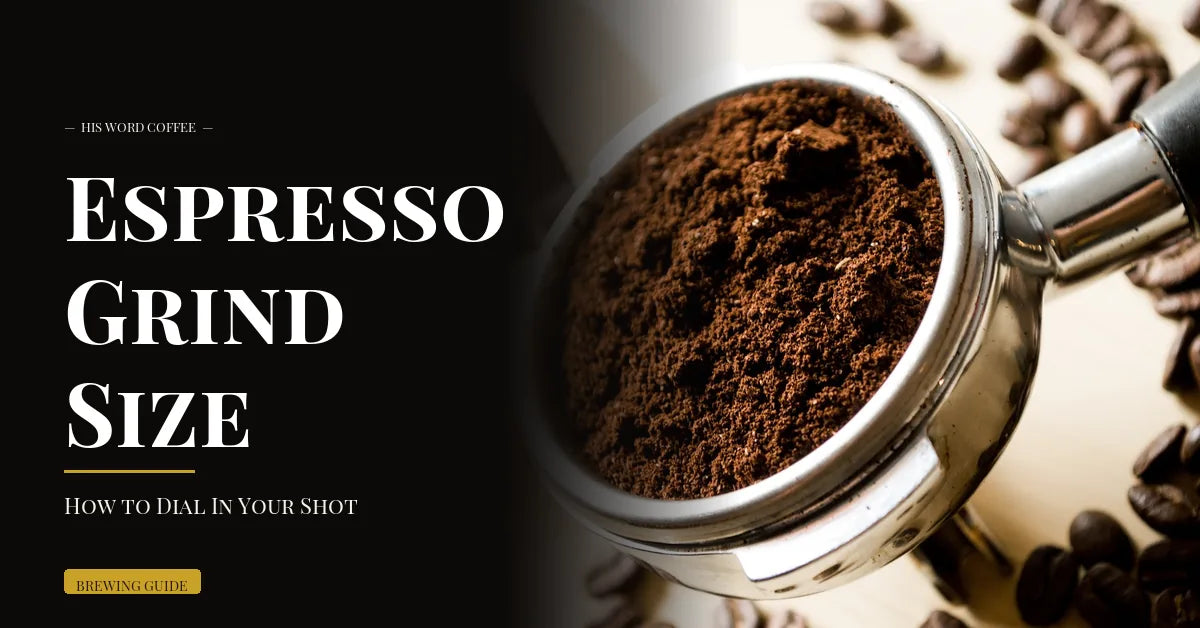
Espresso uses the finest grind of any common brewing method, like baker's sugar, slightly gritty but not powdery when rubbed between your fingers. On most grinders, it sits at the bottom 1-2 on a 10-point scale. Getting it right requires small adjustments and tasting the result. This guide walks through the full process of dialing in your espresso grind.
Key Takeaways
- Espresso grind range: Finest setting on most grinders, 1-2 on a 10-point scale, or 1-8 on a Baratza Encore
- Target shot time: 25-35 seconds for a standard double espresso (18g in, 36g out)
- Sour or fast shot: Grind finer. Bitter, slow, or choking shot: grind coarser
- Standard espresso ratio: 1:2 double (18g coffee in, 36g liquid out)
- Grinder consistency matters more for espresso than any other brewing method
- Adjust in tiny increments, even 0.5 steps on a dial grinder makes a noticeable difference
- Rest fresh-roasted beans 7-10 days after roast date before pulling espresso shots
In This Guide
What Fine Actually Means for Espresso
Espresso grind is often described as "fine," but that label doesn't tell you much without a frame of reference. The best visual descriptor is like baker's sugar: finer than beach sand, coarser than talcum powder. When you rub espresso grounds between your fingers, you should feel a very slight grittiness. If the grounds feel silky smooth with no texture at all, they are too fine. If you can clearly feel individual grain texture, like fine sand, they are too coarse.
That narrow window exists for a specific reason. Your espresso machine pushes water through the coffee bed at 9 bars of pressure. The fine grind creates resistance against that pressure, slowing the water down so it has time to extract soluble compounds from the coffee. If the grind is too coarse, water races through in seconds and the shot tastes thin and sour. If it is too fine, water can barely pass through at all, the machine struggles, extraction stalls, and the result is bitter and harsh.
Most people are surprised by how fine espresso grind actually is when they first see it. A common mistake is stopping at "fine" on a blade grinder or budget burr grinder and expecting espresso results. Consumer-grade grinders often cannot reach true espresso fineness, or they reach it inconsistently. The grind size and grind consistency are both working against you when the equipment is not matched to the task.
Espresso Grind Settings by Grinder
Grind settings vary significantly between grinder models, so there is no single number that applies across machines. The table below gives starting points for common grinders used at home. These numbers are a starting place, not a destination. Your actual setting will depend on your specific machine, your basket size, your coffee, and how long since that coffee was roasted.
| Grinder | Espresso Range | Notes |
|---|---|---|
| Burr grinder (1-10 scale) | 1-2 | Very bottom of the range |
| Baratza Encore | 1-8 | Start at 5, work down toward 1 |
| Baratza Virtuoso | 1-5 | More precise adjustment; similar range |
| Niche Zero | 10-20 (of 63) | Wide range for fine-tuning |
| Hand grinder (varies) | 4-8 clicks from finest | Brand dependent; dial in by shot timing |
Use the table as a starting point, then use shot timing to confirm and refine your setting. The same grinder at the same number can produce different results depending on humidity, bean density, and roast level. Our complete coffee grind size chart shows how espresso compares to every other brewing method and gives a fuller picture of the grind spectrum.
The Shot Timing Method: How to Know If Your Grind Is Right
The most reliable way to dial in espresso grind is with a kitchen scale and a timer, not by feel or appearance alone. The standard recipe for a double espresso is 18 grams of coffee in a double basket, targeting 36 grams of liquid in the cup, with the shot running 25-35 seconds from the first drop to your target yield. That 1:2 ratio and that time window are your two reference points.
If your shot finishes in under 20 seconds, the grind is too coarse. Water passed through too quickly, and the coffee is under-extracted. Adjust finer by 0.5 steps on a dial grinder, or one click on a stepped grinder, then pull another shot. If your shot takes over 40 seconds or the machine struggles to push water through at all, the grind is too fine. Adjust coarser by the same small increment and try again. Write down each setting and the result, this is called dialing in, and keeping notes is the fastest way through it.
Expect to pull 5-10 shots when dialing in a new coffee or after opening a fresh bag. That is normal, not a sign that something is wrong. Each coffee has different density and solubility characteristics. A light roast from Ethiopia will dial in differently than a dark roast blend, even on the same machine at the same dose. Once you find your setting for a given coffee, write it down. You will lose it when the bag runs out, but having that number as a reference for the next bag of the same coffee saves time.
Scale Recommendation
A kitchen scale that measures in 0.1g increments is essential for espresso. You cannot accurately measure a 36g yield by eye, even experienced baristas miss by 5-8 grams without a scale. A decent scale with 0.1g precision costs $20-35 and makes every other step of dialing in far more consistent.
Espresso Ratios Explained
Unlike filter coffee where you measure water going in, espresso is measured by coffee-in versus liquid-out. This ratio tells you how concentrated the shot is. The three most common ratios have distinct flavor profiles, and knowing them helps you decide whether to adjust your grind or your yield target when a shot is not tasting right.
- Ristretto (1:1.5): 18g in, 27g out, concentrated, sweet, less bitter, shorter shot
- Standard double (1:2): 18g in, 36g out, balanced starting point for most coffees
- Lungo (1:3): 18g in, 54g out, more volume, more bitter, higher caffeine (the FDA's caffeine safety guidelines) per drink
Most home baristas start with the 1:2 ratio because it gives the most forgiving range for dialing in. The ratio and the grind setting interact with each other. If you pull a 1:2 shot and find it consistently bitter at all reasonable grind settings, try pulling a slightly shorter yield, 32g instead of 36g, before going coarser on the grind. The two variables work together. Our coffee-to-water ratio guide covers ratios across all brewing methods if you want to see the full picture.
One thing that trips people up: the ratio target and the time target are both constraints. A shot that hits 36g in 20 seconds is both too fast (grind issue) and at the right ratio. Do not stop at ratio, always confirm with time. The ideal shot hits both the ratio and the time window simultaneously.
Get Better Coffee Every Week
Brewing guides, coffee science, and tips for getting more out of your setup. No spam.
Sour vs. Bitter: Reading Your Shot
Your palate is a diagnostic tool when you are dialing in espresso. Two primary off-flavors signal what the grind needs: sourness points toward under-extraction, and bitterness points toward over-extraction. Understanding which problem you have tells you exactly which direction to move your grind setting without guessing.
A sour, acid (research published in PubMed)ic, or thin shot that finishes sharp, almost vinegary, means the water moved through too fast and did not extract enough from the grounds. Grind finer. More resistance from the grounds means longer contact time, which means more extraction. A bitter, harsh, dry, or astringent shot means the water had too much contact time and pulled out unpleasant compounds. Grind coarser. If the shot tastes weak or watery but is neither particularly sour nor bitter, you may need a finer grind or a higher dose. If the shot tastes both sour and bitter at the same time, a combination that is hard to fix, that usually signals uneven extraction caused by inconsistent grind particle size, a distribution problem in the puck, or channeling in the basket.
A well-dialed shot has balance. You should taste sweetness, some acidity that feels bright rather than sharp, body that coats the palate, and a clean finish without lingering bitterness. That combination is the target. When you hit it, note the setting immediately. Dialing in is iterative, and it is easy to lose your place if you are not keeping records of each shot.

Why Grinder Consistency Matters More for Espresso
Espresso is the most sensitive brewing method to grind inconsistency. The reason comes back to that 9 bars of pressure. When you force water through a coffee puck at high pressure, it finds the path of least resistance. If your grounds contain a mix of fine particles and coarse chunks, common with blade grinders and lower-quality burr grinders, water channels through the coarse areas and never fully extracts from the fines. The result is a shot that is simultaneously over-extracted (from the fines) and under-extracted (from the coarse chunks), which produces the sour-and-bitter combination that is nearly impossible to fix by adjusting grind size alone.
A grinder capable of consistent espresso-range particle size should have a stable burr gap, flat or conical burrs rather than blades, and either stepped or stepless adjustment that holds its position shot to shot. Entry-level espresso-capable grinders start around $150-200. The Baratza Encore is a common recommendation at that price point, though some home baristas find it marginally adequate for espresso rather than excellent. Moving up to a dedicated espresso grinder, Baratza Sette, Niche Zero, DF64, produces noticeably more consistent results across a full bag of coffee.
A blade grinder is not a viable option for espresso. Blade grinders chop randomly rather than cut at a consistent gap, producing a wide distribution of particle sizes in every grind. Even at the finest blade-grinder setting, the inconsistency defeats the purpose. If you are serious about espresso, the grinder is the first upgrade that makes a measurable difference, more than the machine in many cases.
How Coffee Freshness Affects Espresso Grind
Coffee roasted in the last 1-3 days off roast is harder to dial in for espresso than coffee rested 7-14 days. The reason is CO2. During roasting, the coffee beans absorb significant CO2, which they release gradually over the days after roasting. When you grind very fresh coffee and tamp it into a basket, that off-gassing CO2 creates channels and disrupts the even flow of water through the puck. Shots run faster than expected, taste sharp and incomplete, and resist dialing in through grind adjustment alone.
The fix is to rest your beans. Most home espresso baristas wait 7-21 days post-roast before pulling shots, with the sweet spot landing around 10-14 days for most medium roasts. Light roasts often benefit from even longer rest, up to three weeks. This is counterintuitive because "fresher" sounds better, but in espresso it is well-established practice. The roast date on your bag is the reference point. Our bags print the roast date, not a "best by" date, because the roast date is what actually tells you where you are in the flavor window.
If you are pulling shots from a bag you just received and the results are inconsistent no matter what you try, rest is likely the variable. Let the bag sit open on your counter for a few days or loosely closed with the valve open. You are not wasting time, you are letting the coffee settle into a state where it can be properly extracted.
Why Roast Dates Matter
This is one reason specialty coffee bags use roast dates rather than "best by" dates. The roast date tells you exactly where you are in the flavor development window, and for espresso, that window starts later than most people expect. A bag that is 7-10 days post-roast is just entering its prime for pulling shots.
Fresh-Roasted Espresso, typically ships in 1, 3 business days
Our coffees are roasted to order on our fluid bed roaster. When they arrive, rest them 7-10 days before your first espresso shot, then dial in using the method above.
Shop CoffeeFrequently Asked Questions
What grind setting should I use for espresso on a Baratza Encore?
Start at setting 5 and work your way down toward 1, pulling a shot and measuring the time after each adjustment. Most coffees dial in somewhere between 3 and 8 on the Encore, though some light roasts require going even lower. The Encore is capable of espresso at its finer settings, but it is on the edge of its range, expect to spend extra time dialing in compared to a dedicated espresso grinder.
Why does my espresso taste sour even with a fine grind?
A sour shot at a fine grind setting usually points to one of three causes: the coffee is too fresh (resting 7-10 more days often resolves it), the dose is too low (try increasing from 17g to 18g), or the grinder is not producing a consistent enough particle size to achieve even extraction. If you have rested the coffee and confirmed your dose, consider whether your grinder may be the limiting factor.
How long should an espresso shot take to pull?
A standard double espresso, 18g in, 36g out, should run 25-35 seconds from the first drop of espresso to your target yield. Shots that finish in under 20 seconds are running too fast (grind coarser). Shots that run over 40 seconds or cause the machine to struggle are too fine (grind coarser). The time window assumes your machine is properly maintaining 9 bars of pressure.
Can I use a blade grinder for espresso?
Blade grinders are not suitable for espresso. They produce a random mix of particle sizes rather than a consistent grind, and that inconsistency causes channeling when water is forced through the puck at pressure. The result is under-extraction in some areas and over-extraction in others simultaneously. Entry-level burr grinders starting around $50-80 are a significant upgrade over blade grinders for espresso, though a grinder in the $150-200 range produces noticeably better results.
Do I need to rest my coffee before pulling espresso?
Yes, resting matters significantly for espresso. Coffee roasted in the last 1-4 days contains high levels of CO2 that interfere with even extraction and make shots run faster than expected. Wait at least 7 days after the roast date before pulling espresso shots, and aim for the 10-14 day window for most medium roasts. Light roasts can benefit from even longer rest, up to three weeks post-roast.
Dialing in espresso takes patience and a systematic approach. The most common mistake is adjusting too many variables at once, changing the dose, the grind, and the yield target all in the same session and losing track of what caused what. Change the grind, pull a shot, measure the time, taste it. One variable, one result, one note written down.
Once you have dialed in a coffee, record the grind setting, dose, yield, and time somewhere you will find it again. You will need to re-dial when you open the next bag, but having a reference point cuts the process from 10 shots to 3 or 4. Espresso rewards the systematic approach more than any other brewing method, and the results, when everything lines up, are worth the work.

Leave a comment
This site is protected by hCaptcha and the hCaptcha Privacy Policy and Terms of Service apply.