
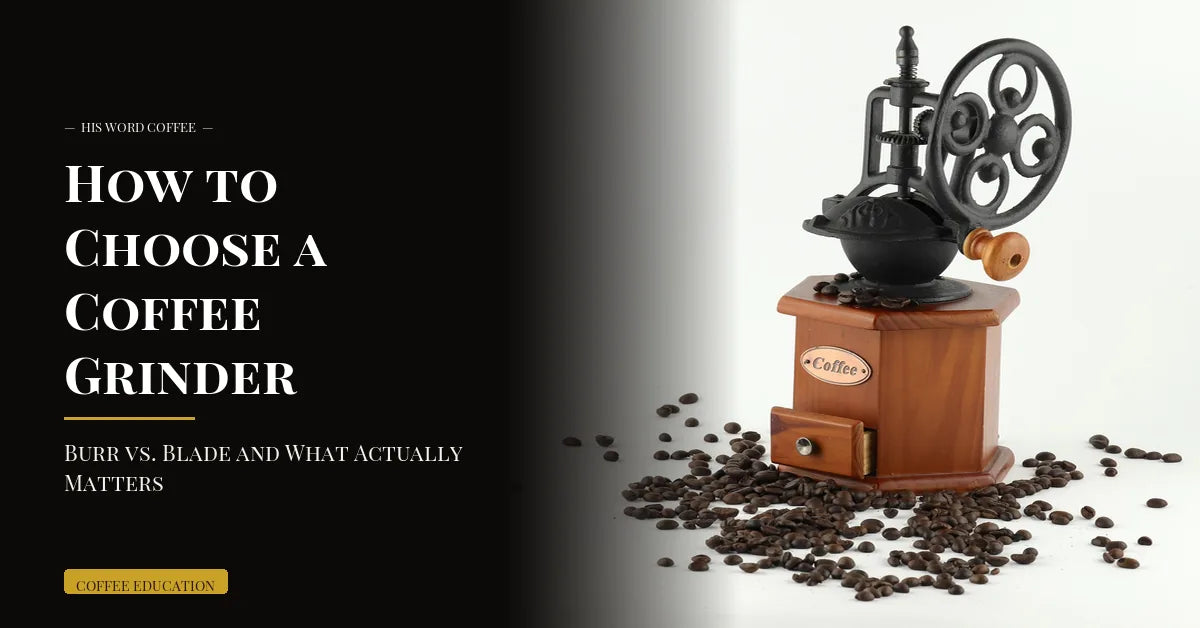
Most coffee advice focuses on beans, roast levels, and brewing methods. But there is one piece of equipment that quietly determines whether any of those choices matter: the grinder. It is the single biggest variable you can control once you have fresh, quality beans, and it is the one most people overlook.
Key Takeaways

- Burr grinders produce consistent particle sizes; blade grinders do not. Consistency is what makes good coffee repeatable.
- Conical burr grinders are quieter and retain less coffee. Flat burr grinders are faster and more uniform at higher price points.
- Manual burr grinders offer better grind quality per dollar than electric grinders at the same price.
- Match your grinder to your brew method using a grind size chart, since different methods need very different particle sizes.
- Grind your coffee immediately before brewing whenever possible. Freshness matters more than most people realize.
In This Guide
- Why the Grinder Matters More Than You Think
- Blade Grinders: What They Are and When They Work
- Burr Grinders: How They Produce Consistent Coffee
- Flat Burr vs. Conical Burr
- Manual vs. Electric Burr Grinders
- What You Actually Get at Each Price Point
- Grind Settings and Brew Method Compatibility
- Why Grinding Fresh Matters
- How to Clean and Maintain Your Grinder
- Frequently Asked Questions
Why the Grinder Matters More Than You Think
Here is the core problem with most home coffee setups: people spend money on specialty beans, a quality brewer, and filtered water, then run everything through a cheap blade grinder and wonder why the cup still tastes bitter, thin, or sour.
Coffee extraction depends entirely on surface area and contact time. When you grind coffee, you are breaking beans into particles so that hot water can dissolve the soluble compounds inside. If those particles are wildly different sizes, some will extract too quickly and turn bitter while others extract too slowly and stay sour. Both faults exist in the same cup, which is why under-extracted coffee can taste simultaneously weak and harsh.
Research published in the journal Matter by a team at the University of Oregon confirmed that grind consistency is one of the primary levers for improving extraction uniformity. The study found that grinding coarser and more consistently produced more reproducible espresso shots. The finding translates to all brew methods: consistency in particle size is what separates repeatable, good coffee from unpredictable results.
The Specialty Coffee Association has long emphasized grinder quality as foundational to coffee preparation. A great roast cannot save a bad grind. You are essentially setting a ceiling on your cup's potential every time you grind.
Blade Grinders: What They Are and When They Work

Blade grinders look like tiny food processors. A spinning metal blade chops the beans, and you control coarseness by how long you run the machine. They are inexpensive (often under $20), widely available, and very easy to use.
The fundamental problem is that a spinning blade does not produce consistent particle sizes. It shatters beans randomly, producing a mix of large chunks, medium pieces, and fine powder all at once. No matter how carefully you pulse the machine, that inconsistency is built into the mechanism.
There is also a heat issue. Blade grinders generate friction heat that begins degrading volatile aromatic compounds in the coffee before it ever reaches hot water.
When blade grinders are acceptable:
- You are making drip coffee for a large household where extraction precision matters less than convenience and volume.
- You are on a tight budget and coffee is not yet a priority, but you still want freshly ground beans over pre-ground.
- You are using a percolator, a camp stove setup, or any brew method where the margin for error is wide.
If you are making espresso, pour-over, or French press and you want those methods to actually perform as intended, a blade grinder will hold you back. The inconsistency in particle size will make dialing in your brew nearly impossible.
Burr Grinders: How They Produce Consistent Coffee
Burr grinders work on a fundamentally different principle. Instead of chopping, they crush and mill beans between two abrasive surfaces (the burrs), set at a fixed distance from each other. Every particle that passes through comes out within a narrow size range determined by that gap.
This is why burr grinders are the standard in specialty coffee. The consistency is mechanical, not dependent on timing or technique. Set the gap, grind, and the output is predictable. Change the gap to adjust coarseness, and the entire distribution shifts together.
Burrs are typically made from steel or ceramic. Steel burrs are more common, sharper, and produce slightly more heat. Ceramic burrs run cooler but can chip if a small stone or foreign object gets into the hopper. Both materials work well for home use. The quality of the burr geometry matters far more than the material.
| Feature | Blade Grinder | Burr Grinder |
|---|---|---|
| Grind consistency | Poor, random particle sizes | High, narrow size distribution |
| Coarseness control | Approximate (timed) | Precise (stepped or stepless settings) |
| Heat generation | High (friction from fast blade) | Low to moderate (varies by speed) |
| Repeatability | Low | High |
| Price range | $10 to $30 | $40 to $500+ |
| Suitable for espresso | No | Yes (mid-range and up) |
| Best for | Casual drip, camping | All brew methods |
Flat Burr vs. Conical Burr
Within burr grinders, there are two main burr geometries: flat and conical. Both crush beans between two surfaces, but the shape and orientation differ.
Flat Burr Grinders
Flat burr grinders have two horizontally positioned, ring-shaped burrs facing each other. Beans fall through the center and get ground as they travel outward through the gap. This geometry tends to produce a very uniform, bimodal particle distribution (two peak sizes, fine and medium), which some coffee professionals prefer for espresso clarity.
Flat burr grinders tend to be faster at a given RPM and are common in commercial espresso machines. At home price points, they can retain more ground coffee in the grinding chamber (called retention), meaning a small amount of stale coffee from the previous grind carries over into your next batch.
Conical Burr Grinders
Conical burr grinders have a cone-shaped inner burr that sits inside a ring-shaped outer burr. Beans fall from the top and spiral downward through the gap. This geometry is quieter, generates slightly less heat, and typically has lower retention, meaning very little old coffee stays in the machine between grinds.
Most home burr grinders in the $40 to $200 range use conical burrs. They are an excellent choice for filter coffee, French press, and pour-over. For espresso at home, conical burr grinders work well, though achieving very fine, consistent espresso grinds may require spending a bit more.
Manual vs. Electric Burr Grinders
Once you decide on a burr grinder, the next choice is manual or electric. This is where many people are surprised by the honest trade-offs.
Manual Burr Grinders
Manual grinders use a hand crank to drive the burrs. They have no motor, which keeps costs low and allows manufacturers to invest more of the price into burr quality. At $50 to $80, a quality manual grinder will produce a more consistent grind than most electric grinders at the same price, sometimes rivaling electrics costing two or three times as much.
The trade-off is effort and time. Grinding 18 to 25 grams of coffee for a pour-over or espresso takes 1 to 3 minutes of hand cranking depending on the grinder and the coarseness setting. For a single cup in the morning, many people find the ritual pleasant. For grinding two to four cups back-to-back, it becomes noticeably tedious.
Manual grinders are also excellent for travel, camping, or offices, since they require no power source and are compact.
Electric Burr Grinders
Electric grinders are faster and require no effort. Press a button and your coffee is ground in 15 to 30 seconds. The convenience is real, and for households grinding multiple servings daily or in a time-pressured morning routine, electric grinders earn their price.
The trade-off is that you pay more for equivalent grind quality. To match the consistency of a $70 manual grinder, you typically need to spend $100 to $150 on an electric model. The motor, housing, and electronics all add cost before the burr set itself.
Electric grinders also tend to retain more ground coffee in the chute, and they generate more heat at the burr set during fast grinding runs.
What You Actually Get at Each Price Point
Blade grinders or very basic burr grinders with plastic burrs. Fine for casual drip coffee if you simply want fresher grounds than pre-ground.
Entry-level conical burr grinders (electric) or very good manual burr grinders. Solid for drip, French press, and pour-over. Not ideal for espresso.
Mid-range electric burr grinders with better burr geometry and build quality. Good for most filter methods. Some models can do espresso adequately.
Purpose-built home espresso grinders or premium filter grinders. Tighter grind distributions, better retention, step or stepless adjustments.
Professional-grade home grinders. True single-dose design, 64mm+ flat burrs or high-quality conical burrs. Near-commercial performance.
The jump from blade to entry-level burr makes the biggest difference in cup quality, dollar for dollar. After that, each price step up brings diminishing but real returns, particularly for espresso where grind precision matters most.
Grind Settings and Brew Method Compatibility
Every brew method has an ideal grind size range. Getting this right is as important as choosing the right grinder, because even a great burr grinder at the wrong setting will produce bad coffee.
The general principle: finer grinds increase surface area and extraction speed; coarser grinds decrease it. Longer brew times call for coarser grinds; shorter brew times (like espresso) call for finer grinds. Here is a quick reference:
| Brew Method | Grind Size | Texture Reference |
|---|---|---|
| Espresso | Extra Fine | Baker's sugar or finer |
| Moka Pot | Fine | Fine sea salt |
| AeroPress (espresso-style) | Fine to Medium-Fine | Fine sea salt to granulated sugar |
| Pour-Over / Drip | Medium | Coarse granulated sugar |
| Drip Coffee Maker | Medium | Granulated sugar |
| Chemex | Medium-Coarse | Rough sand |
| French Press | Coarse | Coarse sea salt or breadcrumbs |
| Cold Brew | Extra Coarse | Peppercorns |
For a complete visual reference with more detail on each method and common troubleshooting, see the coffee grind size chart on the His Word Coffee blog. It covers everything from Turkish coffee to cold brew in one place and is a useful resource to bookmark alongside your grinder settings.
If you are brewing drip coffee specifically and want to dial in your medium grind, the drip coffee grind size guide covers how water temperature, brew time, and grind coarseness interact for standard drip machines.
A few practical tips for dialing in grind size:
- If your coffee tastes sour or weak, grind finer (increase extraction).
- If your coffee tastes bitter or harsh, grind coarser (decrease extraction).
- Change only one variable at a time. Grind size has a much larger effect than most people expect; a small adjustment is often enough.
- Use the same dose and water ratio each time so you can isolate the grind as the variable.
Why Grinding Fresh Matters
Ground coffee goes stale much faster than whole beans. When beans are ground, their total surface area increases by a factor of roughly 10,000. Every square millimeter of that newly exposed surface is actively releasing carbon dioxide (off-gassing) and beginning to oxidize. Within 15 minutes of grinding, measurable aromatic degradation occurs. Within a few hours at room temperature, pre-ground coffee has lost a significant portion of its volatile compounds.
Specialty roasters who invest in quality sourcing and careful roasting rightly point out that pre-ground coffee is one of the biggest compromises a home brewer can make, second only to using stale beans. The best grinder in the world cannot help pre-ground coffee that has been sitting in a bag for two weeks.
This means the value of any burr grinder depends on using it consistently, grinding only what you need immediately before brewing. If your routine does not allow for that, it is worth reconsidering. A simple hand grinder kept next to the kettle or coffee maker makes the habit much easier to maintain.
Starting with fresh, quality beans matters just as much as the grind itself. Browse the His Word Coffee collection for small-batch roasted beans that are shipped fresh so your grinder has something worth working with.
The Specialty Coffee Association's research resources provide deeper reading on coffee freshness standards and how industry professionals approach this question.
How to Clean and Maintain Your Grinder
A dirty grinder transfers stale, rancid coffee oils into your fresh grounds. Most people never think to clean their grinder, but it makes a real difference in cup quality over time, and it is not complicated.
Weekly: Quick Brush Clean
Use a small stiff brush (many grinders include one) to sweep ground coffee out of the grinding chamber, the burr faces, and the chute. Do this every week or more frequently if you grind daily. Brush into a waste bin, reassemble, and grind a small amount of fresh beans to clear out any brush fibers or residual coffee.
Monthly: Deeper Clean
Once a month, remove the top burr (most grinders allow this without tools) and brush both burr faces thoroughly. Wipe down the hopper and collection bin with a dry cloth. Do not use water on the burrs unless the manufacturer specifically recommends it, as moisture causes steel burrs to rust.
Some home users run a small amount of uncooked white rice through their grinder to absorb oils and dislodge debris. This works as an occasional technique but is not a substitute for brushing. Note that rice is harder than coffee and will dull burrs slightly over time if done frequently.
Quarterly: Full Inspection
Every few months, inspect the burrs for visible wear or chips. Sharp burrs produce more consistent grinds. If you notice your grinder is producing more dust or fines than it used to, and your coffee has become harder to dial in, it may be time for a burr replacement. Most quality grinder manufacturers sell replacement burrs.
For electric grinders, wipe the exterior with a dry cloth and check that the hopper seal is tight. Loose hoppers let moisture and air into the bean reservoir, accelerating staling.
Frequently Asked Questions
Is a burr grinder really worth it over a blade grinder?
Yes, for most people who care about coffee quality. The improvement in cup consistency is noticeable from the very first use. Entry-level burr grinders in the $50 to $70 range offer meaningfully better results than blade grinders costing $20 to $30. The investment pays off quickly if you brew at home regularly instead of buying cafe coffee.
Can I use a burr grinder for espresso at home?
Yes, but espresso is the most demanding use case. It requires a very fine, very consistent grind, and minor variations in particle size have an outsized effect on shot quality. For home espresso, you generally need to spend at least $100 to $150 on a grinder to get reliably good results. Manual grinders in the $80 to $100 range can actually perform well here if you are willing to do the hand cranking.
How many grind settings do I actually need?
More settings give you more flexibility, but you likely brew one or two methods regularly. For those use cases, even a grinder with 15 to 20 steps is plenty. Stepless grinders (which have infinite adjustment within a range) are preferred by espresso enthusiasts for fine-tuning, but they are not necessary for filter brewing.
Does grinder speed (RPM) matter?
Lower RPM grinders generate less heat at the burr surface and tend to produce less static. High-speed grinders are faster but can slightly increase heat exposure during the grind. For home use with reasonable doses (15 to 25 grams), the difference is minimal. It becomes more relevant in commercial settings grinding continuously throughout the day.
Can I grind a large batch ahead of time and store it?
You can, but quality will decline quickly. If you must grind in advance, store ground coffee in an airtight container, away from light and heat, and use it within 24 to 48 hours. Beyond that, you are sacrificing a meaningful amount of the freshness that makes specialty coffee worth buying in the first place. The better approach is to grind only what you need each day.
How often should I replace the burrs?
Burr life depends on the material and usage. A good steel conical burr set used for home brewing (one to two cups per day) typically lasts three to five years before noticeable degradation. Signs of worn burrs include increased fines, difficulty dialing in a grind, and coffee that tastes flat or inconsistent despite correct settings. Check your grinder manufacturer's guidance for their specific burr replacement timeline.
Is a more expensive grinder automatically better?
Not automatically, but generally yes within a given category. The relationship between price and quality is reasonably strong for grinders because better burr geometry, tighter manufacturing tolerances, and better motors all cost more to produce. The biggest quality jump is at the entry burr level. After $150 to $200, the improvements are more specialized and matter most to espresso enthusiasts dialing for competition-level precision.
What is grind retention and why does it matter?
Grind retention is the amount of ground coffee that stays inside the grinder after grinding, typically in the burr chamber or chute. High retention means stale coffee from your last grind mixes with your current grind. Low retention grinders (common in single-dose designs) pass nearly all ground coffee into your brew vessel. For daily home brewing with one dose at a time, low retention is a meaningful quality-of-life and freshness benefit.
Start With Great Beans
Even the best grinder can only do so much if your beans are not fresh. His Word Coffee sources and roasts small batches so your grinder has something worth grinding.
Shop Fresh CoffeeSources: Specialty Coffee Association, Brewing Best PracticesExplore More.

Leave a comment
This site is protected by hCaptcha and the hCaptcha Privacy Policy and Terms of Service apply.