
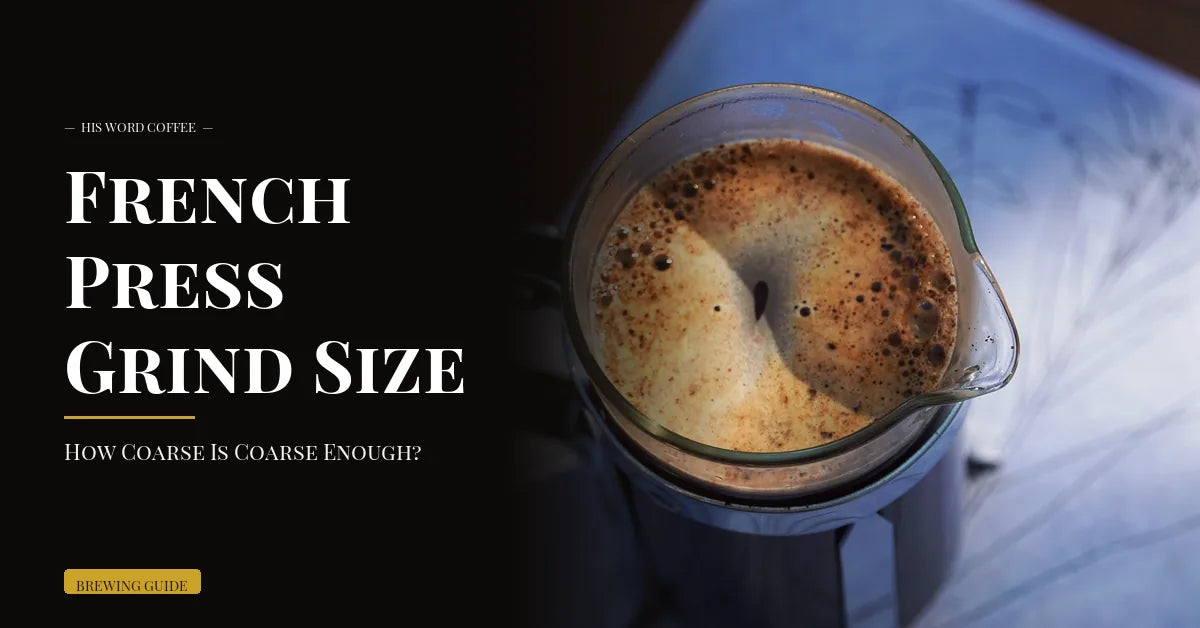
French press coffee lives and dies on grind size. Pour through a too-fine grind and you get a muddy, bitter cup with sludge at the bottom. Go too coarse and your coffee tastes thin and sour. The sweet spot is what coffee pros call coarse, with grounds that look and feel like coarse sea salt or cracked peppercorns.
This guide answers the question we hear most at our roastery in Vancouver, Washington: how coarse should French press grind be, and how do I dial in my grinder to get there. We cover settings for the most popular grinders, what the science says about extraction, and how to fix common French press problems by adjusting one variable at a time.
Brewing French press this week? A full-bodied coffee usually shines here. Try House Blend for a familiar daily cup, or Guatemala Los Huipiles if you like chocolate, caramel, and a little more depth. Browse fresh-roasted beans.
Key Takeaways
- Target Particle Size: Roughly 1.0 mm particles, the chunky end of the Specialty Coffee Association grind range. Looks like coarse sea salt or cracked peppercorns.
- Encore Setting: Baratza Encore at 28 to 32 is the standard starting point. Move 2 clicks coarser if bitter, 2 clicks finer if sour.
- Steep Time: 4 minutes for a coarse grind at 200 degrees Fahrenheit. The James Hoffmann method adds a 4 minute settling rest before pressing for a cleaner cup.
- Coffee Ratio: 1 gram of coffee for every 15 grams of water (60 grams coffee per liter) hits balanced strength without harshness.
- Why Coarseness Matters: The metal mesh filter does not catch fines. Smaller particles keep extracting after the plunge, producing the classic bitter, gritty French press cup.
- Burr Grinder Required: Blade grinders mix dust and boulders in the same batch. A $40 hand burr like the Hario Skerton Pro out-performs any blade grinder for French press.
- Best Roast: Medium to medium dark roasts shine in full immersion. Body and chocolate notes win out over acidity at this brew style.
In This Guide
Why grind coarseness matters most for French press
The French press uses long, full immersion brewing with a metal mesh filter. That combination puts grind size at the top of the variables list. Unlike a paper filter, the metal mesh cannot trap small particles, so any fines in your grind end up in your cup. Those fines also keep extracting after you press the plunger down, which is where the classic bitter, gritty French press flavor comes from.
Research on coffee extraction confirms the link between particle size and flavor. A 2020 study in Nature Scientific Reports showed that finer grinds extract more compounds in the same time window, including the bitter chlorogenic acid lactones that build up past the 4-minute mark. Coarser particles slow extraction, which keeps your cup landing in the sweet spot instead of running past it.
A coarse, even grind also keeps the cup cleaner. Larger particles stay above the mesh when you press, so much less sediment ends up in the bottom of your mug. The Specialty Coffee Association brewing protocols place French press at the coarsest end of their grind spectrum for exactly this reason.
What coarse actually looks and feels like
Hold a pinch of correctly ground French press coffee between your thumb and forefinger. It should feel like coarse sea salt, kosher salt, or cracked peppercorns. The SCA describes French press grind as roughly 1.0 mm particles, which is chunky compared with what most pre-ground supermarket coffee delivers.
If your grind feels like table salt or beach sand, it is too fine. You will get a thick, muddy cup and a plunger that resists going down. If it feels closer to breadcrumbs or cracked black pepper, you are in the right zone.
Quick visual check
Spread a tablespoon of grounds on a white plate. You should see distinct individual particles, not a powdery layer. Each grain should be roughly the size of a sesame seed.
French press grind settings for popular grinders
Every grinder labels its dial differently, so these are starting points. Brew a cup, taste it, then move 2 clicks coarser if bitter or 2 clicks finer if sour.
| Grinder | French Press Setting | Notes |
|---|---|---|
| Baratza Encore | 28 to 32 | Top of the dial. Standard reference grinder.Most Common |
| Baratza Virtuoso+ | 28 to 32 | Same range as Encore with a digital timer. |
| Fellow Ode Gen 2 | 9 to 11 | Flat burrs run more uniform than conical at this size. |
| 1Zpresso K-Pro | 90 to 110 clicks | From zero. Each click is 0.022 mm. |
| Comandante C40 | 28 to 32 clicks | From zero. Classic hand grinder for travel. |
| Wilfa Svart | Top of coarse range | Near the French press icon on the dial. |
| Hario Skerton Pro | 6 to 7 full turns | Coarser from fine zero. Budget hand grinder. |
| Blade grinder | Not recommended | Cannot produce a uniform grind.Avoid |
If you have a different model, look for the French press icon on the dial or set the grinder near its coarsest setting and adjust from there. For a full visual reference across every brew method, see our complete coffee grind size chart.
Why a burr grinder beats a blade grinder
Blade grinders chop beans randomly and produce a mix of dust and boulders in the same batch. The dust over-extracts in 4 minutes and dumps bitter compounds into your cup, while the boulders barely extract at all. The result is a cup that tastes muddled, harsh, and weak at the same time.
A burr grinder crushes beans between two precision cutting surfaces and produces a much more uniform particle size. Uniformity is the single biggest variable in good French press coffee. Even an entry level hand burr grinder will outperform a top of the line blade grinder for this brew method.
Budget tip: A used Baratza Encore or a Hario Skerton Pro hand grinder will both produce solid French press grounds for under $80 total. The grinder upgrade is the highest-impact change you can make to your coffee.
Our 4-minute French press recipe
Once the grind is right, the rest of the recipe is forgiving. This is the method we use to dial in new coffees at the roastery.
- Heat 500 grams of water to 200 degrees Fahrenheit (just off boil).
- Weigh 30 grams of coffee and grind it coarse.
- Add the grounds to the press, then pour all the water.
- Start a 4 minute timer and put the lid on with the plunger up.
- At 4 minutes, gently break the crust with a spoon and skim any foam.
- Wait another 4 minutes for the grounds to settle (Hoffmann method).
- Press the plunger down slowly until you feel resistance, then stop.
- Pour all the coffee out within 30 seconds, or decant into a thermos.
The double steep, slow press technique produces a noticeably cleaner cup with less sediment than the traditional aggressive plunge. The key is letting gravity do the work instead of your arm.
Troubleshoot by taste
Use what is in the cup to adjust the grind. These are the same fixes we walk customers through at events and at the roastery.
- Bitter, ashy, or harsh: Grind coarser by 2 to 3 notches, or cut the steep to 3 minutes 30 seconds.
- Sour, thin, or grassy: Grind finer by 2 notches, or extend the steep to 4 minutes 30 seconds.
- Muddy and gritty: Grind coarser and skip the aggressive plunger push.
- Watery despite right grind: Increase coffee dose to 1 gram per 14 grams of water.
- Cold at the bottom of the cup: Preheat the press with hot water and dump it before brewing.
Best beans for French press
Full immersion shows off body and chocolate notes more than acidity. Medium and medium dark roasts shine in a French press. Single origin Colombian and Guatemalan coffees do especially well, as do balanced blends roasted on the darker side.
For sensitive stomachs, our Haiti Hope Rising low-acid Haitian coffee brews a smooth, gentle French press cup that goes easy on the gut without losing flavor. For a deeper dive on bean choice by brew style, see our guide to the best coffee for French press.
Coarse-friendly beans, freshly roasted
Every bag we ship is fluid-bed roasted to bring out clean body and chocolate notes that French press loves. Picked for full immersion brewing.
Shop Our CoffeeFrequently asked questions
French press grind should be coarse, with particles around 1.0 mm wide. Visually it should look like coarse sea salt or cracked peppercorns. On a Baratza Encore that lands at settings 28 to 32. On a 1Zpresso K-Pro it is 90 to 110 clicks from zero.
The Baratza Encore French press setting is 28 to 32 on its 40-point dial, near the coarsest end. Start at 30 and adjust by 2 clicks at a time based on taste. Coarser fixes bitterness, finer fixes sourness or weak coffee.
Not without a tradeoff. Drip grind is too fine for French press and produces a muddy, often bitter cup, and it can clog the mesh filter. If a drip grind is all you have, shorten the steep to 2 minutes 30 seconds, press very slowly, and accept some sediment.
Four minutes is the standard for a coarse grind. The James Hoffmann method extends this with a 4 minute settling rest after the initial steep, then a slow press, which produces a noticeably cleaner cup. Going past 6 minutes risks over-extraction and bitterness with most grinds.
The two most common causes are a grind that is too fine and a steep that runs too long. Bitter, harsh notes mean over-extraction. Try coarsening the grind by 2 notches, keeping the steep at exactly 4 minutes, and pouring the coffee out of the press immediately rather than letting it sit.
Yes. Blade grinders produce a wide mix of dust and boulders that brew bitter and muddy at the same time. A burr grinder gives uniform particle size, which is the single biggest variable in good French press coffee. A $40 Hario Skerton Pro hand burr will out-perform any blade grinder.
1 gram of coffee for every 15 grams of water is the standard French press ratio (about 60 grams of coffee per liter of water). For a stronger cup, push to 1 to 14. For a milder cup, drop to 1 to 17. Always measure by weight, not volume, for consistent results.
No bloom step is needed. Blooming (pouring a small amount of water to release CO2) helps pour over and drip where carbon dioxide can disrupt water flow. In a full immersion brewer like the French press, the grounds and water sit together for 4 minutes anyway, so the bloom happens naturally inside the press.
Sources: Specialty Coffee Association brewing protocols; Nature Scientific Reports: Systematically improving espresso (extraction kinetics); PMC: Coffee bioactive compounds and brewing variables. Article last reviewed and updated May 19, 2026.

Leave a comment
This site is protected by hCaptcha and the hCaptcha Privacy Policy and Terms of Service apply.