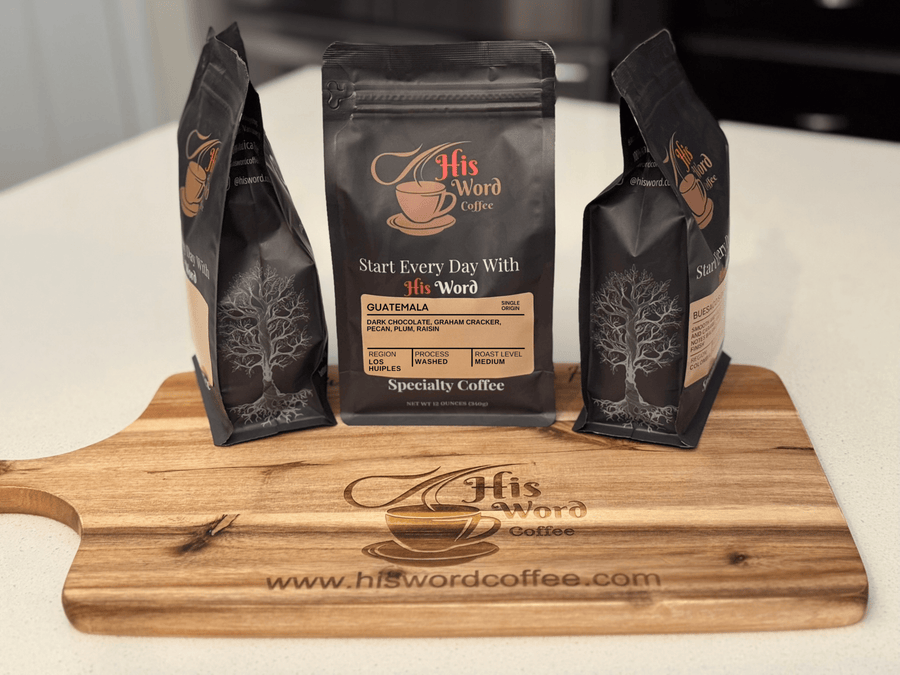
Stop Serving Bitter Coffee to Sweet People.
Coffee That Keeps People Lingering.
You know that moment after service, when conversations start flowing and people actually stay?
Good coffee helps that happen.
Skip the bitter, burnt "church coffee" reputation. Serve a cup that says "you are welcome here."
Key Takeaways
- ✓Fresh-Roasted Coffee: We roast in small batches and ship within 2 to 3 days, so your congregation gets fresh flavor instead of stale beans that have sat on a shelf.
- ✓Air-Roasted Process: We roast on a fluid-bed air roaster, which lifts the beans on hot air for an even roast. Many roasters find this gives a clean, smooth cup, which helps with guests who do not usually love coffee.
- ✓Faith-Rooted Family Business: His Word Coffee is run by Nick and Rachel Murphy in Vancouver, WA. Every bag supports a small family business that shares your church's values.
- ✓Wholesale For Regular Orders: Churches ordering on a regular schedule can ask about wholesale pricing. Learn about wholesale.
Why Church Coffee Gets a Bad Name (And How to Fix It)
The "church coffee" joke exists for a reason. Most fellowship-hall coffee comes from a giant can of pre-ground beans that were roasted months ago, then it sits in an urn on a warmer for an hour. Two things wreck the flavor: stale beans and heat. Coffee starts losing its best aromatics within a couple of weeks of roasting, and holding brewed coffee on a hot plate turns it bitter fast.
The fix is simple. Start with fresh-roasted coffee, brew it close to serving time, and hold it in an airpot or insulated dispenser instead of on a burner. You do not need a barista or fancy gear. You just need beans that were roasted in the last few weeks instead of last year.
How We Roast (And Why It Matters for a Crowd)
I am Nick Murphy, and my wife Rachel and I roast every bag here in Vancouver, WA. We use a fluid-bed air roaster, which means the beans float on a column of hot air the whole time instead of tumbling against a hot metal drum. In our roasting, this style makes it easier to get an even roast with fewer scorched spots, which tends to read as a cleaner, smoother cup.
That smoothness is exactly what you want for a fellowship hall. When you are pouring for a hundred people, you are serving lifelong coffee drinkers and folks who only sip a cup on Sundays. A balanced, approachable roast meets both. Our Smooth Breakfast Blend is the one we reach for most often for groups: it is a medium roast that is easy to drink black, takes cream and sugar well, and does not turn harsh as it sits.
We taste every batch before it ships. Coffee professionals score quality coffee on a 100-point scale, and beans that earn 80 points or higher are considered specialty grade by the Specialty Coffee Association. We source specialty-grade green coffee and cup it as we dial in each roast, so the bag you hand your congregation is the same coffee we are proud to drink ourselves.
How Much Coffee Does a Church Need?
A standard rule of thumb in food service is about 1.5 to 2 cups of coffee per person at a morning gathering, and one pound of coffee brews roughly 45 to 50 cups of 6 ounces. Here is a simple starting point you can adjust to your crowd:
- Small group or Bible study (15 to 25 people): about 1 to 2 pounds per gathering.
- Mid-size fellowship (50 to 100 people): about 3 to 5 pounds per service.
- Large congregation (150 to 300+ people): about 6 to 12 pounds, often split across decaf and regular.
Plan for a decaf option too. A good ratio is roughly one part decaf to every three or four parts regular, since many guests want a warm cup in the evening or after their morning limit. Our Evening Grace Decaf uses a natural sugarcane (EA) decaffeination process and keeps the same smooth character as our regular roasts, which makes it an easy second urn. For bigger churches that go through coffee fast, we offer larger formats like 5-pound bags of our Colombia single origin and a Church VIP Breakfast Blend made for regular fellowship-hall service.
Brewing Tips for Fellowship Hall Coffee
- Use the right ratio. Aim for about 2 tablespoons of ground coffee per 6 ounce cup. Weak coffee is the second most common complaint after bitter coffee.
- Brew close to serving. Coffee tastes best in the first 30 to 45 minutes. Brew in batches as people arrive rather than all at once before the doors open.
- Hold it off the heat. Move finished coffee into airpots or insulated dispensers. A burner under a glass pot will scorch coffee and make it bitter within an hour.
- Keep gear clean. Coffee oils go rancid and leave a stale taste. Rinse urns and pots well between Sundays.
- Grind matters. A medium grind works for most drip urns. If you order whole bean, a simple grinder lets you keep beans fresher longer.
Faith-Rooted, Family-Owned
His Word Coffee started with a love of good coffee and a family heritage that runs back to my grandfather in Montana's Bitterroot Valley. Rachel and I are raising two daughters, and we built this business to do honest work and serve people well. We are not a giant corporation. When you order, you are buying from a family that prays over this work and cares how your fellowship cup tastes.
That is also why we like partnering with churches. Coffee after service is rarely about the coffee. It is about the conversation that happens over it. We are glad to play a small part in that.
Explore Our Church Coffee Program
Questions about a regular order or coffee for a church event? Email info@hiswordcoffee.com or call 360-270-8106.
Written by Nick Murphy, co-founder and roaster at His Word Coffee, Vancouver, WA.