
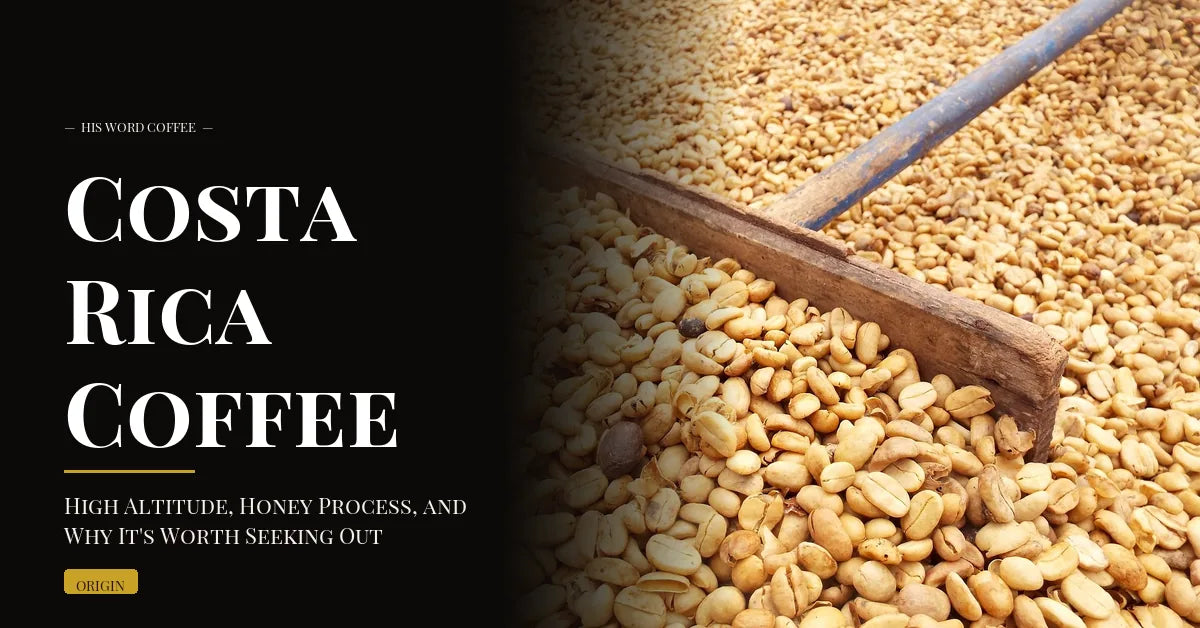
Costa Rica is a small country that quietly set the standard for what quality-first coffee can look like. It banned low-grade robusta decades before specialty coffee was a mainstream conversation. It helped pioneer the honey process that now shapes how roasters around the world think about sweetness and body. And its most celebrated region, Tarrazu, produces some of the most consistently excellent Central American coffee available today. If you have not explored Costa Rican coffee carefully, you have been missing one of the most reliable and rewarding origins on the map.
Key Takeaways

- Costa Rica legally allows only arabica production, making even non-specialty coffee there relatively high quality by global standards.
- Tarrazu is the flagship growing region: high altitude (1,200 to 1,900 meters), bright acidity, chocolate notes, and clean finish.
- Costa Rica is widely credited with popularizing the honey process in Central America, producing coffees that sit between washed clarity and natural sweetness.
- Three honey levels (yellow, red, black) offer a spectrum from near-washed to near-natural flavor profiles.
- Pour over and drip brewing highlight the brightness of washed lots; French press excels with honey-process coffees.
In This Guide
- A Quality-First Coffee Nation
- Geography and Growing Conditions
- Costa Rica's Key Growing Regions
- The Honey Process: Costa Rica's Signature Contribution
- Washed vs. Honey vs. Natural
- Varietals and Research
- Flavor Profiles at a Glance
- How to Brew Costa Rican Coffee
- Costa Rica at His Word Coffee
- Frequently Asked Questions
A Quality-First Coffee Nation
Costa Rica does not compete on volume. Countries like Brazil and Vietnam dominate global coffee production by sheer tonnage. Costa Rica produces a fraction of that output, and it has chosen not to chase quantity. What it has done instead is build a reputation for quality that few origins can match at its price point.
The most significant signal of that commitment: Costa Rica was among the first countries in the world to legally ban the cultivation of robusta coffee. Only arabica is permitted. That single policy decision has cascading effects on the entire supply chain. Farmers have no incentive to plant lower-quality, higher-yielding robusta to cut costs. The processing infrastructure, buyer relationships, and export reputation are all built around arabica quality. Even commodity-grade Costa Rican coffee is better than commodity-grade coffee from many other origins because the floor is simply higher.
That legal standard, combined with the country's dramatic geography and long history of coffee culture, is why Costa Rica consistently shows up in specialty roasters' sourcing programs. It is not an exotic or unusual origin. It is a reliable, accessible, and genuinely excellent one, and it deserves far more attention than it typically gets in specialty coffee conversations dominated by Ethiopia and Colombia.
Geography and Growing Conditions

Costa Rica sits in Central America, bordered by Nicaragua to the north and Panama to the south. The Pacific Ocean lies to the west and the Caribbean to the east. That geography matters enormously for coffee. The country is narrow but mountainous, with volcanic mountain ranges running through its center and dramatic elevation changes across a relatively small area.
The Talamanca Mountains in the south and the Central Valley region in the interior are the two dominant landscape features for coffee production. Elevations in the primary growing regions range from approximately 1,200 to 1,900 meters above sea level. At those altitudes, cooler temperatures slow the maturation of coffee cherries, allowing sugars and acids to develop more fully. The result is what coffee professionals call "high-grown character": brighter acidity, more complex flavor, and better clarity in the cup.
Costa Rica also benefits from two distinct seasons, dry and wet, which create predictable harvest windows and allow for controlled processing. Most Costa Rican coffee is harvested between November and March, with processing happening at micro-mills (known locally as beneficios) that have proliferated across the country over the past two decades. The rise of small, farm-level micro-mills gave individual producers the ability to control their own processing, which is one major reason honey-process experimentation became so widespread and refined in Costa Rica specifically.
Costa Rica's Key Growing Regions
Costa Rica is divided into eight recognized coffee-producing regions, each with its own microclimate, altitude range, and flavor tendencies. Here are the most important ones to know.
The most celebrated and widely exported Costa Rican region. Located south of San Jose in the mountains above Cartago. Known for bright citric acidity, full body, milk chocolate, and clean fruit notes. Washed Tarrazu is the benchmark for classic Central American coffee and the origin most specialty roasters reach for first when sourcing Costa Rica.
Encompasses the areas around Heredia and Alajuela, two cities close to San Jose. Lower in altitude than Tarrazu, which produces a milder, more approachable cup: gentle acidity, medium body, and pleasant sweetness. An excellent entry point for people new to Costa Rican coffee.
Covers the Naranjo and Palmares areas west of San Jose. Produces excellent specialty coffee, often processed as honey or natural, with fruit-forward sweetness and good body. One of the regions where honey-process experimentation has been most active and commercially successful.
A small boutique region east of San Jose, sometimes called the "Bordeaux of Costa Rica" for its unique volcanic terroir and distinctive cup quality. Production volume is low, which makes it harder to find but worth seeking out when available. Expect bright acidity, complexity, and a wine-like character from the best lots.
Located in the southern part of the Central Valley. Produces balanced, clean, and consistent coffee with medium acidity and body. Not as dramatic as Tarrazu but reliable and pleasant, often used in blends or as an accessible single-origin option for everyday drinking.
Costa Rica's southernmost growing region, near the Panamanian border. Lower altitude means a milder, earthier flavor profile with less brightness than northern regions. Less frequently seen in specialty programs but part of the broader Costa Rican production picture.
The Honey Process: Costa Rica's Signature Contribution
If there is one thing Costa Rica contributed to the modern specialty coffee movement that changed how roasters and farmers think globally, it is the honey process. Costa Rica is widely credited with popularizing this method in Central America, and from there it spread throughout the coffee world. Understanding the honey process means understanding a large portion of what makes Costa Rican coffee distinctive.
To understand honey processing, start with the two traditional methods. In washed (or wet) processing, the outer fruit skin and all of the sticky mucilage layer are removed before the coffee bean dries. This produces a clean, bright cup that clearly expresses the bean's inherent qualities, since almost no fruit character transfers during drying. In natural (or dry) processing, the whole cherry, skin, pulp, and mucilage, is left intact while the bean dries inside. This transfers significant fruit character to the bean, producing heavy body and intense, often berry-like sweetness.
Honey processing sits deliberately between those two. The outer skin is removed (as in washed processing), but the sticky mucilage layer, which looks and feels somewhat like honey, is left on the bean during drying. The amount of mucilage retained and the duration of drying determine whether the result leans toward washed or natural in flavor. Costa Rican producers refined this into three distinct levels.
Most mucilage is removed before drying, and the beans are dried quickly, sometimes partially in shade. This produces a result very close to a washed coffee: clean and bright, with just a touch of added sweetness and slightly more body. The bean turns yellowish during drying. Best for drinkers who want washed clarity with a bit more roundness.
More mucilage is retained, and the beans are dried over one to two weeks with less turning and more sun exposure. The extra contact time transfers more fruit sweetness and body to the cup. Expect stone fruit, apricot, and light caramel notes alongside chocolate. More complexity than yellow honey, with a rounder mouthfeel. A reliable middle ground that showcases what honey processing does best.
Maximum mucilage retained, dried for three to four weeks, often with minimal turning to increase fermentation influence. The result is the most natural-process-like of the honey levels: deep fruit complexity, heavy body, concentrated sweetness, and significant fermented character. The beans turn nearly black during drying. Exceptional when executed carefully.
The ability to choose a honey level means Costa Rican producers can tailor their coffee to specific buyer preferences and market demands. A farmer with the same underlying lot can produce yellow honey for buyers who want cleanliness, red honey for buyers who want sweetness and body, and black honey for roasters chasing complexity. That flexibility is one reason Costa Rica's micro-mill model has been so successful in the specialty market.
Washed vs. Honey vs. Natural: Side by Side
Costa Rica produces coffee across all three main processing methods, though washed and honey dominate. Here is how they compare in the cup.
| Process | Acidity | Body | Sweetness | Primary Notes | Common Regions |
|---|---|---|---|---|---|
| Washed | High, bright | Medium | Moderate | Citrus, milk chocolate, honey, clean finish | Tarrazu, Tres Rios, Orosi |
| Yellow Honey | Medium-high | Medium | Medium | Caramel, light stone fruit, clean body | West Valley, Central Valley |
| Red Honey | Medium | Medium-full | Medium-high | Apricot, peach, brown sugar, chocolate | West Valley, Tarrazu |
| Black Honey | Low-medium | Full | High | Tropical fruit, dried fig, syrupy, complex | West Valley, specialty farms |
| Natural | Low | Full | Very high | Berry, mango, wine-like, heavy body | Specialty farms, limited production |
Varietals and Research
Costa Rica's coffee genetics story is one of practical quality management. The two most commonly planted varietals are Caturra and Catuai. Caturra is a natural mutation of Bourbon, brought to Costa Rica from Brazil in the mid-twentieth century. It became dominant because it is compact (meaning more trees per hectare), productive, and produces excellent cup quality at high altitude. Catuai, a hybrid of Mundo Novo and Caturra, followed for similar reasons, with added disease resistance.
Typica, one of the oldest arabica varietals, is still found in Costa Rica, particularly in some older farms in Tarrazu and the Central Valley. It produces exceptional cup quality but lower yields, which is why it has been gradually replaced by higher-productivity varietals over the decades.
What makes Costa Rica particularly interesting from a research standpoint is its active involvement in the World Coffee Research network and international varietal development programs. As climate change puts pressure on coffee-growing altitudes globally, Costa Rica has been one of the countries most willing to invest in finding varietals that perform well under shifting conditions. The country's Institute of Coffee (ICAFE) has long maintained rigorous quality standards and supported experimental work at the farm level.
The Specialty Coffee Association has consistently recognized Costa Rican producers in its cupping competitions and educational programs, which reflects the depth of the country's commitment to quality from farm to export.
Flavor Profiles at a Glance
The short version for anyone making a buying decision:
Washed Tarrazu is the quintessential Costa Rican experience. Bright citric acidity, milk chocolate in the finish, honey sweetness in the mid-palate, medium body, and a clean, lingering close that makes the next sip as inviting as the first. If you have ever described a coffee as "crisp" or "classic," washed Tarrazu is what you were reaching for.
Honey-process Costa Rica is for drinkers who find washed coffees too sharp or who want more sweetness without the fruit-bomb intensity of naturals. A good red honey from the West Valley reads like a softer version of itself: stone fruit in the aroma, chocolate and brown sugar in the body, and a round, satisfying finish. Less edge, more comfort.
Natural Costa Rica is the least common but rewards the curious. Expect more fermented fruit character, heavier body, and a departure from the crisp clarity that defines most Costa Rican coffee. Worth trying if you encounter it from a reputable roaster who has sourced carefully from a farm that handles the method well.
How to Brew Costa Rican Coffee
Brewing Recommendations by Method
- Pour over (V60, Chemex, Kalita): The best method for washed Tarrazu. The clarity and brightness of a well-made pour over directly showcases what high-altitude, clean-processed Costa Rican coffee does. Use a medium-fine grind, water at 93 to 96 degrees Celsius, and a 1:15 to 1:16 coffee-to-water ratio. Bloom for 30 to 45 seconds to degas.
- Drip (automatic): Works extremely well and is the most accessible way to enjoy Costa Rican coffee daily. A quality automatic brewer that hits 91 to 96 degrees Celsius extraction temperature will produce an excellent cup. Medium grind.
- French press: Excellent for honey-process and natural lots. The immersion method and metal filter allow more body and texture into the cup, which complements the additional sweetness and mouthfeel of honey-process coffees. Use a coarse grind, steep for 4 minutes.
- Espresso: Washed Tarrazu at medium roast makes a clean, chocolatey espresso with pleasant citrus brightness. Not the most common use case for a Costa Rican origin, but very capable when done right. Look for a medium roast to preserve the origin character.
- Grind fresh: As with any specialty coffee, grinding immediately before brewing makes a meaningful difference in cup quality. See our coffee grind size chart for reference points across brewing methods.
Stay in the Loop
Costa Rica at His Word Coffee
His Word Coffee's current Costa Rica offering is Costa Rica Tarrazú Coffee, a dark-roast natural-process single origin from the Tarrazú region. The current product page lists milk chocolate, star fruit, strawberry, almond, and cane sugar tasting notes. That makes it a good example of how Costa Rican coffee can be familiar and fruit-forward at the same time.
This guide also explains washed and honey-process Costa Rican coffees because those methods are part of the larger Costa Rica story. Product details change by lot and season, so use the current product page when you are choosing a bag.
Browse our current Costa Rica Tarrazú Coffee, see the single-origin coffees, or explore all our coffees if you are looking for a reliable everyday blend or something to share with someone who is just getting into specialty coffee.
Frequently Asked Questions
It depends on the processing method and region. Washed Costa Rican coffee, especially from Tarrazu, tends to be bright and clean with citric acidity, milk chocolate, and a light honey sweetness. Honey-process lots are softer, with stone fruit and brown sugar notes and more body. Natural-process Costa Rica is rarer and heavier, with fruit-forward complexity.
Tarrazu is the most celebrated coffee-growing region in Costa Rica, located in the mountains south of San Jose at elevations between 1,200 and 1,900 meters. Coffee from Tarrazu is known for bright acidity, full body, clean flavor, and chocolate and citrus notes. It is one of the most widely exported premium Central American origins and a benchmark for washed coffee quality.
Honey process (also called pulped natural) is a processing method where the outer skin of the coffee cherry is removed but the sticky mucilage layer is left on the bean during drying. The amount of mucilage retained determines whether the result is yellow honey (closest to washed), red honey (more sweetness and body), or black honey (closest to natural process). Costa Rica helped popularize this method in Central America.
Costa Rica legally permits only arabica cultivation, which means the quality floor is higher than in countries that grow both arabica and robusta. Even commodity-grade Costa Rican coffee is relatively good by global standards. Specialty-grade lots from Tarrazu and the West Valley are among the most consistent and rewarding available from Central America.
Pour over (V60, Chemex) is ideal for washed lots, as it highlights brightness and clarity. Drip brewing works excellently for daily use. French press suits honey-process and natural lots by adding body and texture. Espresso at medium roast produces a clean, chocolatey shot. For grind guidance, see our coffee grind size chart.
Colombian coffee is typically sweeter and more fruit-forward, with caramel and red fruit notes and medium acidity. Costa Rican washed coffee, particularly from Tarrazu, is brighter and crisper, with higher acidity and cleaner chocolate notes. Costa Rica also has a stronger honey-process tradition, which gives it a wider processing range than Colombia's predominantly washed profile.
Look for specialty roasters who list the growing region on the bag, ideally Tarrazu or a named micro-mill. His Word Coffee carries Costa Rican single-origin lots when available. Check our single-origin collection for current offerings.
Costa Rica sets the standard for quality-first coffee. When we carry a Tarrazu or honey-process lot, it is because we found something worth sharing. Browse our current single-origin offerings and see what is in season.
Shop Single Origins All CoffeesSources: World Coffee Research (worldcoffeeresearch.org), Specialty Coffee Association (sca.coffee). Processing method descriptions reflect standard industry classification. Flavor notes are general tendencies and vary by farm, mill, and roast level.


Leave a comment
This site is protected by hCaptcha and the hCaptcha Privacy Policy and Terms of Service apply.