
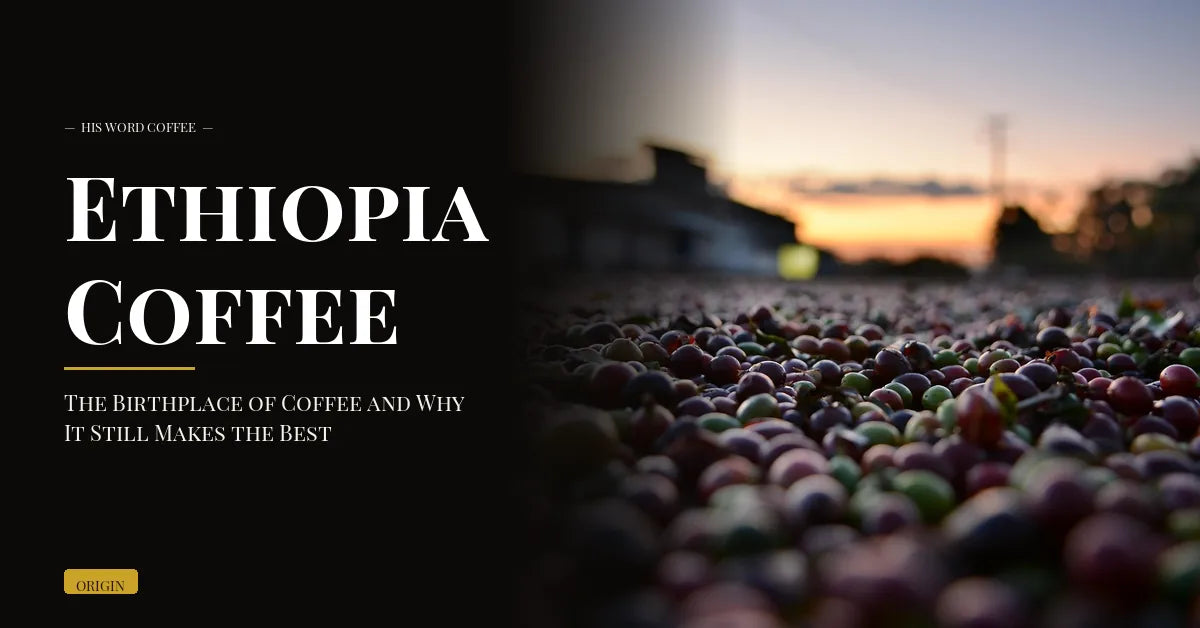
Ethiopia is not just where some great coffee comes from. It is where coffee itself was born. Every single cup of Coffea arabica on the planet traces its genetic ancestry to the wild forests of southwestern Ethiopia. That fact alone makes Ethiopian coffee worth understanding. But then you taste a cup of washed Yirgacheffe, floral and bright as jasmine tea, and you realize the story goes much deeper than history.
Key Takeaways
- Ethiopia is the only country where Coffea arabica grows wild and untended in native forests.
- Major growing regions include Yirgacheffe, Sidama, Guji, Harrar, and Kaffa, each with distinct flavor personalities.
- Ethiopian coffees carry hundreds of uncatalogued heirloom varieties, producing flavors found nowhere else on earth.
- Altitude across growing regions reaches 1,500 to 2,200 meters, among the highest in the world.
- Both washed and natural processing are widely used, and the choice dramatically shifts the flavor profile.
- The Ethiopian coffee ceremony is a three-round social ritual central to daily and community life.
Ethiopia: Coffee's Birthplace
The story most people know goes like this: around 850 AD, an Ethiopian goat herder named Kaldi noticed his goats dancing and refusing to sleep after eating red berries from a particular shrub. He brought the berries to a local monastery, a monk brewed them, found himself unusually alert during evening prayers, and word spread. It is a good legend. Historians note it is probably just that, a legend recorded centuries after the fact. But the core truth it points toward is entirely real.
Coffea arabica evolved in the wild forests of the Kaffa region in southwestern Ethiopia. This is not a cultivated origin story. The plant is indigenous here. It grew under forest canopy, adapted to high altitude and seasonal rainfall, developed its extraordinary aromatic complexity over thousands of years of natural selection, and was eventually discovered by people who lived nearby and understood what they had. Wild coffee still grows in those forests today. No other country on earth can make that claim.
Ethiopia is, biologically and historically, the source of every arabica coffee plant on the planet. Yemen received coffee seeds from Ethiopia sometime in the 15th century. From Yemen, coffee spread to the Ottoman Empire, to Europe, to the Americas and Indonesia through colonial trade routes. Brazil, Colombia, Guatemala, Kenya, all of them trace their arabica genetics back to the forests of southwestern Ethiopia. The plant has been cultivated and adapted elsewhere for centuries, but its roots, quite literally, are here.
According to the Specialty Coffee Association, Ethiopia consistently ranks as one of the world's top coffee-producing nations, and more importantly, as the source of some of its most distinctive specialty lots. This is not nostalgia. Ethiopian coffee continues to define what arabica can taste like at its most expressive.
The Ethiopian Coffee Ceremony
Coffee in Ethiopia is not simply a morning habit. It is a social institution. The Ethiopian coffee ceremony, called "jebena buna" in Amharic, is one of the most important social rituals in Ethiopian culture, and it is practiced daily across homes, businesses, and community gatherings throughout the country.
The ceremony is built around three rounds of coffee, each with its own name and meaning. The first round is called "abol." Green coffee beans are roasted fresh over hot coals, ground by hand, and brewed in a clay pot called a jebena. The coffee is strong, fragrant, and served in small ceramic cups called "sini." Guests are expected to stay for all three rounds.
The second round is called "tona," a slightly weaker brew made from the same grounds. The third round, "baraka," means blessing in Amharic. Each round represents a different dimension of the gathering: the first is about arrival and welcome, the second deepens conversation, the third is a benediction on the people present.
The ceremony is almost always performed by women of the household and can last anywhere from one to three hours. Refusing to participate is considered rude. Participating is considered an act of respect and community. Ethiopia is a country where coffee is not a commodity to be consumed efficiently. It is a reason to sit with people and be present with them.
In Ethiopia, coffee is not a product. It is a practice, a relationship, a daily act of hospitality that has been repeated for centuries without losing any of its meaning.
This context matters when you hold a bag of Ethiopian coffee. The people who grow it come from a culture in which coffee is woven into the fabric of daily life in a way that no other coffee-producing country quite matches.
Key Growing Regions
Ethiopia is a large and topographically diverse country. Its coffee-growing regions are not interchangeable. Each has its own altitude range, microclimate, varietals, and processing traditions, producing cups that can taste remarkably different from one another. Here are the five regions you are most likely to encounter on specialty coffee bags.
Yirgacheffe
Most Famous InternationallyYirgacheffe sits within the Sidama zone but earned its own designation because its coffees are simply that distinct. The combination of extreme altitude, heirloom varieties adapted to the specific microclimate, and careful washed processing produces some of the most floral, aromatic coffees in the world. A well-prepared washed Yirgacheffe tastes less like coffee and more like a cup of jasmine tea with notes of lemon and fresh blueberry. Natural-process Yirgacheffe cranks the fruit intensity even higher. This is the region that converted a generation of tea drinkers to specialty coffee.
Sidama
Consistent and BalancedSidama (sometimes spelled Sidamo) is the broader zone that surrounds Yirgacheffe. Its coffees are slightly less intensely floral but deeply satisfying: chocolate-forward with clean berry notes and a balanced acidity that makes them extremely approachable. Sidama coffees are workhorses of the Ethiopian specialty market, consistently excellent across many producers and washing stations. If Yirgacheffe is the showstopper, Sidama is the reliable classic.
Guji
Newer Designation, ExcitingGuji was historically grouped within Sidama until producers and exporters began advocating for its own regional identity, which specialty roasters have embraced. Guji shares some of Yirgacheffe's brightness and fruit expression but with distinct microclimates across its growing areas that add layers of tropical fruit and juiciness. Some of the most exciting natural-process lots in Ethiopian coffee are currently coming out of Guji.
Harrar
Bold and WildHarrar is in eastern Ethiopia, far removed geographically and climatically from the southern regions. It is drier, lower altitude on average, and processed exclusively using the natural (dry) method where whole cherries dry in the sun for weeks. The result is one of the most distinctive coffees in the world: heavy-bodied, intensely fruity, sometimes wine-like and almost fermented in character. Harrar is not for everyone but is beloved by those who appreciate bold, complex, rustic cups. It is one of the oldest coffee trade routes in history.
Kaffa
The Ancestral RegionKaffa is where the word "coffee" itself likely came from and where wild Coffea arabica still grows beneath indigenous forest canopy. Coffees from Kaffa tend to be earthier and spicier than those from the southern regions, with less intense florality and more of a wild, savory depth. Finding a single-origin Kaffa on the specialty market is still relatively rare, which makes them worth seeking out. They taste like a direct connection to coffee's ancient origins.
Heirloom Varieties and Genetic Diversity
In most coffee-producing countries, you can name the variety on a bag: Bourbon, Caturra, Gesha, SL-28, Typica. These are distinct genetic lines that have been studied, catalogued, and propagated intentionally. When you buy a Kenyan coffee labeled SL-28 or a Colombian Caturra, you know something specific about the plant that produced it.
Ethiopian coffees are different. Most bags simply say "heirloom" or "heirloom varieties" or "mixed heirlooms." This is not vagueness. It is honesty about a genuinely extraordinary situation.
Ethiopia has hundreds, possibly thousands, of distinct wild and semi-wild coffee varieties that have never been formally identified or catalogued by botanical science. The genetic diversity within Ethiopian Coffea arabica is greater than in the rest of the world's arabica population combined. When researchers from the World Coffee Research organization have studied Ethiopian coffees, they have found genetic lineages with no known name and no record outside their specific growing location.
This genetic diversity is one of the primary reasons Ethiopian coffees taste the way they do. The flavor compounds produced by these heirloom varieties, many of them adapted over centuries to specific microclimates, altitudes, and soil types, simply do not exist in the more uniform gene pool of commercially cultivated arabica elsewhere. The jasmine and bergamot notes in a Yirgacheffe, the wild blueberry in a Harrar, the spice complexity in a Kaffa: these flavors come partly from processing and altitude, but they begin with genetics.
It also means that Ethiopian coffee is, in a very real sense, irreplaceable. If these wild forest populations are lost to deforestation or climate change, flavors that took thousands of years of evolution to develop would disappear permanently. This is one reason why conservation of Ethiopian forest coffee ecosystems matters beyond Ethiopia itself.
Altitude and What It Does to Flavor
Ethiopia grows coffee at some of the highest elevations in the world. While lower-altitude producers might work at 800 to 1,200 meters, Ethiopian farms and forest gardens commonly sit between 1,500 and 2,200 meters above sea level. Some Yirgacheffe and Guji lots are harvested above 2,100 meters. That extra altitude is not incidental. It is the reason these coffees taste the way they do.
At high altitude, temperatures are cooler and the growing season is longer. Coffee cherries take more time to ripen, sometimes three to four months longer than at lower elevations. That slower development gives the plant time to accumulate more complex sugars, aromatic compounds, and acids within each cherry. The result in the cup is greater complexity, brighter and more nuanced acidity, and flavor notes that simply cannot develop in cherries that ripen quickly in warmer, lower conditions.
This is why altitude is one of the first things specialty roasters look at when evaluating green coffee. A lot grown at 2,100 meters in Yirgacheffe is almost certainly going to have more going on in the cup than a comparable lot from the same region grown at 1,400 meters. Ethiopian altitude, combined with heirloom genetics and careful processing, is the triple foundation of what makes these coffees exceptional.
Washed vs. Natural Processing in Ethiopia
Processing refers to how the coffee cherry is removed from the seed (the coffee bean) after harvest. Ethiopia uses both major methods: washed and natural. The choice of processing has a dramatic effect on flavor, sometimes more dramatic than the growing region itself.
Washed (Wet) Processing
In washed processing, the fruit is removed from the seed before drying. The beans are pulped, then fermented in water tanks to break down the remaining mucilage (the sticky fruit layer), rinsed thoroughly, and then dried on raised beds or patios. Because the fruit is removed early, washed coffees express the terroir of the bean itself more directly. The result is a cleaner, brighter, more transparent cup. Washed Yirgacheffe is where florality and citrus clarity shine most vividly. The jasmine and bergamot notes are at their most vivid in a well-produced washed lot.
Natural (Dry) Processing
In natural processing, the whole cherry is dried in the sun with the fruit intact, sometimes for three to six weeks. The sugars and flavor compounds from the fruit ferment slowly into the bean during drying. Natural-process coffees are typically heavier in body, sweeter, and fruit-forward in a way that can almost seem like jam or red wine. Ethiopian natural coffees, from regions like Harrar, Guji, and Yirgacheffe, produce some of the most intensely fruity cups available anywhere: wild blueberry, strawberry, tropical fruit, fermented dark cherry. Natural processing amplifies what is already extraordinary about Ethiopian heirloom genetics.

Neither method is superior. They produce different expressions of the same underlying coffee. Many roasters and consumers seek out both styles from Ethiopia specifically to experience that contrast.
Flavor Profile Comparison by Region
| Region | Altitude (m) | Processing | Body | Acidity | Primary Flavor Notes |
|---|---|---|---|---|---|
| Yirgacheffe | 1,700 to 2,200 | Washed, Natural | Light to Medium | Bright, complex | Jasmine, blueberry, citrus, bergamot, floral tea |
| Sidama | 1,500 to 2,200 | Washed, Natural | Medium | Moderate, pleasant | Dark chocolate, red berry, stone fruit, soft citrus |
| Guji | 1,800 to 2,100 | Washed, Natural | Medium to Full | Bright, juicy | Tropical fruit, nectarine, raspberry, clean citrus |
| Harrar | 1,400 to 2,000 | Natural only | Full, heavy | Moderate | Wild blueberry, dark wine, dark chocolate, fermented fruit |
| Kaffa | 1,500 to 1,900 | Natural, Washed | Medium to Full | Mild | Earthy, spice, dark fruit, forest floor |
Brewing Ethiopian Coffee at Home
Ethiopian coffees reward intentional brewing. The flavors are complex enough that your brewing method becomes a meaningful choice, not just a matter of convenience. Here are the approaches that best honor what these coffees offer.
Pour Over for Washed Yirgacheffe and Sidama
A pour over brewer (Hario V60, Chemex, Kalita Wave) is the best choice for washed Ethiopian lots. The slow, controlled extraction through a paper filter highlights clarity, florality, and the delicate citrus and tea-like notes that define great washed Yirgacheffe. Use water at 93 to 95 degrees Celsius (199 to 203 F), a 1:15 to 1:16 coffee-to-water ratio, and a medium grind. Bloom the grounds for 30 to 45 seconds before pouring. The result should be aromatic, bright, and almost transparent in the cup.
French Press for Natural-Process Harrar
Natural-process Ethiopian coffees, particularly Harrar, have the body and fruit intensity to stand up to immersion brewing. A French press retains the oils and full texture of the brew, which works beautifully with Harrar's heavy body and wine-like fruit character. Use a coarser grind, steep for four minutes, press slowly. You will get a rich, bold, deeply fruited cup that feels completely different from a washed pour over.
Cold Brew for Natural-Process Berry Notes
Natural Yirgacheffe and Guji coffees make extraordinary cold brew. The long, cold extraction draws out the fruit sweetness and berry character while keeping the acidity gentle and integrated. Coarse grind, 1:7 coffee-to-water ratio, steep in the refrigerator for 18 to 24 hours, then strain. The result is sweet, fruit-forward, and refreshing in a way that showcases Ethiopian natural coffees at their most approachable.
Grind size matters significantly for any of these methods. See our coffee grind size chart for a complete visual guide to matching grind to brewer.
Get notified when new Ethiopian single-origin lots arrive. We will let you know when Yirgacheffe, Guji, and other regional coffees come into rotation.
Ethiopian Coffee at His Word Coffee
Ethiopian coffees appear regularly in our single-origin rotation at His Word Coffee. When a well-sourced lot from Yirgacheffe, Sidama, or Guji comes through, we roast it to highlight what makes it distinct rather than pushing it toward a generic dark roast that would flatten its character. Ethiopian beans typically perform best at medium or medium-light roast levels, where the florality and fruit notes remain present and the natural complexity of the heirloom varieties can come through.
If you are new to Ethiopian coffee, a washed Yirgacheffe is an excellent starting point. Brew it as a pour over and drink it black. If you are open to something bolder, a natural-process lot from any of the southern regions will show you how intensely fruity coffee can get. Browse our current single-origin offerings to see what is in rotation, or explore our full collection.
Frequently Asked Questions
What does Ethiopian coffee taste like?
Ethiopian coffee is known for its floral, fruity, and complex flavor profile. Washed coffees from regions like Yirgacheffe tend to have jasmine, citrus, and bergamot notes with a tea-like brightness. Natural-process coffees from regions like Harrar or Guji lean toward intense berry and dark fruit character with heavier body. Sidama coffees are more balanced, with chocolate and stone fruit notes. No single description covers all Ethiopian coffee because the regions, varieties, and processing methods produce dramatically different results.
Is Ethiopian coffee the strongest coffee?
Strength is determined by how you brew coffee, not by origin. Ethiopian coffees are not inherently higher in caffeine than other arabica origins. What they are is more complex and flavorful. A light to medium roast Ethiopian Yirgacheffe brewed as a pour over will taste bright and delicate rather than heavy or bitter. If you want more caffeine, brew a higher concentration regardless of origin.
What is special about Yirgacheffe coffee?
Yirgacheffe produces coffee with exceptional florality and fruit clarity that is rarely matched elsewhere in the world. The combination of very high altitude (up to 2,200 meters), ancient heirloom coffee varieties, and careful washed processing creates cups with jasmine, blueberry, bergamot, and citrus notes that make the coffee taste almost like tea or fruit juice. It is one of the most distinctive and recognizable regional coffees in specialty coffee.
What is Ethiopian natural coffee?
Ethiopian natural coffee (also called dry-process) means the coffee cherries were dried whole in the sun after harvest, with the fruit still on the bean, for three to six weeks. During drying, the fruit ferments and infuses the bean with its sugars and compounds. The result is a coffee with significantly more fruit character, heavier body, and a sweetness that washed coffees do not have. Ethiopian naturals from regions like Harrar, Guji, and Yirgacheffe are some of the most fruit-forward coffees produced anywhere in the world.
How does Sidama coffee compare to Yirgacheffe?
Both Sidama and Yirgacheffe are grown in the same broad southern Ethiopian zone and share some characteristics, including bright acidity and heirloom genetic diversity. Yirgacheffe, however, is a specific microregion within the Sidama zone known for particularly intense florality and fruit clarity. Sidama coffees are generally a bit less intensely floral, more balanced, and more chocolate-forward. Yirgacheffe is often the more dramatic and surprising cup; Sidama is often the more approachable and consistent one.
Why does Ethiopian coffee say "heirloom varieties"?
Ethiopia has hundreds of wild and semi-wild coffee varieties that have never been formally catalogued or named by botanical science. Most Ethiopian coffee farms and forest gardens grow a mix of these local varieties that have adapted over centuries to their specific microclimate and altitude. Because no single named variety dominates and most have no formal scientific classification, producers honestly label them as "heirloom" or "mixed heirlooms." This genetic diversity is actually a major reason Ethiopian coffees are so distinctively flavorful.
What is the best way to brew Ethiopian coffee?
For washed Ethiopian coffees like Yirgacheffe, a pour over brewer (V60, Chemex, Kalita) with medium grind and water around 94 degrees Celsius best highlights the floral and citrus notes. For natural-process Ethiopian coffees like Harrar, a French press brings out the body and deep fruit character. Ethiopian naturals also make outstanding cold brew. Whatever method you use, Ethiopian coffees generally reward medium to medium-light roasts and benefit from being tasted black first before adding anything. For grind guidance, see our grind size chart.
Explore Ethiopian Coffee
Ethiopian coffees rotate through our single-origin offerings throughout the year. When a great lot from Yirgacheffe, Guji, or Sidama comes in, it moves quickly.
Shop Single OriginsSources: Fair Trade Certified, How It Works. Specialty Coffee Association, Brewing Best PracticesExplore More.



Leave a comment
This site is protected by hCaptcha and the hCaptcha Privacy Policy and Terms of Service apply.