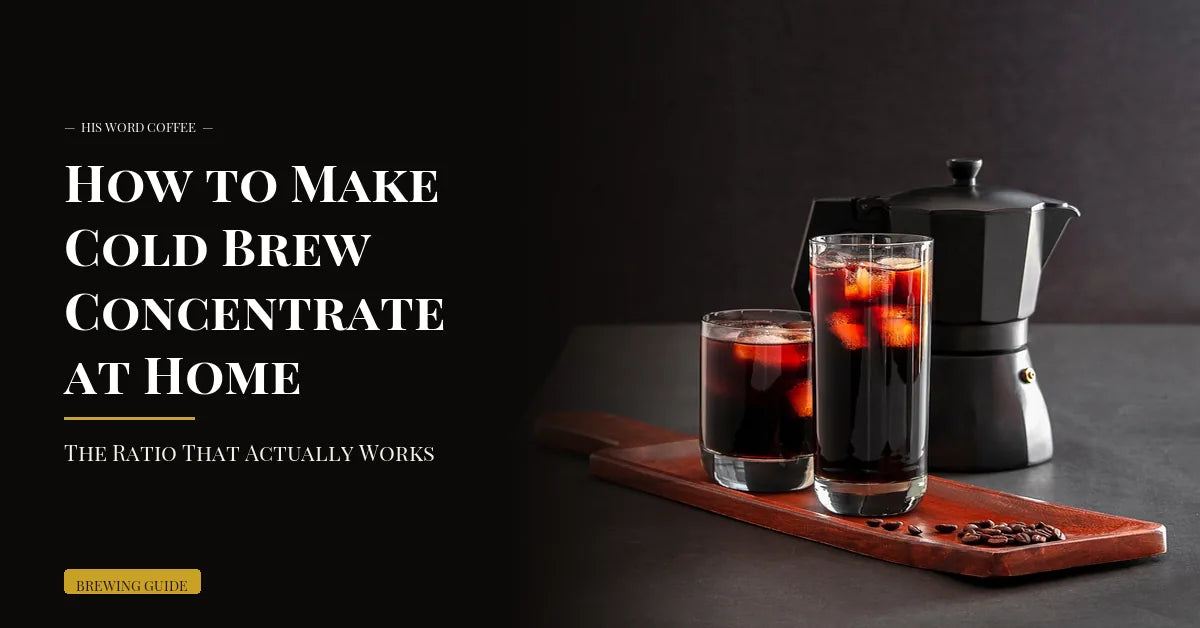
Cold brew concentrate is the smartest way to make iced coffee at home. One batch brews in the refrigerator overnight, keeps for up to two weeks, and makes a cup in about 30 seconds. Here is exactly how to do it, including the ratio that actually works.
Quick Reference
- Ratio: 1 cup coarse-ground coffee to 2 cups cold filtered water (1:4 by weight, roughly 85g coffee to 480ml water)
- Steep time: 16 to 24 hours in the refrigerator, or 10 to 12 hours at room temperature
- To drink: dilute 1:1 with cold water, milk, or oat milk
- Shelf life: up to 2 weeks refrigerated in a sealed container
- Grind: extra coarse only, similar to raw sugar crystals
In This Article
- What is cold brew concentrate?
- Concentrate vs. regular cold brew
- Why make concentrate instead of regular cold brew?
- Equipment you need
- Which coffee to use
- Step-by-step recipe
- Quick reference table
- How to use your concentrate
- Troubleshooting common problems
- Best coffee origins for cold brew
- Frequently asked questions
What is Cold Brew Concentrate?
Cold brew concentrate is a very strong coffee extraction made by steeping coarsely ground coffee in cold water for an extended period, typically 16 to 24 hours. The result is a thick, deeply flavored liquid that is not meant to be drunk straight. You dilute it before serving, usually at a 1:1 ratio with water or milk.
Because it uses cold water and a slow steep instead of hot water and quick extraction, cold brew concentrate is naturally lower in acidity and bitterness than hot-brewed coffee. The absence of heat means many of the acidic compounds that form during hot brewing simply never develop. What you get is a smooth, slightly sweet, chocolatey concentrate that is remarkably easy to drink.
It is also shelf-stable in the refrigerator for up to two weeks, which is one of its biggest practical advantages over every other brewing method.
Concentrate vs. Regular Cold Brew: What is the Difference?
The difference comes down to the coffee-to-water ratio used during brewing.
| Type | Brew Ratio (coffee:water) | Ready to Drink? | Dilution Before Serving |
|---|---|---|---|
| Regular cold brew | 1:8 | Yes, straight from the jar | None required |
| Cold brew concentrate | 1:4 to 1:5 | No, too strong to drink straight | 1:1 with water, milk, or oat milk |
Regular cold brew at a 1:8 ratio is brewed to drinking strength, so you pour it directly over ice and you are done. Concentrate is brewed at roughly double the strength, which means you need half as much liquid to store the same number of servings. When you want a cup, you add an equal part of whatever liquid you prefer.
Neither is better or worse. Concentrate is simply more efficient to store and gives you more flexibility over the final strength of each cup.
Why Make Concentrate Instead of Regular Cold Brew?
There are three practical reasons most home brewers prefer concentrate once they try it.
Storage efficiency. A 32-ounce jar of concentrate yields roughly 64 ounces of finished cold coffee after dilution. A 32-ounce jar of regular cold brew yields 32 ounces. Same jar, twice the coffee.
Adjustable strength per cup. Some mornings you want a gentle coffee, other mornings you need something stronger. With concentrate, you control the final strength by adjusting your dilution ratio. Use a 1:1.5 ratio for a lighter cup, or a 2:1 (concentrate to water) ratio if you are dragging. Regular cold brew does not give you that flexibility without pre-diluting the whole batch.
Longer shelf life. Properly strained and sealed concentrate keeps for up to two weeks in the refrigerator. Regular cold brew at drinking strength tends to taste best within 7 to 10 days. The higher concentration appears to inhibit the flavor degradation that sets in as the batch ages.
Equipment You Need
You do not need specialized equipment to make excellent cold brew concentrate. Here is what actually matters.
A large jar or container. A 32-ounce wide-mouth mason jar is the most common choice for small batches (1 cup coffee, 2 cups water). For a double batch, use a 64-ounce jar or a dedicated cold brew pitcher. Wide-mouth openings make it easier to add grounds and stir without making a mess.
A fine mesh strainer. You will use this lined with cheesecloth, a paper coffee filter, or a clean cotton cloth to strain the brewed concentrate. The strainer holds the filter material while the filter catches the fine particles that pass through mesh alone. This two-layer approach gives you a clean, smooth concentrate without grit.
A coffee grinder. If you can only buy whole bean coffee, you need a grinder. A burr grinder produces a much more consistent grind than a blade grinder, which matters for cold brew because inconsistent particle sizes lead to uneven extraction. For cold brew concentrate specifically, you want a very coarse setting, so a basic burr grinder does the job well.
A sealed storage container. A second mason jar, a glass pitcher with a lid, or any airtight container works for storing the finished concentrate.
Which Coffee to Use
Two factors matter more than any other: grind size and freshness.
Grind Size is Critical
Cold brew requires an extra coarse grind, sometimes described as similar in texture to raw sugar crystals or coarse sea salt. If you rub the grounds between your fingers, they should feel chunky and distinct, not powdery or sandy.
Using too fine a grind is the single most common mistake people make with cold brew. Fine grounds over-extract during the long steep, producing a bitter, harsh concentrate with excessive sediment that is difficult to strain out. A coarser grind extracts more slowly and evenly over the 16 to 24 hour window, developing the smooth, low-acid character that makes cold brew worth making. For a detailed breakdown of grind sizes and their effects, see our cold brew grind size guide.
Freshness Makes a Measurable Difference
Cold brew is forgiving of many variables, but it is not forgiving of stale coffee. Fresh-roasted beans produce a concentrate with noticeably more depth, natural sweetness, and complexity. Stale beans, because they have already lost their soluble aromatic compounds through oxidation, produce a flat, one-dimensional concentrate that no ratio or steep time will fix. Use beans roasted within the past four to six weeks for best results.
Roast Level
Medium to dark roasts work best for cold brew concentrate. Light roasts can work, but they tend to taste sour or thin when cold-extracted because their flavor development depends more on the chemical changes that occur during hot extraction. If you are new to cold brew, start with a medium roast and adjust from there.
Step-by-Step Cold Brew Concentrate Recipe
This recipe makes approximately 16 ounces of concentrate, which yields about 32 ounces of finished cold coffee after dilution. That is roughly four 8-ounce glasses. Scale up proportionally for larger batches.
-
Measure and grind your coffee. Weigh out 85 grams (about 1 cup by volume) of whole bean coffee. Grind on your coarsest setting, or ask your roaster to grind it extra coarse for cold brew. The grounds should look like coarse cornmeal or raw sugar, not like drip coffee grounds.
-
Add water to your jar. Pour 480ml (2 cups, or 16 fl oz) of cold, filtered water into a 32-ounce mason jar. Using filtered water removes chlorine and other off-flavors that can mute the coffee's character.
-
Add the grounds and stir. Add your ground coffee to the water. Stir well with a long spoon or chopstick for 20 to 30 seconds, making sure all the grounds are saturated with water. Dry pockets of grounds will not extract evenly. You will see a lot of bloom and bubbling, which is normal.
-
Cover and steep. Cover the jar with a lid or plastic wrap. Place it in the refrigerator for 16 to 24 hours. If you prefer to brew at room temperature, steep for 10 to 12 hours and then transfer to the refrigerator before straining. Cold steeping takes longer but produces a slightly cleaner flavor. Room-temperature steeping is faster but requires more attention to timing since over-extraction happens more quickly.
-
Set up your strainer. Place a fine mesh strainer over a clean mason jar or large measuring cup. Line the strainer with a piece of cheesecloth folded into two layers, a paper coffee filter, or a clean cotton cloth. The liner is what catches the fine particles.
-
Strain slowly, without pressing. Pour the brewed mixture into the strainer and let gravity do the work. This will take several minutes. Do not press or squeeze the grounds in the filter, as this forces bitter compounds into your concentrate. If the filter clogs, simply wait. A slow, passive strain produces the cleanest result.
-
Transfer and store. Once fully strained, transfer the concentrate to a clean, sealed container. Label it with the date. Store in the refrigerator for up to two weeks.
Quick Reference Table
| Variable | Recommended | Notes |
|---|---|---|
| Coffee-to-water ratio | 1:4 by volume (1 cup to 2 cups) | By weight: approx. 85g coffee to 480ml water |
| Grind size | Extra coarse | Like raw sugar crystals; coarser than French press |
| Steep time (cold) | 16 to 24 hours | Refrigerator; 18 hours is a reliable midpoint |
| Steep time (room temp) | 10 to 12 hours | Do not exceed 12 hours; over-extraction risk increases |
| Serving dilution | 1:1 concentrate to liquid | Adjust to taste; 1:1.5 for lighter cups |
| Shelf life | Up to 2 weeks | Sealed container, refrigerated; flavor best in first 10 days |
| Yield (per batch above) | ~16 oz concentrate | About 32 oz finished coffee after 1:1 dilution |
How to Use Your Cold Brew Concentrate
Once you have a jar of concentrate in the fridge, making coffee takes less than a minute. Here are the most common ways to use it.
Black iced coffee. Fill a glass with ice, add 4 ounces (half cup) of concentrate, and add 4 ounces of cold filtered water. Stir briefly and drink. This is the simplest and fastest option.
Cold brew latte. Fill a glass with ice, add 4 ounces of concentrate, and add 4 ounces of oat milk, almond milk, whole milk, or any milk you prefer. Oat milk in particular pairs exceptionally well with cold brew because its natural sweetness complements the chocolate and caramel notes in the concentrate.
Sweetened cold brew. Add a simple syrup, vanilla syrup, or a small amount of maple syrup either to your glass or to the batch itself. If adding to the batch, use a light hand since the concentrate amplifies sweetness more than brewed-to-strength coffee does.
Blended coffee drinks. Substitute cold brew concentrate for espresso in any blended coffee recipe. Use 2 to 3 ounces of concentrate per 12-ounce blended drink, adjusting to taste.
Coffee ice cubes. Pour concentrate into an ice cube tray and freeze. Use the cubes in your next glass of cold brew so it stays cold and strong without getting watered down as the ice melts.
Troubleshooting Common Cold Brew Problems
Your grind is likely too fine, or you steeped too long. Use a coarser grind and reduce steep time to 16 to 18 hours. Make sure you are not pressing or squeezing the grounds during straining.
Your grind may be too coarse, or you used too little coffee relative to water. Check your ratio, and grind slightly finer. Also verify that all grounds were saturated during the initial stir.
Slight cloudiness is completely normal and does not affect taste. It is caused by very fine particles passing through the filter. If cloudiness bothers you, strain a second time through a paper coffee filter.
Your straining material has too large a mesh or you are using only a single layer. Use a paper coffee filter or two tight layers of cheesecloth. Also, avoid stirring the settled grounds when pouring into the strainer.
Under-extraction can cause sourness in cold brew. Try steeping a few hours longer, or adjust your grind slightly finer. This is more common with light roast coffees.
Stale coffee is the most common cause. Beans that are more than 6 to 8 weeks past roast date will produce a flat concentrate regardless of technique. Use fresher beans.
Best Coffee Origins for Cold Brew Concentrate
Not all coffees perform equally in cold brew. The cold extraction process highlights certain flavor characteristics while others become muted. These origins tend to produce excellent concentrates.
Brazil. Brazilian coffees are among the most popular cold brew choices worldwide. They tend to have a full body, low acidity, and natural notes of chocolate, almond, and brown sugar that become deeply pronounced in a cold brew concentrate. The low-acid profile means the final cup is smooth and easy to drink even without milk.
Sumatra. Sumatran coffees bring an earthy, syrupy body with low acidity and distinctive herbal or dark fruit notes. They produce a particularly thick, rich concentrate that holds up well to milk and sweeteners. If you enjoy coffee with real weight and depth, a Sumatra-based cold brew is worth trying.
Colombia. Colombian coffees offer a classic chocolate and caramel body with moderate acidity that softens beautifully in cold brew. They are versatile and consistent, making them a reliable choice for anyone new to cold brew concentrate.
Blends designed for cold brew. Many roasters, including our own Breakfast Blend, develop blends specifically to perform well across a range of brewing methods. A well-built blend often produces a more balanced concentrate than any single-origin coffee because the components are chosen to complement each other.
For a broader look at the cold brew process and how different variables affect the final cup, see our complete cold brew coffee guide.
Get Our Cold Brew Recipes by Email
New recipes, brewing tips, and early access to seasonal coffees. No noise, just coffee.
Frequently Asked Questions
Can you use any coffee to make cold brew concentrate?
Yes, you can use any coffee. However, the quality and freshness of the beans make a significant difference in the result. Fresh-roasted coffee produces a noticeably more flavorful concentrate. Stale beans, regardless of origin or roast level, produce a flat, lifeless brew that no technique will improve. Medium to dark roasts are generally the most reliable starting point.
How long does cold brew concentrate last in the refrigerator?
Properly strained cold brew concentrate keeps for up to two weeks in a sealed container in the refrigerator. The flavor is generally best within the first 10 days. After two weeks, it begins to taste stale and may develop off-flavors. Do not store at room temperature after brewing.
What is the correct cold brew concentrate ratio?
The standard ratio for cold brew concentrate is 1:4 by volume, meaning 1 part coffee to 4 parts water. By weight, this works out to approximately 1 gram of coffee per 4 grams of water. Some brewers prefer a 1:5 ratio for a slightly lighter concentrate that still dilutes well. The 1:4 ratio is a reliable starting point and produces a concentrate that tastes balanced when diluted 1:1 with water or milk.
Can I brew cold brew concentrate at room temperature?
Yes. Room temperature brewing produces results in 10 to 12 hours rather than 16 to 24 hours. However, you should monitor it closely since warmer temperatures accelerate extraction and increase the risk of over-extraction if you leave it too long. Some brewers also prefer refrigerator brewing because they find it produces a slightly cleaner, clearer concentrate. Both methods work well when the timing is right.
Why is my cold brew concentrate bitter?
The most common causes of bitterness are a grind that is too fine, a steep time that is too long, or pressing the grounds during straining. Start by checking your grind size, which should be extra coarse, similar to raw sugar crystals. Then confirm your steep time is within the 16 to 24 hour window for refrigerator brewing. When straining, allow gravity to do the work rather than pressing or squeezing the grounds.
Do I need a special cold brew maker?
No. A standard wide-mouth mason jar, a fine mesh strainer, and some cheesecloth or a paper coffee filter are all you need. Dedicated cold brew pitchers with built-in filters are convenient but not necessary. The technique and ratio matter far more than the equipment.
How much caffeine is in cold brew concentrate?
Cold brew concentrate is significantly higher in caffeine than a standard cup of hot-brewed coffee, because of the higher coffee-to-water ratio used in brewing. After diluting at a 1:1 ratio, a typical 8-ounce serving of cold brew contains roughly 150 to 200mg of caffeine, though this varies with the coffee variety, grind, and steep time. According to research published by the National Institutes of Health, caffeine content in cold brew can vary significantly between preparations.
Is cold brew concentrate less acidic than hot coffee?
Yes. Cold brew, including concentrate, is consistently lower in acidity than hot-brewed coffee. The cold water extraction process does not trigger the same chemical reactions that hot water does, so many of the acidic compounds present in hot coffee simply never form. A study on coffee brewing methods noted that cold brew produces measurably lower titratable acidity than drip coffee. For drinkers who experience stomach discomfort from hot coffee, cold brew concentrate diluted with water or milk is often a more comfortable option. The scientific literature on cold brew coffee consistently supports its lower acidity profile compared to hot extraction methods.
Ready to Brew? Start with Fresh Coffee.
Cold brew is only as good as the beans you start with. Our coffees are roasted fresh and shipped within days of roasting, so your concentrate starts with the best possible foundation.
Shop Fresh CoffeeSources referenced in this article:
National Institutes of Health, PMC5740245: Caffeine content in cold brew coffee preparations.
ScienceDirect: Scientific literature on cold brew coffee acidity profiles.
Sources: Specialty Coffee Association, Brewing Best PracticesExplore More.


Leave a comment
This site is protected by hCaptcha and the hCaptcha Privacy Policy and Terms of Service apply.