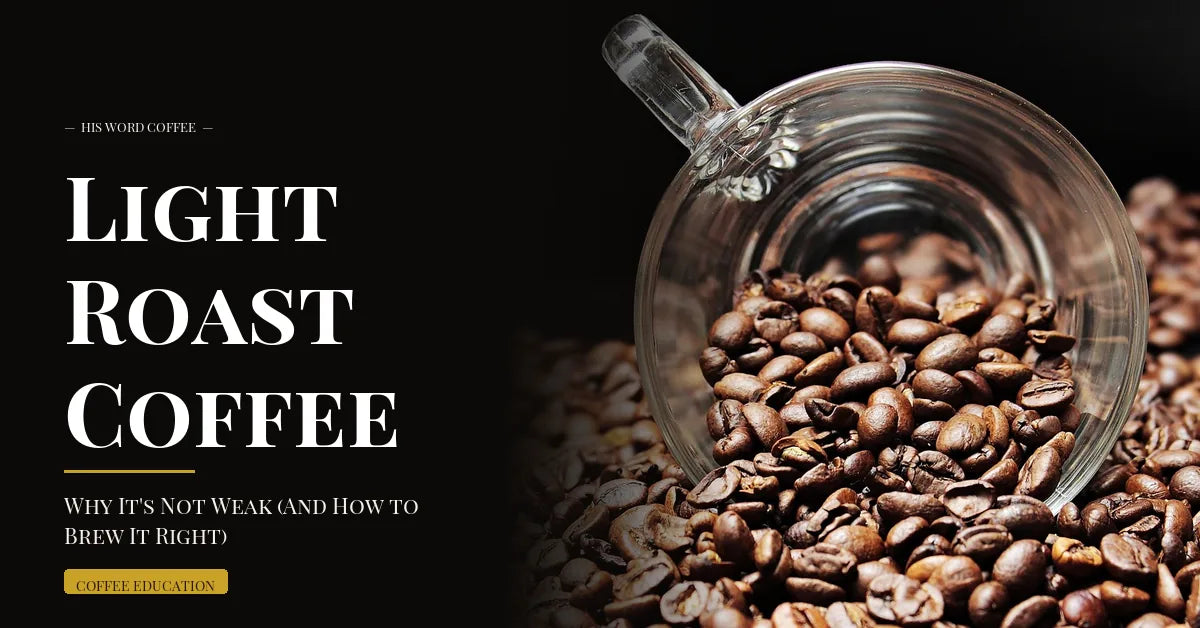
Light roast coffee gets a bad reputation. People assume it is mild, weak, and barely worth drinking. That reputation is wrong in almost every meaningful way. Light roast coffee is actually more nuanced, retains more caffeine (the FDA's caffeine safety guidelines) per bean, and showcases flavors that darker roasting simply destroys. This guide breaks down exactly what light roast is, why the myths exist, and how to brew it so it tastes the way it is supposed to.
Key Takeaways
- Light roast coffee reaches internal temperatures of 356 to 401 degrees Fahrenheit, preserving the bean's original character.
- Light roast has slightly more caffeine per bean than dark roast, because extended roasting slowly breaks down caffeine.
- The "light equals weak" myth comes from perceived lower bitterness, not actual caffeine content.
- Light roast flavor is driven by origin, not roast. Floral, fruity, and citrus notes come from the bean itself.
- Brewing light roast correctly requires higher water temperature (200 to 205 degrees Fahrenheit) and a medium-fine grind.
In This Guide
What Defines Light Roast Coffee
Roast level is defined by internal bean temperature at the end of the roasting process. Light roast coffee reaches roughly 356 to 401 degrees Fahrenheit (180 to 205 degrees Celsius) inside the bean. The roaster pulls the beans before or just after the "first crack," a moment when moisture and CO2 escape the bean and it audibly pops, similar to popcorn.
The result is a bean that looks noticeably different from what most people picture as coffee. Light roast beans are pale to medium brown. The surface is dry, with no visible oils. The bean is denser than a dark roast because it has lost less mass to heat and moisture evaporation. That density matters For brewing.
The most important consequence of light roasting is what it preserves. Every coffee bean starts its journey with a unique chemical fingerprint shaped by the altitude it was grown at, the variety of the plant, the processing method (washed, natural, or honey), and the specific region's soil and climate. This is called terroir, a term borrowed from wine. Dark roasting largely erases terroir. Light roasting keeps it intact, which is why specialty coffee (the SCA's standards) roasters who pay a premium for exceptional beans almost always roast them light.
Light Roast Names: The Spectrum Explained
There is no single universal standard for roast names, which causes some confusion. You will see terms like Cinnamon Roast, New England Roast, City Roast, and City+ used across different roasters. Here is a rough guide to where they fall:
- Cinnamon Roast: The lightest category. Beans are pulled early in first crack. Very pale, grain-like, high acidity, sometimes underdeveloped. Not common in specialty coffee because it can taste raw.
- New England Roast: Slightly darker than cinnamon, still fully light. High acidity, tea-like clarity, pronounced origin flavors. Popular among specialty roasters for delicate single origins.
- City Roast: The standard light roast benchmark. Medium-light brown, fully developed but without caramelization pushing into medium territory. Excellent balance of origin clarity and drinkability.
- City+ Roast: Just past City, approaching the edge of medium roast. Still classified as light. More body than City, slightly less acidity, still preserves most origin character. Often the sweet spot for people new to light roast.
When a roaster lists a coffee as "light," they are most likely in the City to City+ range unless they specify otherwise. Cinnamon roasts are relatively rare outside of very dedicated specialty shops.
Roasting to a light level is a deliberate choice to preserve origin characteristics, not a shortcut. A well-roasted City roast requires precise temperature control and timing. It is harder to roast well than dark roast, because there is less margin for error and nowhere for mistakes to hide.
The Caffeine Myth, Debunked
This is the one that surprises almost everyone: light roast coffee has slightly more caffeine than dark roast coffee. The common belief, that darker means stronger and therefore more caffeinated, gets the science backwards.
Caffeine is a stable molecule, but it is not completely indestructible under sustained heat. As roasting time increases and temperatures climb into dark roast territory, a small but measurable percentage of caffeine is degraded. Research published in food chemistry literature confirms this: longer, hotter roasting reduces caffeine content per bean.
There is also a volume and mass effect worth understanding. Dark roasting causes significant moisture loss and structural changes that make each bean lighter and slightly larger in volume. So if you measure coffee by volume (scoops), dark roast beans pack less mass per scoop than light roast beans. Light roast beans are denser. You actually get more bean, and therefore more caffeine, per volumetric scoop with light roast.
In practice, the difference between light and dark roast caffeine content is modest. You are not going to double your caffeine intake by switching to light roast. But the myth that "light roast is weak" in terms of caffeine is simply false. If anything, light roast is the slightly stronger choice by caffeine content.
The confusion comes from flavor perception. Dark roast tastes bold, bitter, and intense, sensations many people associate with strength. Light roast tastes bright, delicate, and sometimes acidic, which reads as "mild" to people expecting that dark roast profile. But flavor intensity and caffeine content are different things. A drink can taste mild and still deliver significant caffeine, and a drink can taste bold while delivering less.
By caffeine content: yes, at least as strong as dark roast and often slightly stronger. By flavor intensity relative to expectations: different, not weaker. Light roast coffee delivers full caffeine and real complexity. It just tastes different from what most American coffee drinkers grew up with.
Why Light Roast Tastes Different
Understanding why light roast tastes the way it does requires a shift in how you think about coffee flavor. Most people experience coffee flavor as something produced by roasting. Roasting does produce flavor compounds, the caramelization, the bittersweet chocolate notes, the smoky depth of a dark French roast. But origin-driven flavor, the flavor that was in the bean before it ever touched heat, is a completely different layer. Light roasting is the only way to taste that layer clearly.
Here is what you can expect from a well-roasted light roast coffee:
- Bright acidity: A clean, lively tartness similar to citrus or stone fruit. This is the coffee's natural malic and citric acids, which are reduced by continued roasting. Acidity in coffee is a positive quality in specialty circles, similar to acidity in wine.
- Floral notes: Some origins, especially Ethiopian varieties, produce jasmine, rose, and chamomile aromas that are entirely native to the bean. Dark roasting burns these off completely.
- Fruit flavors: Blueberry, strawberry, apricot, peach, black currant. These emerge from natural fermentation and plant genetics in certain varieties. Light roasting preserves the volatile compounds responsible.
- Tea-like clarity: The cup feels lighter on the palate than dark roast. Some people describe it as more transparent or cleaner.
- Lower bitterness: Bitterness in coffee largely comes from roasting byproducts, chlorogenic acid lactones and other compounds that form as the roast darkens. Light roast has significantly less of these.
The body (the weight or texture of the coffee in your mouth) tends to be lighter with light roast. This is often interpreted as weakness. It is not. Body and strength are different axes. Light roast simply has a different texture, more similar to tea than to, say, a thick espresso.
Some light roasts from exceptional origins, particularly natural-processed Ethiopians or high-altitude Kenyas, can taste almost wine-like, with fermented fruit complexity, bright acidity, and layered aromatics that evolve as the cup cools. If you have never experienced this and you love complex flavors, it can be a revelation.
Who Light Roast Is For (And Who It Is Not For)
Light roast coffee is not for everyone, and there is no reason to pretend otherwise. Understanding who benefits most from it helps you decide whether it makes sense to try.
Light roast is a good fit if you:
- Drink coffee black or with only a small amount of milk. Light roast flavor is delicate enough that heavy milk, cream, or sweetener can overwhelm it.
- Are curious about what makes different origins taste different. Light roast is the clearest window into terroir.
- Find dark roast too bitter or harsh. Light roast has dramatically less bitterness.
- Are exploring specialty coffee and want to understand flavor at its most nuanced.
- Want maximum caffeine retention without switching to a different caffeine source.
- Enjoy wine, tea, or other beverages where brightness and acidity are considered virtues.
Light roast is probably not the right fit if you:
- Want bold, smoky, deep flavor and find anything bright or acidic off-putting.
- Drink coffee primarily with large amounts of milk, cream, or flavored syrups. These additions simply dominate the subtleties of light roast.
- Genuinely dislike acidity in any form. While light roast brightness is different from sourness, someone with real acid sensitivity may find it uncomfortable.
- Are looking for that classic American diner coffee taste, which is generally medium to dark roast.
There is no hierarchy here. Preferring dark roast is not unsophisticated. It is simply a different and equally valid set of preferences. But if you have never given light roast a real chance, with proper brewing and an open mind about what coffee can taste like, it is worth trying before writing it off.
Best Origins for Light Roast Coffee
Not every coffee excels at light roast. The origins that shine brightest at lighter roast levels tend to have strong natural flavor development from altitude, genetics, and processing. These are the ones worth seeking out:
If you are new to light roast, Colombia or Costa Rica are safer starting points. If you want to go deep into what light roast can do, Ethiopian and Kenyan origins are the classic paths.
Explore our single-origin coffees to find options worth trying at lighter roast levels.
How to Brew Light Roast Coffee Correctly
Here is where many people go wrong with light roast, and why they end up disappointed. Light roast does not brew the same way as dark roast. If you treat it identically, you will get a flat, sour, or underdeveloped cup. The adjustments are specific and they matter.
Many people assume you should use lower water temperature for lighter coffees. The opposite is true. Light roast beans are physically denser because they have lost less mass in the roaster. Extracting their flavor compounds requires more energy. Use water between 200 and 205 degrees Fahrenheit (93 to 96 degrees Celsius) for light roast, which is close to boiling. Dark roast can tolerate lower temperatures, around 195 degrees Fahrenheit, without becoming bitter, because its compounds extract more easily.
| Variable | Light Roast Recommendation | Why |
|---|---|---|
| Water Temp | 200 to 205 degrees Fahrenheit (93 to 96 degrees Celsius) | Dense beans need more heat for proper extraction |
| Grind Size | Medium to medium-fine | Slightly finer than medium roast to increase extraction surface |
| Brew Ratio | 1:15 to 1:16 (coffee to water by weight) | Standard specialty ratio; adjust dose up if cup tastes thin |
| Best Method | pour over (V60, Chemex, Kalita) | Highlights clarity, brightness, and floral aromatics |
| Drip Machine | Works well if machine reaches 200 degrees Fahrenheit | Many consumer drip machines brew at 185 to 190 degrees, which underextracts light roast |
| French Press | Use with caution | Immersion brew can amplify astringency and muddy the clarity light roast offers |
Pour Over: The Ideal Method for Light Roast
Pour over brewing, using a dripper like the Hario V60, Chemex, or Kalita Wave, is the method that best showcases what light roast has to offer. The controlled flow rate and filter clarity preserve the delicate aromatics and clean brightness. Here is a simple starting point:
- Dose: 20 grams of coffee to 300 grams of water (1:15 ratio)
- Grind: Medium-fine, about the texture of granulated table sugar
- Water: 204 degrees Fahrenheit. If you do not have a temperature-controlled kettle, bring water to a boil and let it rest 30 seconds.
- Bloom: Pour 40 to 50 grams of water over the grounds and wait 30 to 45 seconds. Light roast coffee degasses differently than dark roast, but blooming still matters.
- Pour: Add remaining water in slow, steady circles over 2 to 3 minutes total brew time.
- Taste and adjust: If the cup tastes sour or thin, grind finer or increase water temperature slightly. If it tastes harsh or over-extracted, grind coarser.
For a deeper look at grind settings across different brew methods, see our coffee grind size chart.

Grind Fresh, Every Time
This matters for any coffee, but it matters more for light roast. The delicate volatile compounds responsible for floral and fruit notes in light roast coffee degrade quickly after grinding. Pre-ground light roast loses its most distinctive qualities within hours. A burr grinder, even an entry-level one, will make a significant difference in cup quality.
What About Espresso?
Light roast espresso exists and is popular in Scandinavian and Australian specialty coffee culture, but it is unforgiving. Pulling a well-extracted shot from light roast requires precise dialing and a machine capable of high pressure consistency. If you are new to espresso, starting with a medium roast is more forgiving. If you are experienced and curious, light roast espresso can be extraordinary: juicy, bright, and layered in ways dark roast cannot be.
Get brewing guides and roaster notes delivered to your inbox. We send practical coffee content, no noise.
Air Roasting and Light Roast: A Natural Pairing
Most commercial coffee is roasted in drum roasters, where beans tumble through a heated rotating drum. Drum roasting works well across all roast levels, but at lighter profiles it introduces a specific risk: scorching. When beans contact the hot drum surface unevenly, hot spots can develop, leading to flavor inconsistencies even within a City roast batch.
Air roasting uses a fluid bed of hot air to levitate and roast the beans without any surface contact. Every bean is surrounded by moving hot air and roasts evenly. At light roast levels, this produces exceptionally clean cups with none of the scorched or chaff-influenced off-notes that can creep into drum-roasted light roasts.
Our lighter roast offerings are sourced to highlight each origin's natural character. We use air roasting, which at lighter profiles produces cleaner, brighter flavors than drum roasting can reliably deliver. If you have tried light roast before and found it harsh or uneven, a properly air-roasted light roast may change that experience.
For a deeper comparison of roasting methods, see our guide to air-roasted vs. drum-roasted coffee.
Frequently Asked Questions
Does light roast coffee have more caffeine than dark roast?
Yes, slightly. Caffeine degrades slowly under sustained heat, so longer roasting reduces caffeine content per bean. Light roast beans are also denser, so a scoop by volume contains more bean mass and more caffeine than an equivalent scoop of dark roast. The difference is modest, but the direction is clear: light roast has at least as much caffeine, and usually a bit more.
Why does light roast taste sour sometimes?
Sourness in light roast usually indicates underextraction, which happens when water temperature is too low, grind is too coarse, or brew time is too short. Underextracted coffee pulls out acids early without extracting the sugars and other compounds that balance them. Fix: increase water temperature to 200 to 205 degrees Fahrenheit, grind slightly finer, and ensure your total brew time falls in the 2.5 to 3.5 minute range for pour over.
What is the difference between light roast and medium roast?
Light roast (356 to 401 degrees Fahrenheit) preserves more origin character, has brighter acidity, lighter body, and less bitterness. Medium roast (410 to 428 degrees Fahrenheit) develops more caramelization, balances acidity with sweetness, and has more body. Medium roast sits between the origin-driven transparency of light roast and the roast-driven character of dark roast. Many people find medium roast the most approachable starting point.
Is light roast good with milk?
It depends on how much milk. A small pour of milk or a light splash of oat milk can complement a light roast without overwhelming it. But lattes, flat whites with heavy milk ratios, and cream-heavy preparations will mute the delicate flavors that make light roast distinctive. If you drink mostly milk-based drinks, a medium or medium-dark roast will hold up better.
What does light roast coffee taste like?
The flavor depends heavily on origin, but common descriptors for light roast include: floral (jasmine, rose), fruity (blueberry, citrus, apricot, black currant), bright acidity, tea-like clarity, and sometimes a wine-like complexity. Body tends to be lighter than medium or dark roast. Bitterness is low. If you are expecting dark roast character, light roast will taste entirely different, which is the point.
Should I use a finer grind for light roast?
Yes, slightly finer than you would use for the same brew method with a darker roast. Light roast beans are denser and require more extraction surface area to pull the same level of dissolved solids. A medium-fine grind for pour over, rather than a standard medium, is a good starting adjustment. Combine this with higher water temperature for best results.
What is the best brewing method for light roast?
Pour over methods (V60, Chemex, Kalita Wave) are generally considered optimal for light roast because they produce a clean, clear cup that highlights origin flavors and aromatics. Drip machines work if they reach proper temperature. French press is workable but less ideal because the full immersion and lack of paper filtration can muddy the clarity that makes light roast worth drinking.
Ready to explore what light roast can taste like when sourced and roasted with intention?
Browse Our Coffee OfferingsSources and further reading: Specialty Coffee Association (SCA) roast classifications at sca.coffee. For research on roast degree and caffeine content, see: Perrone, D. et al. (2008) "Comprehensive analysis of the main caffeine metabolites in Brazilian coffee," Food Chemistry, available through standard academic databases. These provide the scientific grounding for claims in this article.
Sources: Specialty Coffee Association, Brewing Best Practices.

Leave a comment
This site is protected by hCaptcha and the hCaptcha Privacy Policy and Terms of Service apply.