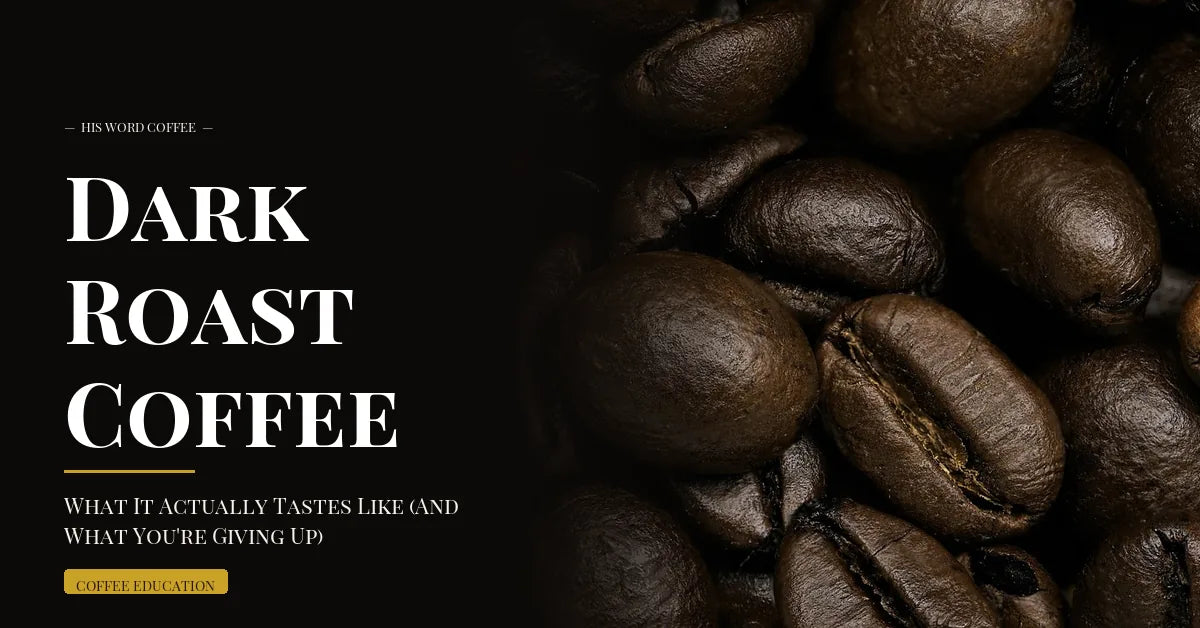
Dark roast coffee is one of the most popular styles sold in America, and also one of the most misunderstood. People assume it has more caffeine (the FDA's caffeine safety guidelines). They assume it is stronger. They assume bolder must mean better. Some of those assumptions are wrong, and one of them is costing you money if you are buying expensive single-origin beans and roasting them dark. This guide covers what dark roast actually is, what it tastes like, and exactly what you give up when you roast a bean to French or Italian levels.
Key Takeaways
- Dark roast is defined by roasting temperature, not by origin. Beans roasted past roughly 430 degrees Fahrenheit produce the classic dark roast flavor profile.
- Origin characteristics are largely burned away at dark roast levels. A dark Yirgacheffe tastes like generic dark roast, not like Ethiopia.
- Light roasts have slightly more caffeine than dark roasts. Roasting reduces caffeine content.
- Dark roast has lower acid (research published in PubMed)ity, which some people genuinely need, especially those with acid reflux.
- Air-roasted dark roast is cleaner and less bitter than drum-roasted dark roast, because beans never contact hot metal.
- Brazil, Sumatra, and Ethiopia Harrar hold up well at dark roast. Delicate origins like Yirgacheffe and Kenya AA do not.
In This Guide
- What Defines Dark Roast
- Roast Level Comparison Chart
- What Happens During Dark Roasting
- Flavor Profile of Dark Roast Coffee
- The Dark Roast Caffeine Myth
- Dark Roast and Acidity
- When Dark Roast Makes Sense
- What You Are Giving Up
- Air Roasting and Dark Roast
- Best Origins for Dark Roast
- Grinding for Dark Roast
- Frequently Asked Questions
What Defines Dark Roast Coffee
Roast level is determined by the internal temperature the bean reaches inside the roaster, and how long it stays there. Dark roast begins roughly at the "Full City+" stage, where beans have passed through second crack, and extends through French, Italian, and Spanish roast levels.
At these temperatures, the bean surface becomes oily. Those visible oils on a dark roast bean are not a sign of freshness or quality. They are lipids that have migrated to the surface as cell walls break down under heat. If you see shiny, slick beans, you are looking at a dark roast. Full City+ beans may show only a slight sheen. French roast beans glisten. Italian and Spanish roast beans can look almost wet.
Color runs from dark chocolate brown at Full City+ to near-black at Spanish roast. Many specialty coffee roasters stop before French roast because, at that level, the coffee tastes almost entirely of the roasting process rather than the bean's country of origin.
Roast Level Comparison Chart
| Roast Level | Temperature (F) | Color | Flavor Notes | Acidity | Body |
|---|---|---|---|---|---|
| Light (Cinnamon, City) | 356 - 401 | Light tan to medium brown | Fruity, floral, bright, origin-forward | High | Light to medium |
| Medium (City+, Full City) | 401 - 430 | Medium to medium-dark brown | Balanced, caramel, chocolate, some origin character | Medium | Medium |
| Dark (Full City+, French) | 430 - 450 | Dark brown, oily surface | Smoky, bitter, chocolatey, low origin character | Low | Heavy |
| Extra Dark (Italian, Spanish) | 450 - 475 | Near-black, very oily | Charred, ash, smoke, very bitter, very little sweetness | Very low | Heavy |
Full City+ is the lightest end of "dark roast" and retains more sweetness and caramel character than French roast. French roast is the style most Americans picture when they think of dark roast coffee. Italian and Spanish roast push past what most specialty roasters consider acceptable, producing a cup that tastes primarily of char.
What Happens During Dark Roasting
Inside the roaster, coffee undergoes a cascade of chemical reactions. During the Maillard reaction, sugars and amino acids combine to produce hundreds of flavor and aroma compounds. This is where caramel, chocolate, and nutty notes develop. At medium roast, you get a balance between Maillard-produced flavors and the bean's original organic acids and sugars, which carry origin character.
Past second crack, the temperature destroys many of those organic compounds. Chlorogenic acids, which contribute brightness and some fruit character, break down further. The bean structure becomes more porous as CO2 escapes. New compounds form, including pyrazines and acrylamide, which are responsible for the roasty, bitter notes that define French and Italian roast. The flavor the coffee produces shifts from "the place it grew" to "the fire it met."
This is not a flaw, but it is a fact. Dark roast is a different product from the green coffee it started as. If you buy expensive single-origin beans hoping to taste terroir, roasting them dark eliminates most of what you paid for.
Flavor Profile of Dark Roast Coffee
Dark roast coffee is bold, low-acid, heavy-bodied, and dominated by roast-driven flavors rather than origin flavors. Here is how the main flavor dimensions break down:
Bitterness
Dark roast is more bitter than light or medium roast. This is partly because chlorogenic acids break down into quinic acid and caffeic acid during roasting, and quinic acid tastes bitter. It is also because the pyrazines formed at high temperatures read as bitter on the palate. Some people want this. It wakes them up. It cuts through cream. It feels substantial. That is a legitimate preference.
Smoky and Charred Notes
At Full City+, smoky notes are subtle. At French roast, smoke is a defining characteristic. At Italian and Spanish levels, the cup can taste like an ashtray if the roaster is not careful. The smoky note comes from phenolic compounds produced during pyrolysis of the bean's cellulose structure. This is the same basic chemistry that makes campfire smoke smell the way it does.
Chocolate and Low Sweetness
Full City+ often produces distinct dark chocolate character because Maillard reactions are still active and the bean retains some sugar-derived sweetness. At French roast, most residual sweetness burns off and the chocolate note becomes more bitter cocoa than milk chocolate. Italian roast has very little sweetness at all.
Low Acidity and Heavy Body
The organic acids that give light and medium roast their brightness break down under heat. Dark roast is noticeably less acidic on the palate, which some people strongly prefer. The body tends to be heavier because porous, over-developed cells extract more soluble solids into the cup.
The Dark Roast Caffeine Myth
This is the most persistent misunderstanding in coffee. Dark roast does not have more caffeine than light roast. Light roasts actually have slightly more caffeine, because caffeine degrades somewhat during roasting and longer, hotter roasting removes more of it.
The difference is small. We are talking about a few percentage points, not a dramatic gap. You are not going to feel it in a single cup. But the idea that dark roast is "stronger" in caffeine is simply wrong. It tastes stronger, because bitterness and boldness read as intensity on the palate. The caffeine story is different.
Research published in food science literature confirms that caffeine content decreases measurably with increased roast level. If you are drinking dark roast specifically for the caffeine hit, a well-brewed medium or light roast at the same dose of ground coffee delivers at least as much, and likely slightly more.
Dark Roast and Acidity
Lower acidity is one of the legitimate advantages of dark roast coffee, not a marketing claim. If you have acid reflux, a sensitive stomach, or simply find bright, acidic coffee uncomfortable, dark roast is genuinely easier on your digestive system than light or medium roast.
Chlorogenic acids, malic acid, and citric acid are all present in higher concentrations in lightly roasted coffee. As roast level increases, these acids break down, producing a cup with a lower overall titratable acidity. Cold brew from dark roast beans amplifies this effect further, because cold water extracts fewer acids than hot water.
If stomach sensitivity is your main reason for choosing dark roast, that is a medically reasonable preference. We have a full breakdown of the best coffee for a sensitive stomach, which covers roast level, brewing method, and other variables that affect how coffee feels in your stomach.
When Dark Roast Makes Sense
There are real situations where dark roast is the right choice, not a compromise.
With Milk and Cream
The bitterness and boldness of dark roast hold up under the diluting effect of milk in a way that light roast cannot. A latte made with a light roast can taste thin and watery. The same latte made with a dark or espresso roast is rich and substantial. If you drink milk-based drinks regularly, dark roast is built for that application.
As a Cold Brew Base
Dark roast cold brew is one of the best applications for this roast level. The smoky, bitter notes that can feel sharp in hot coffee mellow dramatically during long cold extraction. The result is bold, smooth, chocolatey, and very low-acid. It is an excellent match for the cold brew format.
French Press Brewing
French press brewing leaves the coffee oils in the cup and produces a heavier, more full-bodied extraction. Dark roast amplifies both of those qualities. The combination of heavy body, low acidity, and bold flavor works naturally with French press. If French press is your daily brewing method and you prefer bold coffee, dark roast fits well.
When You Genuinely Enjoy the Flavor
This sounds obvious, but it matters. If you taste a cup of properly roasted French roast and you genuinely enjoy the smoky, bold, slightly bitter character, that preference is valid. Coffee is for drinking. The specialty coffee community has a tendency toward light roast snobbery that is unhelpful. Dark roast done well, especially with air roasting, is good coffee.
Get roast guides, brewing tips, and seasonal coffee updates from His Word Coffee.
What You Are Giving Up
Here is the honest part. Dark roast is a trade-off, and it is worth being clear about what you sacrifice.
Origin Flavor
The flavors that make Ethiopian Yirgacheffe taste like blueberries and jasmine, or Kenya AA taste like blackcurrant and grapefruit, or Panama Gesha taste like tropical fruit and bergamot, are compounds that do not survive high-heat roasting. At French roast, all three of those coffees taste like French roast. The origin is gone.
This is why specialty roasters who source exceptional single-origin beans almost always roast them light or medium. They paid for terroir. Roasting it dark throws that away. If you are spending significant money on rare, traceable beans and then roasting them to French, you are wasting both the money and the farmer's craft.
Complexity and Nuance
Light and medium roast coffees can have layered, evolving flavor profiles that shift as the cup cools. Dark roast tends to flatten those layers. The cup tastes bold from first sip to last, but it does not evolve the way a well-roasted medium does. Complexity is largely a casualty of high heat.
Natural Sweetness
Sugars in green coffee caramelize and then burn during roasting. At Full City+, you still have some caramel sweetness. At French roast, most of it is gone. Italian roast has very little sweetness. If you prefer a cup that does not need sugar, medium roast is usually sweeter than dark roast, counterintuitive as that sounds.

Air Roasting and Dark Roast
Most commercial dark roast coffee is drum-roasted. In a drum roaster, beans tumble inside a rotating drum that is heated from below. The beans contact the hot metal surface repeatedly throughout the roast. At dark roast temperatures, this contact causes scorching on the bean surface, producing sharp, acrid, ashy notes that many people associate with bad dark roast. That charred bitterness is partly the flavor of the bean at high heat, and partly the flavor of burned spots from metal contact.
Air roasting, also called fluid bed roasting, suspends the beans on a column of hot air. The beans never touch any metal surface. They are heated entirely by convection. At dark roast temperatures, this matters significantly. You get the full-body, low-acidity, smoky character of dark roast without the scorched artifacts from metal contact. The result is bolder and more complex than drum-roasted dark roast at the same roast level, and noticeably less bitter and ashy.
For more on how air roasting works and why it produces a different cup, see our guide to what air roasted coffee is.
Our darkest roasts at His Word Coffee are crafted using air roasting, which avoids the scorching that makes drum-roasted dark roasts taste bitter and ashy. If you want bold without char, that is the difference.
Best Origins for Dark Roast Coffee
Not all coffee origins hold up well at dark roast. The beans that work best are naturally low-acid, full-bodied, and earthy enough that something survives the heat.
Brazil
Brazil is probably the best all-around origin for dark roast. Brazilian coffees are naturally earthy, low-acid, nutty, and full-bodied. At dark roast, those qualities deepen rather than disappear. Brazilian dark roast produces a cup with chocolate, nut, and earth notes with minimal bitterness compared to more delicate origins at the same temperature. It is also why Brazilian beans are used so heavily in espresso blends intended for dark roast.
Sumatra
Sumatran coffees have an inherently bold, earthy, full-body character with low natural acidity. At dark roast, they become intensely rich and complex in a way that other origins do not. A dark Sumatra has cedar, tobacco, chocolate, and dark fruit notes that persist even at French roast levels. It is one of the few origins where dark roast increases rather than diminishes the interesting character of the cup.
Ethiopia Harrar
Ethiopia Harrar is a different story from Yirgacheffe. Harrar coffees are processed naturally (dry-processed), which produces a full-bodied, blueberry and wine-like character that holds up at darker roast levels better than the delicate washed Yirgacheffe. At Full City+ or light French roast, a good Harrar still has personality. Push further than that and it fades, but it has more resilience than most Ethiopian origins.
Origins to Avoid at Dark Roast
Yirgacheffe, Kenya AA, Panama Gesha, and most Central American washed coffees are too delicate for dark roast. Their defining flavors, bright acidity, floral notes, and fruit-forward character, are roast casualties. At French roast, they taste like generic dark coffee. You would not know you were drinking a Kenyan AA versus a commodity blend. Do not dark-roast expensive, delicate beans.
Grinding for Dark Roast
Dark roast beans are physically different from light or medium roast beans. High-heat roasting drives out moisture and CO2, leaving a more porous, structurally weaker bean. This porosity means dark roast beans extract faster than light roast beans at the same grind size. More soluble compounds dissolve more quickly into the water, which makes over-extraction easier to achieve.
In practice, this means you may want to grind dark roast slightly coarser than you would grind a medium roast for the same brewing method. A grind that produces a balanced extraction with medium roast may produce a bitter, over-extracted cup with dark roast beans. Start slightly coarser and adjust from there.
Our coffee grind size chart covers grind settings for every common brewing method, and the notes on extraction rate apply directly to adjusting for dark roast.
Frequently Asked Questions
Does dark roast coffee have more caffeine than light roast?
No. Light roast has slightly more caffeine than dark roast. Caffeine breaks down during roasting, so longer and hotter roasting produces marginally less caffeine. The difference is small but measurable. Dark roast tastes bolder, but that is bitterness, not caffeine.
What temperature defines dark roast coffee?
Dark roast generally begins at Full City+, where internal bean temperatures reach approximately 430 degrees Fahrenheit and the bean passes through second crack. French roast ranges from 430 to 450 degrees. Italian and Spanish roast push past 450 degrees.
Is dark roast coffee bad for you?
Dark roast coffee is not harmful for most people. Some research suggests that dark roast may actually have slightly more N-methylpyridinium, a compound that suppresses stomach acid production, which could make it gentler on the stomach than light roast for some individuals. However, the acrylamide formed during dark roasting is a compound worth being aware of, though the levels in coffee are considered low by major food safety agencies.
Is dark roast coffee more bitter than medium roast?
Yes, in general. Dark roast produces more bitter compounds during roasting, including quinic acid (from the breakdown of chlorogenic acids) and various pyrazines. Medium roast preserves more of the natural sweetness from the bean's sugars, which balances bitterness. If you find dark roast too bitter, trying a Full City rather than a French roast is a good first step, as it sits at the lighter end of dark and retains more sweetness.
What is the difference between dark roast and espresso roast?
Espresso roast is a marketing term, not a separate roast category. It typically refers to a Full City+ or French roast that a roaster has designed to work well in espresso machines. The reason is practical: the bold, low-acid, bitter character of dark roast cuts through milk well and produces a familiar espresso flavor. But you can pull espresso from light or medium roast too. The machine does not care. The roast level is a preference choice, not a technical requirement.
What does dark roast coffee taste like compared to medium roast?
Dark roast is bolder, more bitter, smokier, and heavier-bodied. Medium roast is more balanced, with more natural sweetness, more origin character, and brighter acidity. Medium roast often has caramel, chocolate, and fruit notes. Dark roast tends toward smoke, dark chocolate, and bitter cocoa. If you like the taste of the coffee itself more than the roast flavor, medium roast usually shows more of the bean. If you want boldness and low acidity, dark roast delivers that.
Is dark roast good for cold brew?
Dark roast is an excellent choice for cold brew. The long cold-steep process mellows the harsh, sharp edges that can make dark roast feel aggressive in hot coffee. The smoky, chocolatey notes remain but become smooth rather than bitter. Cold brew from dark roast is one of the most naturally balanced applications of this roast level.
We use air roasting exclusively, which means even our darkest roasts are cleaner, smoother, and less bitter than drum-roasted equivalents. Explore our full range of roast levels and find the one that fits your brewing style.
Shop His Word CoffeeSources: Specialty Coffee Association, Brewing Best Practices.

Leave a comment
This site is protected by hCaptcha and the hCaptcha Privacy Policy and Terms of Service apply.