
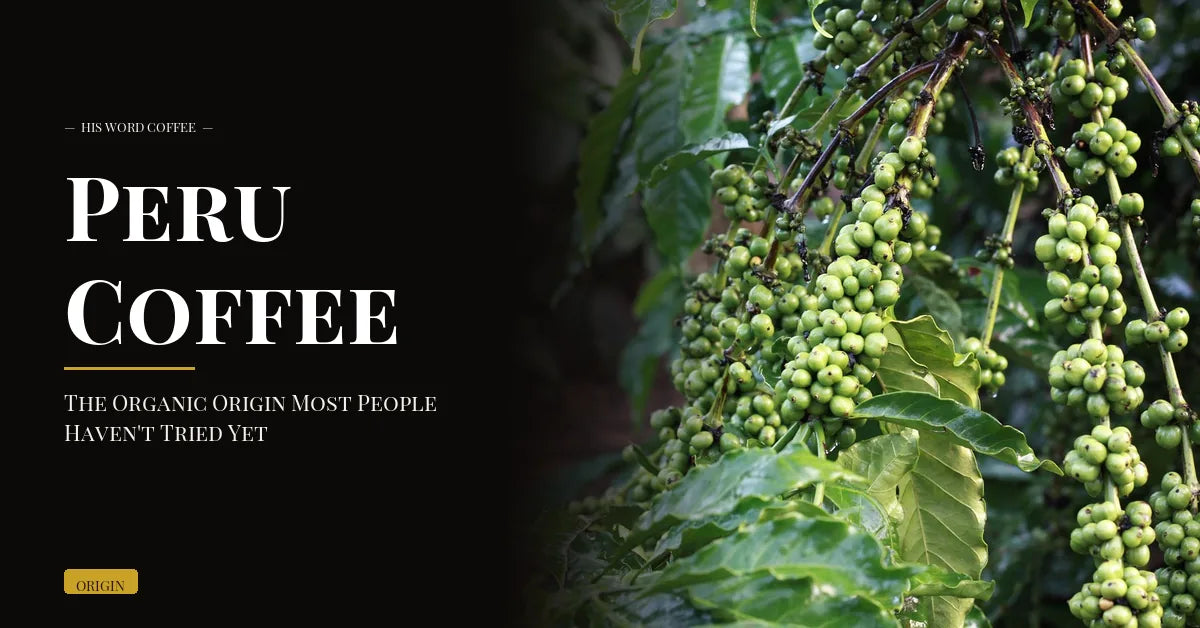
Peru sits quietly in the background of the specialty coffee world. It does not have the brand recognition of Ethiopia or Colombia. It rarely shows up on third-wave coffee bar menus. Yet Peru is one of the largest certified organic coffee producers on the planet, and for everyday drinkers who want a smooth, clean, low-acid cup with no harshness, it may be the most underrated origin in your cup cabinet.
Key Takeaways
- Peru is among the world's top producers of certified organic and fair trade coffee.
- Grown at 1,200-2,000 meters in Andean cloud forest and Amazon basin slopes.
- Flavor profile: mild-to-moderate acidity, medium body, chocolate, honey, soft stone fruit.
- Five major growing regions, each with distinct characteristics, San Martin, Cajamarca, Amazonas, Junin, and Puno.
- Predominantly washed-process with increasing specialty honey lots.
- Excellent for drip, pour over, and French press. Approachable for sensitive stomachs.
- Fair trade cooperatives are common, buying Peruvian coffee often directly supports smallholder farmers.
In This Guide
Peru's Coffee Story
Coffee arrived in Peru in the mid-1700s, carried over from neighboring Ecuador and Bolivia by missionaries and colonial traders. For most of its history, Peruvian coffee was commodity-grade production destined for blends, with little attention paid to origin character or quality sorting.
That changed significantly in the 1980s and 1990s as global interest in traceable, certified-origin coffee grew. Peru's geography turned out to be a significant asset. The country's coffee-growing zones run along the eastern slopes of the Andes where they descend into the Amazon basin. This region, sometimes called the "eyebrow of the jungle," or ceja de selva in Spanish, is a band of cloud forest and high-altitude jungle that combines elevation, rich volcanic soils, and a year-round subtropical climate. It is one of the most biodiverse places on earth, and it produces coffee in a way almost no other country can replicate at scale.
Today Peru ranks among the top ten coffee-producing nations by volume, and it holds one of the highest percentages of certified organic coffee of any major origin. The country exports a significant share of the global fair trade coffee supply. Most of this comes from smallholder farms, the average Peruvian coffee farm is between one and five hectares, family-owned, and worked by hand with minimal mechanization.
That family-scale farming model, combined with Peru's cloud-forest altitude and volcanic soil, is precisely what gives peru coffee its character: clean, smooth, approachable, and consistent.
The Five Major Growing Regions
Peru's coffee is not a single terroir. Five primary regions dominate production, each with its own altitude, microclimate, and cup profile. Understanding the regions helps you choose the right bag for your taste.
San Martin
San Martin accounts for a large share of Peru's total coffee production. At slightly lower altitudes than some other regions, the beans tend to be milder and more approachable, less complex but reliably smooth and consistent. This is a workhorse origin for everyday drinking and is frequently found in organic-certified lots at accessible prices.
Milk Chocolate Caramel Light CitrusCajamarca
Cajamarca is widely considered the crown jewel of Peruvian specialty coffee. High altitude, cool temperatures, and longer maturation cycles produce beans with noticeably more complexity and brightness. The Jaen subregion within Cajamarca has attracted attention from specialty importers and roasters seeking traceable lots with distinct cup character.
Stone Fruit Dark Chocolate Floral NotesAmazonas
The Amazonas region borders Ecuador and Colombia and sits in some of the most remote terrain in South America. Coffee here is often sold simply as "Peru" on commodity markets, but specialty importers have increasingly worked directly with Amazonas cooperatives to bring named-region lots to market. Expect a cup with gentle fruit and a soft, rounded body.
Peach Honey Soft CitrusJunin
Junin sits in the central Andes and produces coffee that is prized for its cleanliness and sweetness. The high altitude and well-defined dry and rainy seasons contribute to a cup that is crisp and pleasant without aggressive brightness. Junin lots are popular with roasters who want a dependable, versatile origin coffee.
Brown Sugar Almond Clean CitrusPuno
Puno is Peru's southernmost coffee region, adjacent to Bolivia near the shores of Lake Titicaca. The extreme altitude and cooler climate produce a cup with more body and a slightly earthier character than northern Peruvian regions. Puno is less commonly found in specialty channels but offers a distinctive option for drinkers who like more body in their cup.
Dark Fruit Walnut EarthyPeru Coffee Flavor Profile
If you had to describe peru coffee flavor in a single sentence, it would be this: clean, smooth, and gently sweet with no rough edges.
The most common tasting notes across Peruvian origins include:
- Chocolate: Milk chocolate and dark chocolate are the most consistent flavor notes across virtually all Peruvian growing regions. This is one reason Peru works so well in blends, it anchors the cup without overwhelming other components.
- Honey and caramel sweetness: The natural sweetness of Peruvian coffee is one of its best features. It means you rarely need to add sugar to find a round, pleasant cup.
- Soft fruit: Peach, plum, and light citrus notes appear frequently, especially in higher-altitude lots from Cajamarca and Amazonas. These fruit notes are subtle, more of a background hum than a bright, assertive Ethiopia-style fruit punch.
- Mild-to-moderate acidity: Peru is notably lower in acidity than most East African origins and gentler than many Colombian coffees. This makes it an excellent choice for people who find high-acid coffees harsh or who experience stomach discomfort from acidic coffee.
- Medium body: Not thin and tea-like, not thick and heavy. Peru sits comfortably in the middle, which makes it very versatile across brewing methods.
- Nutty undertones: Almond, walnut, and hazelnut-adjacent notes show up in many lots, particularly from Junin and San Martin.
A useful reference point: if you enjoy Colombian coffee for its balance and approachability, you will likely enjoy Peru as well, and you may find it even smoother, with less brightness and more emphasis on chocolate and sweetness over fruit-forward complexity.
Everyday Drinker's Note: Peruvian coffee is one of the best origins for people who want to drink specialty coffee black for the first time. Its low acidity, natural sweetness, and absence of aggressive flavors make it approachable without being boring. Start here, then work outward to higher-acidity origins once you have a baseline.
Coffee Varietals Grown in Peru
Peruvian coffee farms grow a range of varietals, some centuries old and some recently introduced. The varietal matters because it influences the genetic ceiling of cup quality, flavor expression, and how the coffee responds to altitude and processing.
| Varietal | Prevalence | Cup Character |
|---|---|---|
| Typica | Widely grown; one of the oldest varietals in Peru | Clean, classic, balanced. Often cited as a benchmark for pure, unadulterated arabica character. Gives the smooth, chocolate-forward profile Peru is known for. |
| Bourbon | Present across multiple regions | Slightly sweeter than Typica with a hint more complexity. Adds fruit and caramel notes. Less common than Typica but appreciated by specialty buyers. |
| Caturra | Common at mid-altitudes | A natural mutation of Bourbon, compact in size. Bright, citrusy, and moderate in body. Widely adopted because of higher yield per tree. Cup quality is good but not as refined as Typica at its best. |
| Catimor | Lower-altitude farms; disease-resistant | A Timor Hybrid cross introduced for leaf-rust resistance. Hardy and productive but can produce less refined cups, particularly at lower altitudes. Less prized in specialty channels. |
| Gesha (Geisha) | Emerging; select specialty farms | The most celebrated varietal in specialty coffee. Peruvian Gesha lots are still rare but growing in availability, particularly from Cajamarca farms working with direct-trade importers. Floral, jasmine, tea-like when done well. |
Most bags labeled simply as "Peru coffee" or "peruvian coffee" will be Typica or Caturra blends. Specialty-grade lots will often specify the varietal, and bags calling out Bourbon or Gesha are generally a signal of higher-quality sourcing.
Processing Methods in Peru
The way coffee is processed after harvest has a major effect on the final cup character. In Peru, the dominant method is washed processing, and that is a big part of why Peruvian coffee tastes the way it does.
Washed (Wet) Process
In washed processing, the fruit pulp is removed from the coffee cherry immediately after harvest, the beans are fermented in water tanks to loosen remaining mucilage, then washed clean and dried on raised beds or patios. The result is a cup that foregrounds the bean's intrinsic character, terroir, varietal, and altitude, rather than adding fermentation or fruit complexity from the drying stage. This is why washed Peruvian coffee tastes so clean and transparent. What you taste in the cup is the mountain, the soil, and the tree, not the fruit processing.
Honey Process
A growing number of Peruvian farms and cooperatives are experimenting with honey processing, where some or all of the fruit mucilage is left on the bean during drying. The result is a cup with more body, more sweetness, and a syrupy quality that bridges washed and natural process coffees. Honey-process peru coffee beans are increasingly available through specialty importers and represent an interesting entry point for drinkers who want more sweetness without the fermented intensity of natural-process coffees.
Natural Process
Full natural processing, where the whole cherry dries with the fruit intact, is still rare in Peru. The country's humid cloud-forest climate makes drying challenging and increases the risk of defects. When done well, Peruvian naturals show dark fruit intensity that is quite different from the country's typical profile, but they remain specialty niche items rather than a broad category.
Get brewing guides, origin stories, and roast updates from His Word Coffee delivered to your inbox.
Why So Much Peru Coffee Is Organic and Fair Trade
This is one of the most interesting things about Peru as a coffee origin, and it is a story that begins not with idealism but with economics.
When Peru's smallholder coffee farmers were establishing their farms in the 1960s through 1980s, most did not have access to synthetic fertilizers, pesticides, or commercial inputs. The remote cloud-forest terrain made supply chains difficult and expensive. So they farmed the way their grandparents farmed: compost, shade trees, hand-weeding, and no synthetic chemicals. Their coffee was organic by necessity long before it was organic by certification.
As global organic markets developed in the 1990s, Peruvian farmers found they were already qualified, they just needed certification. Today, peru organic coffee holds one of the highest rates of certified organic production of any major origin globally. According to the Specialty Coffee Association and multiple origin reports, Peru consistently ranks in the top two or three countries by volume of organic-certified coffee exported.
The fair trade story follows a similar arc. Because Peruvian farms are small and family-owned, they naturally organized into cooperatives for logistics, quality control, and market access. Many of those cooperatives pursued fair trade certification, which guarantees minimum prices and community premiums. The result: Peru is one of the world's largest exporters of fair trade certified coffee, and when you buy a bag of Peruvian coffee from a quality roaster, there is a meaningful chance it carries both organic and fair trade certifications.
For people who care about where their coffee comes from and how farmers are compensated, Peru is one of the most transparently ethical origins available at everyday price points.

External resources: The Specialty Coffee Association publishes origin research on Peru's growing regions and certifications. World Coffee Research tracks varietal development and breeding programs active in Peruvian farming communities.
Who Peruvian Coffee Is For
Not every coffee is for every drinker. Peruvian coffee has a clear home in certain preferences, and it is worth being direct about who will love it and who might want something different.
Peru coffee is a great match if you:
- Drink coffee black and want something smooth and enjoyable without added sweeteners.
- Find high-acid coffees (many Ethiopians, Kenyans, and some Colombians) too bright or sharp.
- Struggle with coffee that upsets your stomach, the low acid profile is noticeably gentler on most digestive systems.
- Want a reliable everyday cup that does not require careful brewing technique to taste good.
- Care about organic certification and fair trade sourcing and want both without paying premium prices.
- Enjoy chocolate and caramel flavor notes more than fruit-forward or floral brightness.
- Are newer to specialty coffee and want an approachable entry point before exploring more complex origins.
Peru may not be your preference if you:
- Love the bright, wine-like, intensely fruity character of natural-process Ethiopian or Kenyan coffees.
- Prefer espresso as your primary brewing method, Peru's mild profile can get a bit flat under espresso extraction pressure, though it works well in blends.
- Want a coffee that changes dramatically cup to cup with unusual and exotic flavor combinations. Peru is consistent and reliable rather than surprising.
Best Brewing Methods for Peru Coffee Beans
Peruvian coffee's medium body and mild-to-moderate acidity make it one of the most versatile origins for home brewing. It is forgiving of technique and performs well across a range of methods.
Drip Machine
Excellent. Peru's balanced profile shines in automatic drip. The medium body holds up well to the full-immersion brew cycle and the result is a consistently smooth, clean pot. A go-to method for everyday drinking.
Pour Over
Very good. A medium grind with a controlled pour highlights Peru's subtle fruit notes and lets the chocolate base come through clearly. Use a medium-light roast for best transparency.
French Press
Works well. The full-immersion and metal filter add body and richness that suits Peru's chocolate character. Use a coarse grind and a medium or medium-dark roast to avoid over-extraction.
Grind tip: For all of these methods, grind matters as much as origin. See our complete coffee grind size chart for method-by-method grind settings and brewing ratios.
Roast recommendation: Peruvian beans roasted to medium or medium-light develop the most interesting cup, enough to develop the chocolate and caramel sweetness, not so dark that the origin character is overwhelmed by roast. Very dark roasts tend to flatten what makes Peru distinctive.
Espresso note: Peru can work as an espresso component in a blend, where its sweetness and body help anchor brighter, higher-acidity components. As a solo espresso origin it tends to be soft and mild, pleasant but not particularly complex. If you are building a home espresso workflow, Peru works better as a supporting character than a lead.
At His Word Coffee, Peruvian single-origin and fair trade certified lots appear in our sourcing rotation. Check our single-origin collection for current availability.
Frequently Asked Questions
What does peru coffee taste like?
Peruvian coffee typically has a mild-to-moderate acidity, medium body, and flavor notes that lean toward milk chocolate, caramel, honey, and soft fruit like peach or plum. It is one of the smoother, more approachable origin profiles in specialty coffee, clean and pleasant without sharp or aggressive flavors. Higher-altitude lots from Cajamarca can show more complexity and brightness.
Is peru coffee good for people with sensitive stomachs?
Yes. Peru's relatively low acidity makes it a frequently recommended option for coffee drinkers who experience acid-related discomfort. It is not a "low-acid" processed coffee (where acids are chemically neutralized), but a naturally lower-acid origin due to its growing conditions and processing method. Most people who find Ethiopian or Kenyan coffees too bright or harsh will find Peru much more comfortable.
Is most peru coffee actually organic?
A significant portion of Peru's coffee production is certified organic, higher than almost any other major producing country. This is largely because Peru's smallholder farming economy historically operated without synthetic inputs, making organic certification a natural next step rather than a significant practice change. That said, not all Peruvian coffee carries formal organic certification, so look for bags that explicitly state it if certification matters to you.
How is peruvian coffee different from colombian coffee?
Both are washed-process Andean coffees with balanced, approachable profiles. Colombian coffee tends to have slightly more brightness (acidity) and more pronounced fruit notes, particularly red apple, berry, and citrus depending on the region. Peruvian coffee is typically smoother and lower in acidity, with more emphasis on chocolate and caramel sweetness and less on fruit complexity. If you love Colombian but want something even smoother, Peru is a natural next step.
What is the best brewing method for peru coffee beans?
Drip machine, pour over, and French press all work excellently with Peruvian coffee. It is a forgiving origin that does not require precise brewing technique to produce a pleasant cup. For the clearest expression of Peru's flavor notes, a pour over with a medium grind at medium-light roast is ideal. For everyday drinking convenience, a well-calibrated drip machine produces consistently good results.
What are the main coffee regions in Peru?
Peru's five primary coffee-growing regions are San Martin (the largest by volume, northern Peru, mild and approachable), Cajamarca (the most acclaimed specialty region, high altitude, more complex), Amazonas (remote northern region, increasing specialty production), Junin (central Peru, clean and sweet), and Puno (southeastern, near Lake Titicaca, more body and earthy character). Most commercially available Peruvian coffee comes from San Martin or Cajamarca.
Is peru fair trade coffee widely available?
Yes. Peru is one of the world's largest exporters of fair trade certified coffee, a result of the country's strong cooperative farming structure. Many Peruvian lots carry both organic and fair trade certifications simultaneously, making Peru one of the most common origins for dual-certified coffee. Look for the Fair Trade USA or Fairtrade International mark on the bag.
Ready to Try Peru Coffee?
Browse our current single-origin offerings or explore the full His Word Coffee collection. Every bean we carry is sourced with care for quality and the people who grow it.
Shop Single Origin Browse All CoffeeSources and Further Reading:
Specialty Coffee Association (SCA): sca.coffee, origin research, certification standards, and producer profiles.
World Coffee Research: worldcoffeeresearch.org, varietal registry, agronomic data, and breeding program updates for Peruvian growing regions.
Sources: Specialty Coffee Association, Brewing Best Practices. Poole et al., Coffee and Health: A Review of Recent Human Research, Crit Rev Food Sci Nutr 2017.

Leave a comment
This site is protected by hCaptcha and the hCaptcha Privacy Policy and Terms of Service apply.