
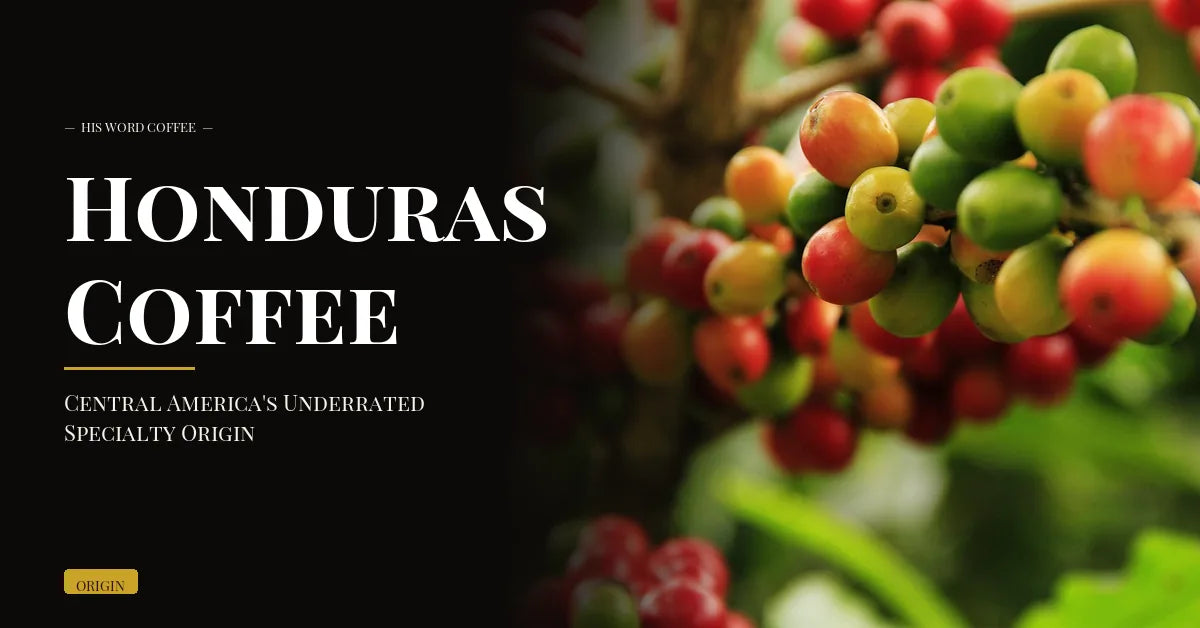
Honduras doesn't get the headlines that Guatemala or Costa Rica command in specialty coffee circles. But cup for cup, well-sourced Honduran coffee offers some of the most satisfying, approachable, and complex drinking experiences in Central America. This is the story of an origin quietly earning its place at the top of the specialty map.
Key Takeaways
- Honduras is now one of the largest coffee exporters in Central America by volume, surpassing Guatemala and Costa Rica in some years.
- Six distinct growing regions each produce different flavor profiles, from the chocolate-and-caramel notes of Marcala to the floral complexity of Montecillos.
- Most specialty Honduran coffee grows at 1,200-1,800 meters and is washed-processed, though honey and natural lots are becoming more common.
- The flavor profile is generally approachable: milk chocolate, caramel, soft tropical fruit, moderate acidity, and medium body.
- Honduras coffee brews exceptionally well as drip coffee and French press, and is a natural fit for balanced espresso blends.
In This Guide
Honduras Coffee: The Big Picture
Ask most specialty coffee drinkers to name a Central American origin and they will say Guatemala, probably. Ask them to name another and you will hear Costa Rica, Nicaragua, maybe Panama. Honduras rarely comes up first. That gap between perception and reality is precisely what makes it interesting.
Honduras has been growing coffee since the mid-1800s, but for most of that history the industry was oriented toward commodity volume rather than specialty quality. The country's mountainous interior offers ideal growing conditions, but road infrastructure, access to processing equipment, and export logistics lagged behind neighboring origins. Coffee that could have earned specialty premiums was mixed into commercial lots and shipped without distinction.
Over the past two decades, investment in wet mills, improved export certification, and partnerships with international specialty buyers have transformed the picture. Honduras now exports more coffee by volume than either Guatemala or Costa Rica in many years, according to International Coffee Organization trade statistics. More importantly, a growing share of that volume is making it to specialty roasters around the world as distinguished single-origin lots.
The producers behind Honduran coffee are predominantly smallholders. The average farm is just a few hectares. That scale, combined with the country's high-altitude terrain, means the potential for exceptional micro-lot coffee is enormous, and the specialty industry is only beginning to realize it.
Key Growing Regions
Honduras has six recognized growing regions, each shaped by its own elevation band, microclimate, and soil composition. Understanding the regions helps you know what to expect in the cup and gives context to sourcing decisions.
Marcala (La Paz)
Marcala is the most celebrated Honduran coffee region, and the first to receive a geographical indication, a protected designation similar to an appellation in wine. The high altitudes of the Montanas de La Paz produce coffees with well-developed sweetness, good structure, and recognizable notes of milk chocolate, caramel, and sometimes dried cherry. The specialty infrastructure here is the most mature in the country, with multiple certified co-ops and wet mills operating at high standards. If you have tried Honduran coffee from a specialty roaster, there is a good chance it came from Marcala.
Copan
Copan sits in the western part of Honduras, near the Guatemalan border and the famous Mayan ruins that draw tourists to the region. The altitude is somewhat lower than Marcala, which produces a milder, rounder cup profile. Copan coffees tend toward gentle sweetness, soft body, and easy approachability. They work well as components in blends where a smooth, crowd-pleasing base is the goal. Volume out of Copan is significant, and quality from well-run producers can be genuinely impressive even at the gentler altitude.
Montecillos
Montecillos is where Honduras gets its most complex and exciting specialty lots. The region encompasses parts of three departments and contains some of the highest coffee-growing land in the country. Coffees from Montecillos often carry floral aromatics, vibrant fruit notes (peach, apricot, red berry), and a lively but balanced acidity. When Honduran coffee shows up on a competition winner's table or a specialty roaster's limited release shelf, Montecillos is often the source. It rewards patience and proper brewing technique.
Agalta
Agalta is Honduras's eastern frontier for coffee. Located in the Olancho department, it is remote, less traveled by specialty buyers, and produces coffees with a distinct character: earthy, full-bodied, and bold. The remoteness that has historically limited export access also means the land is relatively undisturbed and the farming practices tend to be traditional. As infrastructure in this part of the country improves, Agalta may emerge as an interesting origin for producers who prefer coffee with weight and depth.
El Paraiso
El Paraiso sits in the southeastern corner of Honduras, sharing geography and some flavor tendencies with neighboring Nicaragua. Coffees from this region often have a clean, mellow profile with gentle sweetness and a soft finish. The cross-border similarity is not just geographical: many of the varietals and farming practices in El Paraiso mirror those found in Nicaragua's northern growing regions. For drinkers who enjoy smooth, uncomplicated Central American cups, El Paraiso delivers reliably.
Comayagua
Comayagua is a transitional region, geographically central and flavor-wise somewhere between the gentle character of Copan and the more developed complexity of Marcala. It is a significant volume producer and increasingly a source of quality lots as more producers invest in improved post-harvest processing. The cup profile leans toward classic Central American characteristics: balanced sweetness, medium body, and clean finish.
Altitude and Processing
Altitude is the single most important variable in specialty coffee growing, and Honduras has plenty of it. Most coffee designated for specialty markets grows between 1,200 and 1,800 meters above sea level. At these elevations, cooler temperatures slow the development of the coffee cherry, allowing sugars to build gradually and producing beans with greater density and more complex flavor compounds.
Honduras uses a classification system called "Strictly High Grown" (SHG) or "Strictly Hard Bean" (SHB) for coffee grown above 1,200 meters, similar to the grading systems used in Guatemala and Mexico. When you see this designation on a bag, it signals that the coffee was grown at an altitude conducive to specialty-level cup quality.
Processing Methods
The dominant processing method in Honduras is washed (also called wet-processed). The coffee cherry is pulped to remove the fruit skin, fermented briefly to loosen the remaining mucilage layer, washed with clean water, and then dried on raised beds or patios. Washed processing tends to produce cleaner, more transparent cups where the inherent character of the bean, its terroir, varietal, and altitude, comes through without the added sweetness and body that fruit-contact processing provides.
Honey-processed and natural Honduran coffees are becoming more available through specialty channels. In honey processing, some or all of the fruit mucilage is left on the bean during drying, adding sweetness and body. Natural processing leaves the full cherry intact through drying, producing the most fruit-forward, complex cup profiles. These experimental lots from Honduras are worth seeking out if you enjoy comparing how processing affects flavor.
Coffee Varietals
Honduras grows several classic Arabica varietals, most of them well-suited to the altitudes and climates of the major growing regions.
Bourbon is one of the foundational varietals in Honduran coffee, prized for its sweetness and cup complexity. It is a relatively low-yielding plant, which means producers need higher prices to make it economically viable, a dynamic that has pushed Bourbon toward specialty markets.
Caturra is a natural mutation of Bourbon that is more compact and easier to farm at higher densities. It produces a bright, clean cup with good acidity. Caturra is common throughout Central America and forms the backbone of many Honduran lots.
Catuai is a hybrid of Caturra and Mundo Novo developed in Brazil, now widely planted across Central America for its high yield and resistance to fruit drop in wind and rain. Cup quality is solid if not exceptional, and Catuai forms the volume base of many Honduran exports.
Typica is the oldest and most historically significant Arabica varietal in the Americas. It is long-bodied, relatively fragile, and produces a refined, sweet, complex cup. Not common at commercial scale, but found in some high-altitude Honduran farms where the varietal's susceptibility to disease is offset by careful management.
Lempira is a Honduras-specific varietal developed by IHCAFE (the Honduran Coffee Institute) with coffee leaf rust resistance. It was adopted widely after a devastating rust outbreak in the early 2010s. Cup quality from well-grown Lempira can be very good, though it does not achieve the ceiling of the best Bourbon or Typica lots.
Flavor Profile
Honduran coffee, as a category, trends toward the approachable end of the specialty spectrum. That is not a limitation. It means this is coffee that drinks well without demanding a refined palate or specialized brewing equipment. The characteristics that define most well-sourced Honduran lots are:
Sweetness is the defining characteristic. Honduran coffee, especially from Marcala and Montecillos, tends to have a developed, clean sweetness that reads as caramel, toffee, or milk chocolate depending on the roast and brew method.
Acidity is present but gentle. You will not find the sharp, citrusy brightness of a high-grown Ethiopian or the ripe berry punch of a Kenyan here. The acidity in Honduras coffee is typically soft and malic (think apple or pear) rather than citric, which makes it very easy to drink.

Body lands in the medium range for most washed Honduran lots. It is substantial enough to feel satisfying without becoming heavy or muddy. Natural-processed Honduras coffees trend toward fuller body and more pronounced sweetness.
Finish is generally clean and pleasant, often lingering with a hint of chocolate or caramel. Coffees from Montecillos can have a longer, more complex finish with fruit or floral echoes.
Why Honduras Is Underrated
The gap between Honduras's actual coffee quality and its reputation in specialty markets comes down to a few intersecting factors.
Marketing infrastructure lagged behind the product. Guatemala built a sophisticated marketing program around its regions and "Genuino Antiguo" quality designation decades ago. Costa Rica developed a premium-positioning story around small, artisan producers and environmental stewardship. Honduras, by contrast, spent those same decades focused on volume and had no equivalent institutional branding effort. By the time Honduran quality was improving significantly in the 2000s and 2010s, the consumer conversation was already dominated by established origins.
Road and export infrastructure held quality back early on. A significant portion of Honduras's coffee-growing land is in mountainous, remote areas with limited road access. For smallholder producers, getting harvested cherries to a wet mill before fermentation begins is critical to cup quality. Poor roads meant longer transport times, which meant more opportunity for quality loss before processing. Investment in rural infrastructure over the past fifteen years has materially improved this situation, but the historical reputation stuck.
Coffee leaf rust hit Honduras hard. The 2012-2013 roya (coffee leaf rust) outbreak devastated Honduran production, reducing output by an estimated 30-40% and forcing the widespread replanting of rust-susceptible varietals like Bourbon with rust-resistant hybrids. The transition period produced lower-quality lots as new plants matured, reinforcing a narrative that Honduras was a commodity origin. That transition is now largely complete, and quality has rebounded substantially.
According to the Specialty Coffee Association, Honduras has consistently appeared in cupping competitions and green coffee auctions with high-scoring lots in recent years. The origin is no longer overlooked by serious buyers, even if consumer awareness has not fully caught up.
The underdog status, for now, works in the drinker's favor. Honduran single-origin coffee is often priced below comparable quality from Guatemala or Costa Rica simply because the name does not carry the same premium cachet yet. That gap will close as more specialty roasters highlight the origin. For now, it is an opportunity.
How to Brew Honduras Coffee
Honduras coffee's balanced, approachable character makes it forgiving across brewing methods. It does not demand precision the way a fragile, high-acidity Ethiopian might, but it rewards good technique with noticeably better results.
| Method | Grind Size | Water Temp | Ratio | Notes |
|---|---|---|---|---|
| Drip (Auto) | Medium | 195-205F | 1:16 | Honduras shines in drip. The sweetness and chocolate notes come through clearly. An excellent choice if you brew a large batch. |
| French Press | Coarse | 200-205F | 1:14 | The medium body holds up well in immersion brewing. Expect a fuller, rounder cup with more pronounced caramel character. |
| pour over | Medium-Fine | 200-205F | 1:16 | Good for exploring the subtler fruit and floral notes, especially in Montecillos lots. Bloom 30-45 seconds. |
| AeroPress | Medium-Fine | 195-200F | 1:12 | Excellent for a concentrated, flavor-forward cup. Works well inverted or standard. 2-3 minute brew time. |
| Espresso | Fine | 200-202F | 1:2.5 | Honduras works as both a single-origin espresso (expect chocolate and caramel) and as a blend component. Medium-dark roasts from Honduras make excellent espresso bases. |
| Cold Brew | Extra Coarse | Cold/Room Temp | 1:8 | The natural sweetness translates well to cold brew. Steep 14-18 hours. The result is a smooth, chocolatey concentrate. |
Grind size is the variable that most directly controls extraction, and dialing it in correctly makes a larger difference than almost any other adjustment. If your Honduras coffee tastes bitter and harsh, your grind is likely too fine. If it tastes thin, weak, or sour, it is probably too coarse. For a full reference, see our coffee grind size chart.
One underappreciated brewing tip for Honduras coffee: use water just below boiling (195-205F) rather than fully boiling water. The moderate acidity and sweetness of Honduran coffee are best expressed at this range. Fully boiling water can push extraction toward bitterness, particularly at lighter roast levels.
HWC and Honduran Sourcing
At His Word Coffee, we source with an eye toward quality, transparency, and origins with compelling stories. Honduran single-origin lots appear in our rotation when available through our sourcing partners. The consistency of well-sourced Marcala and Montecillos lots makes them natural candidates for our single-origin offerings.
We do not carry a permanent, always-available Honduras single-origin, because great specialty coffee is seasonal and limited by nature. When we have Honduran lots available, we highlight the region, the processing method, and the flavor notes so you know exactly what you are getting. Checking our full collection will show you what is currently in stock.
If Honduras coffee is on your radar and you want to know when we have it, the best approach is to join our list. We notify subscribers when new single-origin lots arrive, including when Honduran coffee is available.
Frequently Asked Questions
What does Honduras coffee taste like?
Most well-sourced Honduran coffee tastes like milk chocolate and caramel, with a soft sweetness, moderate body, and gentle acidity. Depending on the region, you may also notice soft tropical fruit, toffee, or in the case of Montecillos lots, floral and stone fruit notes. It is generally one of the more approachable Central American origins.
What is Marcala coffee?
Marcala coffee comes from the La Paz department of Honduras and was the first Honduran region to receive a geographical indication, a protected origin designation. It is grown at high altitudes (1,200-1,800m) and is known for its developed sweetness, chocolate and caramel notes, and good cup consistency. Marcala is the most internationally recognized of the Honduran growing regions.
Is Honduras coffee good for espresso?
Yes. Honduras coffee's medium body, natural sweetness, and moderate acidity make it an excellent choice for espresso. It works well as a single-origin shot (expect chocolate and caramel) and is widely used as a base component in espresso blends, where its balanced character rounds out brighter or more intense coffees.
How does Honduras coffee compare to Guatemala?
Both are Central American washed coffees with chocolate and caramel characteristics, but they differ in detail. Guatemalan coffee, particularly from Antigua or Huehuetenango, tends to have higher acidity, a more pronounced fruit component, and a slightly more complex flavor profile at its best. Honduran coffee is generally a bit softer and sweeter, with less brightness. Honduras is often more approachable to a wider range of palates, while Guatemala can reward those who enjoy a brighter, more complex cup.
What coffee varietals are grown in Honduras?
The main varietals are Bourbon, Caturra, Catuai, Typica, and Lempira. Bourbon and Typica produce the most complex cups but are lower-yielding. Caturra and Catuai are more practical for producers at scale. Lempira is a rust-resistant hybrid developed specifically for Honduras that has been widely adopted since the 2012-2013 leaf rust outbreak.
What is the best brewing method for Honduras coffee?
Honduras coffee performs well across all brewing methods, but drip and French press are particularly well-suited to its character. Drip brewing highlights the clean sweetness and chocolate notes. French press adds body and rounds out the caramel character. For those who want to explore more delicate flavor notes, a pour-over is a great option. See our grind size chart for method-specific guidance.
Is Honduras coffee organic?
Some Honduran coffee is certified organic, but organic certification is not universal. Many small Honduran producers farm with minimal chemical inputs because certified organic practices are simply what is practical at their scale, but the cost and process of formal certification is beyond their reach. When sourcing Honduran coffee, look for transparency about farming practices from the roaster rather than relying solely on certification labels.
Explore Our Single-Origin Collection
When Honduran lots are available in our rotation, you will find them alongside other carefully sourced single-origins. Every bag we offer comes with full origin and flavor information.
Browse Single-Origin Coffee See All CoffeesSources: Fair Trade Certified, How It Works. Specialty Coffee Association, Brewing Best Practices.


Leave a comment
This site is protected by hCaptcha and the hCaptcha Privacy Policy and Terms of Service apply.