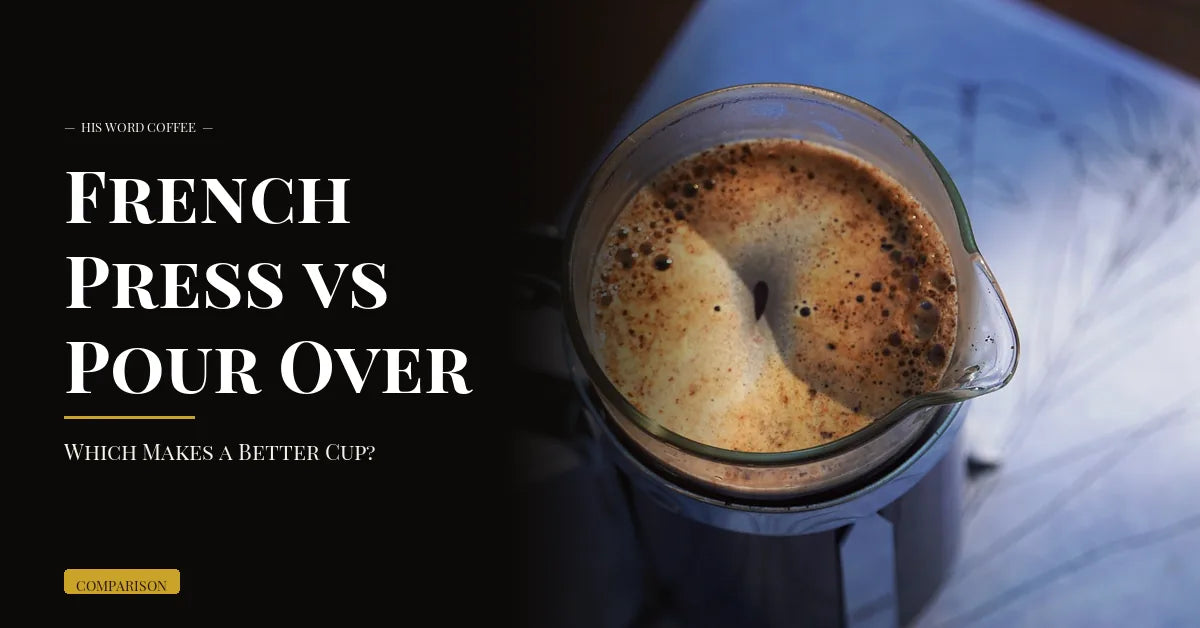
You want a better cup of coffee at home. You've heard about French press and pour over. Now you're asking the same question thousands of coffee drinkers ask every day: which one is actually better? The honest answer is that both methods can produce an outstanding cup. The difference lies in what you value most in your morning brew.
Key Takeaways

- French press produces a rich, full-bodied cup with heavier texture and more coffee oils in the final brew.
- Pour over delivers a cleaner, brighter cup with more clarity and nuanced flavor notes.
- French press uses a coarse grind and 4-minute immersion with minimal hands-on effort.
- Pour over uses a medium-fine grind and requires consistent pouring technique over 3 to 4 minutes.
- Both methods are affordable, with brewers starting around $20 to $40.
- The best choice depends on the flavors you enjoy and how much you like the ritual of brewing.
Table of Contents
- What Is French Press Coffee?
- What Is Pour Over Coffee?
- Flavor Profile: Full Body vs. Bright Clarity
- Grind Size for Each Method
- Brew Time and Effort
- Equipment and Cost
- Which Coffee Origins Shine in Each Method?
- Cleaning and Maintenance
- Head-to-Head Comparison Table
- The Verdict: Which Is Right for You?
- Frequently Asked Questions
What Is French Press Coffee?
The French press, also called a press pot or plunger pot, is one of the oldest and most recognized home brewing methods in the world. It works through full immersion: ground coffee steeps directly in hot water for several minutes, then a metal mesh plunger is pressed down to separate the grounds from the liquid. Because no paper filter is used, the coffee's natural oils and fine particles remain in the cup. The result is a brew with noticeably more body, a heavier texture, and a bold, round flavor. It is also one of the most forgiving methods for beginners because it does not demand precise pour control or specialty equipment beyond the press itself.
What Is Pour Over Coffee?

Pour over coffee is a manual brewing method where hot water is poured slowly and in stages over coffee grounds held in a paper (or cloth) filter inside a dripper. The water flows by gravity through the grounds and filter, dripping into a carafe or cup below. Popular pour over devices include the Hario V60, Chemex, Kalita Wave, and Clever Dripper. Because a paper filter traps most of the coffee's oils and fine sediment, the resulting cup is noticeably clearer and cleaner on the palate. Pour over is beloved by specialty coffee enthusiasts because it allows precise control over bloom, water temperature, and pour rate, making it easier to highlight the distinct flavors of a particular coffee's origin or roast.
Flavor Profile: Full Body vs. Bright Clarity
This is where the two methods diverge most meaningfully, and it comes down almost entirely to filtration.
French Press: Rich, Full-Bodied, and Textured
Because the metal mesh filter in a French press allows coffee oils and very fine particles to pass through, the resulting cup has a distinctive heaviness on the palate. Those oils are responsible for much of what coffee drinkers describe as "richness" or "roundness." You may also notice a slight sediment at the bottom of the cup, which is completely normal. The flavor tends to be bold and cohesive rather than nuanced. Notes that might be described as bright or floral in a pour over can taste more muted and integrated in a French press, which many people prefer. If you enjoy a cup that feels substantial and warming, French press delivers.
Pour Over: Clean, Bright, and Nuanced
The paper filter in pour over brewing removes most of the oils and all of the fine sediment, producing a cup that is visually clear and clean on the tongue. This clarity is not a lack of flavor but a different expression of it. Subtle fruity, floral, or acidic notes that might be masked by body in a French press become much more prominent in a pour over. Specialty roasters and coffee competitions often use pour over methods precisely because the clarity allows judges to evaluate a coffee's origin characteristics more accurately. If you enjoy complexity and like to taste the difference between a Kenyan and an Ethiopian coffee, pour over will reward that curiosity.
Neither profile is better in any absolute sense. Both are genuinely excellent. The question is simply which kind of cup you want to start your morning with.
Grind Size for Each Method
Grind size is one of the most important variables in any brewing method, and French press and pour over call for very different settings.
French Press: Coarse Grind
French press requires a coarse grind, roughly the texture of coarse sea salt or cracked black pepper. Because the grounds steep in water for the full brew time without a paper filter to catch fine particles, grinding too fine creates two problems: over-extraction (a bitter, harsh flavor) and excessive sediment in the cup. A coarse, even grind produces clean extraction and keeps the plunger pressing smoothly. If you find your French press difficult to press down or the cup tastes bitter, a coarser grind is usually the fix.
Pour Over: Medium-Fine Grind
Pour over typically calls for a medium-fine grind, somewhere like fine beach sand in texture. The exact setting varies by device: a Chemex usually needs a slightly coarser grind than a V60 because of its thicker filter. The goal is a flow rate that allows water to pass through the grounds in about 3 to 4 minutes total. If the water drains too quickly, the grind is too coarse and the cup will taste thin and underdeveloped. If it stalls and drains too slowly, the grind is too fine and the coffee will taste bitter.
For a detailed visual reference on grind settings for both methods and others, see our complete coffee grind size chart. We also have a dedicated pour over grind size guide if you want to go deeper on dial-in technique.
Brew Time and Effort
French Press: 4-Minute Immersion, Hands-Off
A standard French press brew follows a simple sequence: add coarse grounds, pour hot water just off the boil (around 200 degrees Fahrenheit or 93 degrees Celsius), stir gently, place the lid on without pressing, wait 4 minutes, then press and pour. The hands-on time is about 2 minutes. The 4-minute steep is largely passive. You do not need to watch it or adjust anything. This makes French press an excellent choice for mornings when you want a great cup without a demanding ritual. Once you have made it a few times, the routine becomes almost effortless.
Pour Over: 3 to 4 Minutes with Intentional Pouring
Pour over requires more active involvement. After blooming the grounds with a small amount of water for 30 to 45 seconds (to degas the coffee and promote even extraction), you pour the remaining water in slow, controlled circles over the next 3 to 4 minutes. The pace and pattern of your pouring directly affects the flavor. Consistent, even pours produce the best results. Many pour over enthusiasts use a gooseneck kettle for precise flow control, and a scale to measure both coffee and water. This is not complicated once you have practiced it, but it requires more attention than a French press. For many people, this ritual is exactly the point: a few quiet minutes of focused, intentional brewing is a good way to start the day.
Equipment and Cost
Both methods are among the most affordable ways to brew excellent coffee at home, which is one reason they are so popular.
French Press Costs
A solid glass French press runs $20 to $40 from brands like Bodum, which has been making them for decades. Stainless steel versions that retain heat better typically cost $30 to $60. You need no other equipment other than a kettle and a coffee grinder. A good burr grinder is recommended for both methods and represents the biggest investment you will make in either brewing setup, typically $50 to $150 for a quality entry-level model.
Pour Over Costs
A basic pour over dripper like a Hario V60 or a Kalita Wave costs $15 to $40. A Chemex, which is both brewer and carafe, runs $40 to $50. You will also need paper filters (inexpensive and available everywhere) and, ideally, a gooseneck kettle for controlled pouring. A basic gooseneck kettle costs around $25 to $35, while electric models with temperature control range from $40 to $80. The total setup cost is similar to or slightly higher than French press if you invest in a gooseneck kettle, but the kettle is optional to start.
Bottom line: neither method will cost you more than $50 to $80 to get started, including a basic grinder. Both are significantly less expensive than any automatic espresso machine capable of producing comparable quality.
Get brewing guides, single-origin profiles, and exclusive discounts delivered to your inbox.
Which Coffee Origins Shine in Each Method?
Not every coffee tastes its best in every brewing method. The characteristics of a coffee's origin, processing method, and roast level interact with the brewing method in ways that can either amplify or diminish what makes that coffee interesting. Understanding this helps you choose coffees that will perform well in whichever method you prefer.
Pour Over: Fruit-Forward and Floral Origins
Coffees with bright acidity, floral aromatics, and distinct fruit notes are showcased beautifully by pour over. The filter's clarity allows those flavors to come through without being weighted down by oils. Ethiopian coffees, which often carry notes of jasmine, bergamot, and blueberry, are frequently cited as ideal pour over candidates. Kenyan coffees, known for their bright, wine-like acidity and blackcurrant notes, are similarly well-suited. Washed (wet) process coffees, which tend to have cleaner, more defined flavors than natural or honey process coffees, generally thrive in pour over.
French Press: Smooth, Chocolatey, and Nutty Origins
Coffees with lower acidity and more chocolatey, nutty, or caramel-forward flavor profiles tend to be excellent in French press. The additional body and oils in the cup enhance the richness of these profiles without amplifying acidity to an uncomfortable level. Brazilian coffees, which are commonly described as having notes of dark chocolate, hazelnut, and brown sugar, are a classic French press pairing. Colombian coffees, with their balanced body and mild, sweet character, also work extremely well. Guatemalan coffees, which often show notes of bittersweet chocolate and stone fruit, are another strong choice for French press.
Our single-origin coffees include sourcing notes and tasting descriptions on every bag to help you match the coffee to your preferred brewing method.
Cleaning and Maintenance
French Press: More Parts, More Attention
After brewing, you need to discard the grounds (do not pour them down the drain, as they can clog pipes), rinse the carafe, and disassemble the plunger to clean the mesh filter. Coffee oils can build up on the mesh over time and cause a rancid flavor in subsequent brews if not washed thoroughly. A complete clean means taking apart the plunger assembly (lid, cross plate, filter screen, and spiral plate), washing each piece, and reassembling. Most French press parts are dishwasher-safe, which simplifies this. A full deep-clean every week or two keeps the press performing well. It is not burdensome, but it is more involved than pour over cleanup.
Pour Over: Simpler Daily Cleanup
Pour over cleanup is straightforward. Lift out the filter with the grounds inside and compost or discard it. Rinse the dripper with water. That is essentially the entire process. Residual oils are minimal because the paper filter absorbs them during brewing, so you do not need to scrub. The carafe or cup beneath the dripper may need a regular wash. If you use a Chemex, the carafe and filter holder are one piece and require a bit more attention, but it is still simpler than disassembling a French press plunger. For anyone who dislikes cleanup, pour over has a clear practical advantage.
Head-to-Head Comparison
| Category | French Press | Pour Over |
|---|---|---|
| Flavor Profile | Bold, rich, round, full-bodied | Clean, bright, nuanced, complex |
| Body / Mouthfeel | Heavy, thick, textured due to coffee oils | Light to medium, silky, clear |
| Flavor Clarity | Integrated; subtle notes can be muted | High clarity; origin notes shine |
| Grind Size | Coarse (sea salt texture) | Medium-fine (fine beach sand texture) |
| Brew Time | 4 minutes immersion | 3 to 4 minutes active pouring |
| Effort Required | Low once learned; mostly passive | Moderate; consistent technique matters |
| Cleanup | More involved; disassemble plunger | Simple; discard filter and rinse |
| Equipment Cost | $20 to $40 for brewer | $15 to $50 for brewer; gooseneck kettle optional |
| Best Coffee Origins | Brazil, Colombia, Guatemala | Ethiopia, Kenya, washed process coffees |
| Coffee Oils in Cup | Yes (no paper filter) | No (paper filter removes oils) |
The Verdict: Which Is Right for You?
There is no universally correct answer to the French press vs. pour over question, and any source that tells you one is simply better than the other is oversimplifying things. Both methods, done well, produce excellent coffee. The decision comes down to your preferences and your morning habits.
Choose French press if: You love a rich, full-bodied cup. You want simplicity and reliability in your routine. You do not want to stand over your brewer monitoring pour technique. You enjoy coffees from Brazil, Colombia, or Guatemala, which shine in immersion brewing. You prefer not to spend money on a gooseneck kettle.
Choose pour over if: You love brightness, clarity, and the ability to taste origin character in your cup. You enjoy a hands-on brewing ritual that rewards attention and consistency. You like Ethiopian or Kenyan coffees and want their floral, fruity notes to come through clearly. You prefer simpler cleanup. You enjoy the craft of brewing as part of the experience.
It is also worth saying that many coffee drinkers own both. A French press for busy weekday mornings and a V60 for weekend brewing when there is time to slow down is a common and sensible approach. Starting with whichever sounds more appealing to you right now is perfectly fine. The best brewing method is the one that gets you a good cup consistently, in a way that fits how you actually live in the morning.
Whatever method you choose, start with quality coffee. The brewing method matters, but the beans matter more. Explore our full coffee collection and our single-origin coffees to find a bag suited to your preferred method and flavor style.
For additional guidance from the specialty coffee community, the Specialty Coffee Association's brewing protocols provide science-backed standards for both immersion and percolation brewing methods.
Find Your Perfect Coffee Match
Whether you brew French press or pour over, it starts with great beans. Explore our single-origin selections and small-batch roasts, all sourced and roasted with care.
Shop All Coffees Single-Origin CoffeesFrequently Asked Questions
Is French press or pour over better for beginners?
French press is generally more beginner-friendly because the technique is simpler. You add grounds, pour hot water, wait 4 minutes, and press. Pour over requires more practice to develop a consistent pour, but it is not difficult to learn and many beginners pick it up quickly with a few tries.
Which method makes stronger coffee, French press or pour over?
French press often tastes stronger because the higher concentration of oils and dissolved solids gives the cup a heavier, bolder character. However, both methods can be adjusted by changing the coffee-to-water ratio. A standard ratio of 1:15 (1 gram of coffee per 15 grams of water) works for both, and you can go stronger or weaker from there.
Can I use the same coffee beans for both French press and pour over?
Yes, you can use any coffee in either method, but the results will differ. Some coffees will taste better in one method than the other based on their origin, roast level, and processing. Bright, fruity coffees tend to shine in pour over, while chocolatey, lower-acid coffees often perform better in French press. Trying the same coffee in both methods is a great way to understand how brewing affects flavor.
Do I need an expensive grinder for French press or pour over?
A burr grinder is strongly recommended for both methods because it produces a consistent grind size, which directly affects extraction quality. You do not need an expensive model to start. A hand burr grinder in the $30 to $50 range produces results that are noticeably better than a blade grinder for either French press or pour over. Electric burr grinders in the $60 to $100 range are a good step up for daily use.
Which method has less sediment in the cup?
Pour over produces virtually no sediment because the paper filter captures all fine particles and grounds before they reach the cup. French press will always have some sediment because only a metal mesh filter is used. Letting the French press sit for 30 to 60 seconds after pressing before pouring allows sediment to settle further, reducing how much ends up in your cup.
Is pour over vs French press taste really that different?
Yes, the taste difference is meaningful and easy to notice once you have tried both with the same coffee. French press tastes fuller, richer, and heavier on the tongue. Pour over tastes cleaner, brighter, and more precise. Both are genuinely enjoyable. Most people have a preference once they try both, and that preference is personal rather than one being objectively superior.
What water temperature should I use for French press and pour over?
Both methods generally work best with water that is just off the boil, around 195 to 205 degrees Fahrenheit (90 to 96 degrees Celsius). If you do not have a thermometer, let boiling water rest for about 30 seconds before pouring. Water that is too cool will under-extract the coffee, producing a flat or sour cup. For very dark roasts, slightly cooler water (around 190 to 195 degrees) can help reduce bitterness in either method.
Sources: Specialty Coffee Association, Brewing Best PracticesExplore More.

Leave a comment
This site is protected by hCaptcha and the hCaptcha Privacy Policy and Terms of Service apply.