
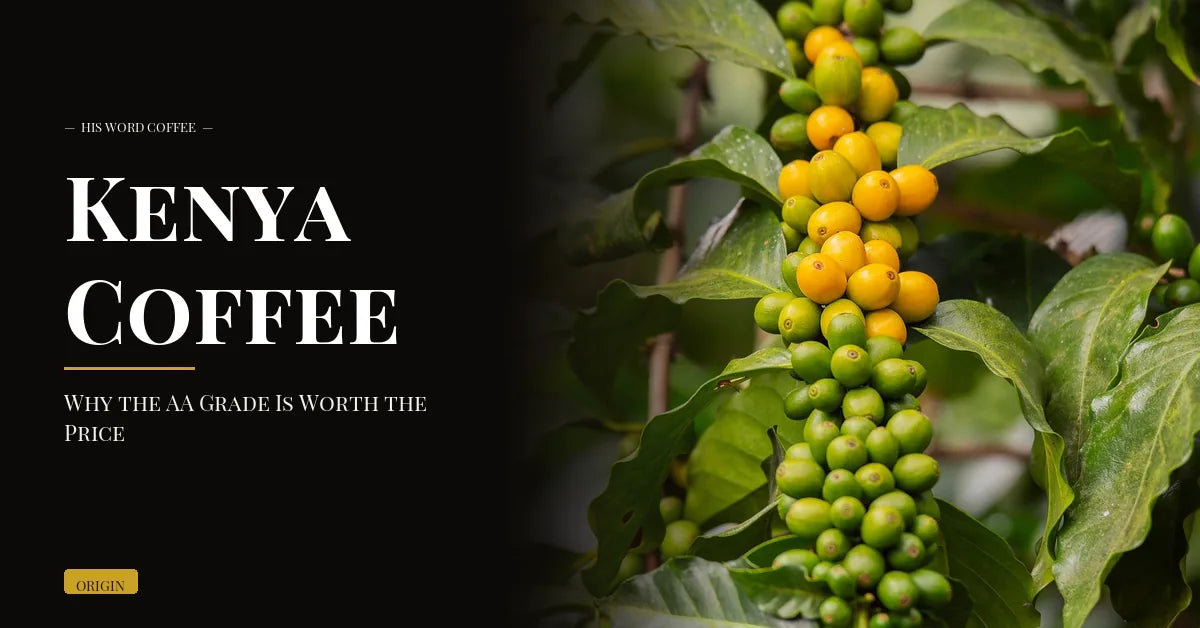
Kenya produces some of the most distinctive, sought-after coffee in the world. The bright, winey acidity, the explosive blackcurrant character, the juicy body that coats your palate, these are not accidental. They are the product of altitude, volcanic soil, meticulous processing, and two extraordinary varietals that no other country can replicate quite the same way. Kenya AA is the flagship grade, and if you have wondered whether the premium price is justified, this guide will answer that definitively.
Key Takeaways
- Kenya AA refers to screen size 18+, the largest bean grade, which generally correlates with well-developed, complex flavor.
- SL28 and SL34 are the two varietals responsible for Kenya's famous blackcurrant and wine-like acidity.
- Kenyan coffee is almost exclusively washed/wet processed, using a distinctive double-wash method that produces exceptional clarity.
- The Nairobi Coffee Exchange auction system helps trace specific estates and maintain quality standards for buyers worldwide.
- Key growing regions include Nyeri, Kirinyaga, Murang'a, Kiambu, and Embu, each with distinct elevation and microclimate characteristics.
- Kenya coffee is ideal for pour-over brewing; it rewards high-quality water and precise temperature control.
In This Guide
- Why Kenya Coffee Has Such a Strong Reputation
- The Nairobi Coffee Exchange: How Kenya's Auction Works
- Growing Regions of Kenya
- Double-Washed Processing: The Secret Behind the Clarity
- SL28, SL34, and Kenya's Key Coffee Varietals
- Kenya Coffee Flavor Profile: What to Expect in the Cup
- Kenya's Grading System: AA, AB, PB, and Beyond
- Who Kenya Coffee Is For
- Best Brewing Methods for Kenya Coffee
- Frequently Asked Questions
Why Kenya Coffee Has Such a Strong Reputation
Ask any specialty coffee (the SCA's standards) buyer or roaster to name the origins they get most excited about, and Kenya will appear on nearly every list. That reputation is not marketing. It is the result of a specific intersection of geography, genetics, and technique that produces a flavor experience unlike any other origin in the world.
Kenyan coffee grows at elevations between 1,400 and 2,000 meters, primarily on the slopes of Mount Kenya and the Aberdare mountain range in the central part of the country. At these elevations, cooler temperatures slow the development of the coffee cherry, allowing sugars and acids to concentrate over a longer maturation period. The volcanic red soils, rich in minerals and with excellent drainage, contribute further to the complexity that ends up in your cup.
The flavor descriptors that specialty roasters reach for when writing tasting notes for Kenyan coffees are unlike almost any other origin: blackcurrant, ribena, cranberry, tomato, grapefruit, red wine, dried fruit. The acidity is described as bright, wine-like, or winey, and it is intense in a way that is polarizing. People who love Kenyan coffee absolutely love it. People who prefer smooth, low-acid, mild coffee find it overwhelming. There is very little middle ground, and that is actually part of what makes Kenya so valuable to the specialty market.
The combination of altitude, varietal, processing, and soil composition creates a cup that is simultaneously fruit-forward, complex, and structured, with a juicy mouthfeel that is almost viscous. At its best, a cup of Kenya AA from Nyeri is one of the most memorable coffee experiences available anywhere.
The Nairobi Coffee Exchange: How Kenya's Auction Works
One of the features that makes Kenya's coffee supply chain distinctive is its centralized auction system. Unlike many producing countries where exporters negotiate directly with farmers or cooperatives, Kenya historically has required most specialty coffee to pass through the Nairobi Coffee Exchange (NCE), a weekly auction that has been operating since colonial times.
Here is how the system generally works. Cooperatives (known as factories in Kenya) and private estates process their coffee, then deliver it to licensed marketing agents. Those agents present the lots at the weekly NCE auction in Nairobi, where licensed buyers, including exporters who then sell to international roasters, bid on individual lots. Each lot is identified by factory, region, and grade, which means buyers can trace specific purchases back to their cooperative of origin.
For specialty buyers, this traceability is enormously valuable. A buyer can identify that a particular Nyeri cooperative consistently produces exceptional lots, follow that factory over several seasons, and build a relationship that eventually leads to direct trade arrangements. The auction creates a transparent price-discovery mechanism and a documented chain of custody that supports specialty coffee sourcing.
The system has also been credited with maintaining Kenya's quality standards. Because lots are graded and sold publicly, with prices visible to all participants, there is a structural incentive to produce high-quality, well-graded coffee. Defective or poorly processed lots fetch dramatically lower prices, which creates accountability up the supply chain.
Growing Regions of Kenya
Kenya's coffee belt is concentrated in the central highlands, with a few outlying areas also producing notable lots. Each region has distinct elevation ranges, microclimate characteristics, and cooperative structures that influence the final cup profile.
Nyeri
Widely considered Kenya's premier coffee region. Located on the southern slopes of Mount Kenya, Nyeri produces the most intense blackcurrant and winey acidity. Elevation: 1,500-2,200m. Home to famous cooperatives like Tegu, Othaya, and Gura.
Kirinyaga
Also on Mount Kenya's slopes, adjacent to Nyeri. Produces similarly complex, fruit-forward profiles with excellent body and brightness. Cooperatives here, such as Karinga and Kiangoi, are frequently featured by specialty roasters worldwide.
Murang'a
Slightly lower elevation than Nyeri and Kirinyaga, but still produces excellent washed coffees. Flavor profiles tend toward fruit sweetness and bright citrus with slightly softer acidity than northern Nyeri lots.
Kiambu
Located northwest of Nairobi, at the southern edge of Kenya's coffee belt. Some of Kenya's oldest estates are here. Profiles vary from classical Kenyan brightness to more rounded, accessible cups depending on the farm and processing.
Embu
On the eastern and southeastern slopes of Mount Kenya. Produces coffees with good body and fruit complexity, though sometimes with slightly different flavor emphasis than Nyeri. An emerging region for specialty buyers seeking alternatives to high-demand Nyeri lots.
Nakuru / Rift Valley
A smaller production area compared to the central highland regions, with good elevation and volcanic soils. Coffees from this area can show floral and citrus character alongside the classic Kenyan fruit notes.
Within the specialty community, Nyeri is often treated as the benchmark for Kenyan coffee quality, and lots from top Nyeri cooperatives command some of the highest auction prices the NCE records. Kirinyaga is a close second in terms of prestige and demand from specialty roasters internationally.
Double-Washed Processing: The Secret Behind the Clarity
Kenya produces almost exclusively washed, or wet-processed, coffee. The washed process removes the cherry fruit from the seed (the coffee bean) using water and fermentation before drying, which produces the clean, bright, transparent flavor clarity that defines Kenyan coffee's cup profile.
But Kenya goes a step further than standard washed processing. Kenyan cooperatives practice what is known as double-washed processing, sometimes called the Kenya method. Here is how it works in its traditional form.
After harvesting, ripe cherries are pulped to remove the outer skin. The beans, still covered in their sticky mucilage layer, are placed in fermentation tanks filled with water for the first fermentation period, typically 12 to 24 hours. After this initial fermentation, the beans are rinsed, then transferred to a second set of tanks or channels for a second fermentation, again submerged in clean water. After the second fermentation, the beans are rinsed again thoroughly, then moved to raised drying beds where they dry in the sun for several weeks, with workers turning them regularly to ensure even drying.
This two-stage fermentation and double-rinse process strips the mucilage more completely than single-stage washed processing and produces a cup with remarkable clarity, brightness, and definition. The fruit-forward flavors in Kenyan coffee come not from residual fruit on the bean (as in natural or honey processed coffees) but from the bean itself, the varietal genetics, and the mineral-rich environment in which it was grown. The processing method acts as a lens that focuses those intrinsic flavors without muddying them.
The result is a cup that is clean, vibrant, and precise, where individual flavor notes like blackcurrant or grapefruit come through with exceptional clarity rather than being blended into a more generalized "fruit" impression.
SL28, SL34, and Kenya's Key Coffee Varietals
To understand why Kenyan coffee tastes the way it does, you need to understand SL28 and SL34. These two varietals, developed by Scott Agricultural Laboratories in colonial Kenya during the 1930s, are responsible for the flavor profile that made Kenya famous in the specialty coffee world.
SL28
The most celebrated Kenya varietal. Selected from a drought-resistant landrace, SL28 produces the signature blackcurrant and ribena character. It thrives at high elevations and volcanic soils. Susceptible to coffee leaf rust, but prized for its extraordinary cup quality. When people talk about "classic Kenya flavor," they mean SL28.
SL34
Selected for high-rainfall adaptability. Produces similar blackcurrant and citrus character to SL28, often with slightly fuller body and more tart acidity. Many of Kenya's finest lots are blends of SL28 and SL34 from the same cooperative, creating balanced complexity.
K7
An older selection with decent cup quality and some disease resistance. Less widespread than SL28/34, but found in some farms and cooperatives, particularly at lower elevations. Produces more modest flavor intensity but still pleasant Kenyan character.
Ruiru 11
Developed in the 1980s for disease resistance, specifically against coffee berry disease and leaf rust. Cup quality is considered good but not exceptional compared to SL28. It has been widely adopted in Kenya because it protects farmers from crop losses that devastate SL28 plantings.
Batian
A newer disease-resistant varietal released in 2010, developed to combine the disease resistance of Ruiru 11 with better cup quality. Named after one of Mount Kenya's peaks. Considered a significant improvement over Ruiru 11 in terms of flavor, and adoption is growing among Kenyan farmers.
The story of SL28 and SL34 is one of the great unintentional discoveries in coffee history. Scott Laboratories selected these varietals primarily for agricultural traits: drought resistance, high yields, and adaptability to Kenyan growing conditions. The extraordinary flavor was not the primary selection criterion. Yet these varietals turned out to carry genetics that produce the most recognizable and sought-after flavor profile in all of specialty coffee.
SL28 in particular is now recognized globally as one of the most important heirloom varietals in Arabica coffee. Coffee researchers and producers in other countries have attempted to grow SL28 outside Kenya, and while some success has been found in Rwanda, Colombia, and other origins, nothing quite replicates what SL28 produces in its native Kenyan highland environment. The combination of varietal genetics, elevation, soil, and processing is irreplaceable.
Kenya Coffee Flavor Profile: What to Expect in the Cup
If you are new to Kenyan coffee, the flavor experience may be unlike anything you have had before. Here is what to expect from a well-sourced, freshly roasted Kenya AA.
Aroma: Even dry, Kenyan coffee grounds are striking. Expect complex, fruit-forward aromas: blackcurrant, dark berry, sometimes stone fruit, and a pleasant vinous quality that hints at what is coming in the cup.
Acidity: Bright, wine-like, and pronounced. Kenya's acidity is not the thin, sharp tartness of an underdeveloped coffee. It is complex, round, and present throughout the sip. This is the defining characteristic that separates Kenya from nearly every other origin, and it is intentional. If you have not experienced it before, it can be surprising. If you love it, it is addictive.
Primary flavor notes: Blackcurrant, cranberry, red currant, and ribena (blackcurrant cordial) are the most common descriptors for SL28 and SL34-dominant lots. These are accompanied by citrus notes ranging from grapefruit to blood orange, and sometimes a tomato-like savory sweetness that adds complexity.
Secondary notes: Wine, dried fruit, tamarind, dark chocolate at medium roast levels. At lighter roast levels, the fruit brightness increases and floral notes may emerge.
Body: Surprisingly full and juicy. Despite the brightness and acidity, Kenyan coffee has a substantial, coating mouthfeel, described as juicy or viscous. It is not a thin, delicate cup.
A note on fermented character: Some Kenya lots exhibit a "fermented" complexity, which in the specialty coffee context is not a defect. A controlled fermented note in Kenyan coffee is similar to the complexity in a natural wine, where the fermentation process during cherry processing adds layers of complexity. This is very different from the sour, unpleasant ferment of poorly processed or defective coffee. In a quality Kenya AA, any fermented character is pleasant, complex, and integrated.

Finish: Long and clean, often with lingering fruit sweetness and a pleasant drying quality from the bright acidity.
Kenya's Grading System: AA, AB, PB, and Beyond
Kenya grades its coffee primarily by screen size, meaning the physical size of the bean measured by the diameter of holes in a grading screen. This is an important nuance: Kenya AA is a grade defined by bean size, not by cupping score or quality assessment. The grading system does not directly measure flavor quality, but there is a meaningful correlation between bean size and cup quality in Kenyan coffee.
| Grade | Screen Size | Description | Typical Cup Character |
|---|---|---|---|
| AA | 18+ (7.22mm+) | Largest beans; premium grade; highest auction prices | Full-bodied, complex, intense fruit and acidity |
| AB | 15-16 (5.97-6.35mm) | Combined A and B screens; very common specialty grade | Excellent quality, similar to AA; often overlooked by buyers |
| PB (Peaberry) | Peaberry only | Single bean per cherry (vs. standard two flat-sided beans) | Concentrated, intense flavor; loyal following in specialty market |
| C | 14 (5.56mm) | Smaller beans; lower price point | Good but less complex; suitable for blends |
| T (Triage) | Mixed/small | Lowest quality; often defects removed from higher grades | Used in commodity or local market coffees |
| E (Elephant) | Very large, 20+ | Exceptionally large beans; rare; sometimes called "elephant beans" | Can be outstanding but uncommon; collector interest |
Why does bean size correlate with cup quality? Larger beans, having developed more fully on the plant, have typically undergone a longer maturation period, which allows more sugars and complex organic acids to develop within the seed. Smaller beans from the same cherry may be less developed. This is not a universal rule, and exceptional AB and PB lots exist that rival or exceed AA lots from the same cooperative. But as a general heuristic, AA grade from top Kenyan cooperatives represents the most consistent premium cup experience.
Kenya AB is worth special mention. It is frequently undervalued relative to AA, and experienced specialty buyers often find Kenya AB from top estates to be excellent value. The price differential between AA and AB can be significant, but the cup quality difference is often subtle. If you want to explore Kenyan coffee without paying a full AA premium, AB is an excellent entry point.
Peaberry (PB) is its own category. A peaberry forms when only one seed develops inside a coffee cherry instead of the usual two. The single seed is oval-shaped rather than flat on one side, and the theory is that without sharing space with a second bean, the peaberry receives all of the cherry's nutrients and develops more concentrated flavor. Kenya PB has devoted enthusiasts in the specialty market, and its concentrated, intense cup profile is distinctive even compared to AA from the same farm.
Get Single-Origin Updates First
Kenya Highlands Reserve and other rotating single-origin coffees sell out fast. Join our list to hear when they arrive and get brewing guides delivered to your inbox.
Who Kenya Coffee Is For
Kenyan coffee is not for everyone, and that is actually what makes it special. It is unapologetically bold, bright, and complex. Understanding whether it fits your palate helps you decide whether to invest in it.
Kenya coffee is ideal for you if:
- You enjoy bright, acidic coffees with complex fruit character
- You love wine, especially old-world red wines with earthy and tart berry notes
- You find most coffees too mild or one-dimensional and want something that demands attention
- You brew pour-over and want to explore the limits of what a single-origin coffee can express
- You are curious about how terroir, varietal, and processing interact to create flavor
Kenya coffee may not be for you if:
- You strongly prefer smooth, low-acid, mild coffee
- You drink coffee primarily with milk and sugar (though Kenya can work in milk drinks at medium roast)
- You find brightness or acidity in coffee uncomfortable or unpleasant
- You are looking for a background, unobtrusive cup rather than an engaging drinking experience
The honest answer for coffee drinkers who are not sure: try it. Kenya AA is one of those origins where reading about it does not prepare you for actually tasting it. Order a small bag, brew it as a pour-over at a lighter to medium roast, and see how you respond. Many people who thought they preferred smooth, low-acid coffee discover with Kenya that what they were missing was complexity rather than mildness.
Best Brewing Methods for Kenya Coffee
Kenya's clean, precise, complex cup profile is best showcased by brewing methods that allow transparency and clarity to come through. Here are the best approaches.
Pour-Over (V60, Chemex, Kalita Wave)
This is the optimal brewing method for Kenya AA. Pour-over highlights the clarity and brightness of the washed processing, allows the blackcurrant and citrus notes to express fully, and produces the vibrant, clean cup that Kenya's double-washed method is designed to deliver. Use water at 93-96 degrees Celsius (199-205F), a medium-light to medium grind, and a total brew time of 3 to 4 minutes. The Chemex in particular complements Kenya's full body well due to its thicker filter, which reduces fine particle passage.
Drip Coffee Maker
A quality drip machine with temperature control works well for Kenya coffee, especially for daily brewing when the full pour-over ritual is not practical. Aim for a drip machine that reaches at least 93 degrees Celsius. The result will not have quite the same clarity as a hand-poured V60, but the fruit character and bright acidity of Kenya will still be evident and enjoyable.
Espresso
Kenya as an espresso is for adventurous palates. At medium roast, a Kenya espresso is intensely complex, with concentrated fruit character and bright acidity that creates a distinctive, almost wine-like shot. It is not a conventional espresso experience, and it is polarizing, but roasters and baristas who love Kenyan espresso are devoted. A longer ratio (1:2.5 to 1:3) helps tame the intensity and allow the complexity to bloom. In milk drinks, the fruit brightness of Kenya cuts through nicely and creates a nuanced latte or flat white.
cold brew
Standard cold brew is not the ideal preparation for washed Kenya, as the long, cold immersion tends to mute the bright acidity and clarity that makes Kenya special. However, a flash-chilled Kyoto-style slow drip cold brew, or a Japanese iced pour-over (hot brew directly over ice), preserves the fruit brightness and can produce an exceptional iced coffee from a quality Kenya AA.
Grind and Water
Grind size has a significant impact on Kenya's flavor expression. A slightly coarser grind for pour-over helps avoid over-extraction, which can emphasize astringency over fruit brightness. For specific grind guidance by method, see our complete coffee grind size chart.
Water quality is particularly important with Kenyan coffee. The bright acidity and clean flavor profile are transparent enough that hard or mineral-heavy water will noticeably dull the cup. Use filtered water with moderate, balanced mineral content for best results.
Roast Level
Kenya coffee is most commonly roasted light to medium by specialty roasters. Lighter roasts preserve the intense blackcurrant and citrus character and maximize the brightness. Medium roasts add some chocolate and caramel development while softening the acidity slightly, producing a more accessible profile without losing Kenya's essential character. Dark roasts are generally avoided in specialty circles because they mask the varietal and processing nuances that make Kenya worth the premium price.
Frequently Asked Questions
What does Kenya AA coffee taste like?
Kenya AA coffee is famous for its intense blackcurrant and berry character, bright wine-like acidity, and juicy, full body. You can expect notes of blackcurrant, cranberry, grapefruit, and sometimes tomato or dried fruit, with a clean, long finish. The flavor is distinctive and complex, unlike most other coffee origins.
Is Kenya AA higher quality than Kenya AB?
Kenya AA denotes a larger screen size (18+) than AB (15-16), and larger beans generally correlate with more developed flavor. However, AA is not a quality grade, it is a size grade. Excellent Kenya AB lots from top cooperatives can rival or match Kenya AA in cup quality, and AB is often better value. Both are worth exploring in specialty coffee.
Why is Kenyan coffee so expensive?
Several factors contribute to Kenya's premium price: the centralized auction system creates competitive bidding on top lots; SL28 and SL34 varietals are lower-yielding than disease-resistant varieties; the double-washed processing is labor-intensive; and demand from specialty buyers worldwide consistently outpaces supply of the best lots. The price reflects genuine scarcity and quality.
What are SL28 and SL34 coffee varietals?
SL28 and SL34 are Arabica coffee varietals developed by Scott Agricultural Laboratories in Kenya during the 1930s. Originally selected for drought resistance and high yields, they turned out to produce extraordinary cup quality, specifically the blackcurrant, berry, and wine-like acidity that Kenyan coffee is known for globally. SL28 in particular is considered one of the most important heirloom coffee varietals in the world.
What is the best way to brew Kenya coffee?
Pour-over methods, specifically V60, Chemex, or Kalita Wave, are the best way to brew Kenya coffee. They highlight the clean, transparent flavor clarity that Kenya's double-washed processing produces and allow the fruit notes and bright acidity to express fully. Use water at 93-96 degrees Celsius and a medium to medium-light grind. Drip coffee also works well.
What is a Kenya peaberry coffee?
A peaberry (grade PB) is a coffee bean that formed as the only seed inside its cherry, rather than the usual two flat-sided beans. Without sharing space, the single bean develops into an oval shape and, theoretically, concentrates more of the cherry's nutrients. Kenya peaberry has an intense, concentrated flavor profile and has a devoted following in the specialty coffee market.
Is Kenya coffee good for espresso?
Kenya coffee can be excellent as espresso at medium roast, but it is an unconventional choice. The concentrated fruit and bright acidity produce a complex, wine-like shot that is distinctive and polarizing. It works particularly well in milk drinks like flat whites and lattes, where the fruit brightness cuts through cream nicely. Use a slightly longer extraction ratio to balance the intensity.
Which regions of Kenya produce the best coffee?
Nyeri and Kirinyaga, both on the slopes of Mount Kenya, are widely considered to produce the finest Kenyan coffee. Nyeri in particular is the benchmark region, with cooperatives like Tegu, Othaya, and Gura consistently producing top-scoring lots at the Nairobi Coffee Exchange auction. Murang'a, Kiambu, and Embu also produce excellent specialty coffee.
Ready to Experience Kenya for Yourself?
Browse our current single-origin offerings and see if Kenya Highlands Reserve is available. Every bag is freshly roasted and shipped within days of roasting.
Shop Single-Origin Browse All CoffeesSources: Fair Trade Certified, How It Works. Specialty Coffee Association, Brewing Best PracticesExplore More.



Leave a comment
This site is protected by hCaptcha and the hCaptcha Privacy Policy and Terms of Service apply.