
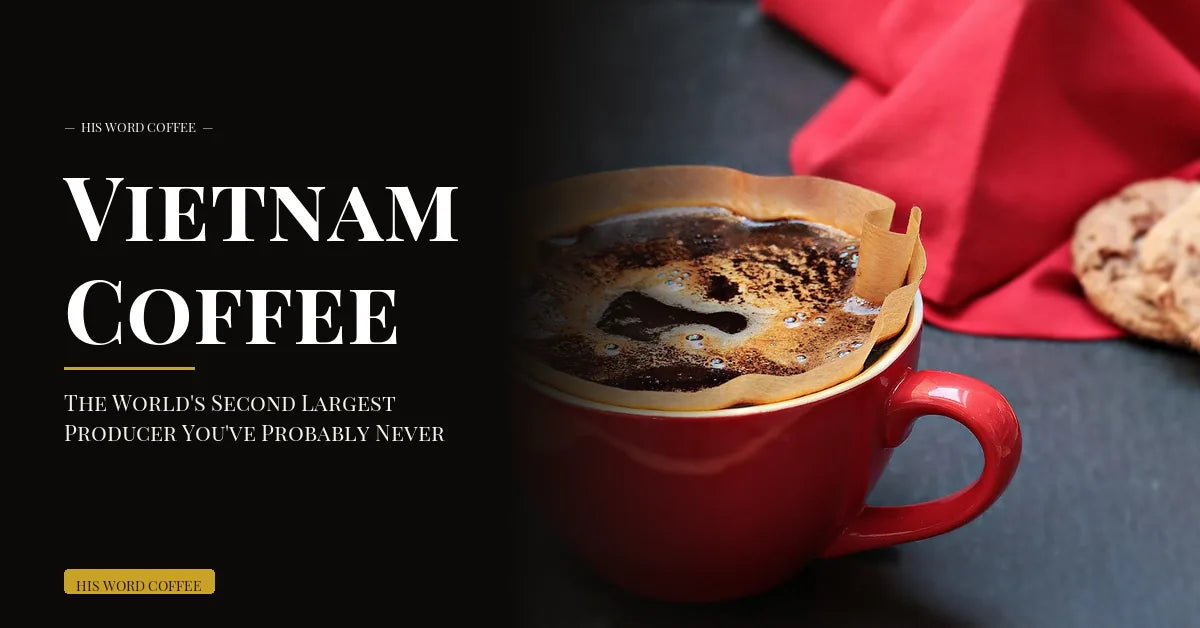
Vietnam produces roughly 30 million bags of coffee every year, making it the world's second largest coffee-producing nation after Brazil. Yet most specialty coffee drinkers in the United States have never tasted Vietnamese coffee in its traditional form. Here is why that gap exists, and what you are missing.
Key Takeaways
- Vietnam is the world's second largest coffee producer, behind only Brazil.
- Vietnamese coffee is almost entirely robusta, not arabica, which sets it apart from most specialty coffee.
- The iconic Vietnamese drink is ca phe sua da: strong robusta drip coffee over ice with sweetened condensed milk.
- A small but growing specialty arabica scene exists in Vietnam's Dalat highlands.
- Vietnamese coffee offers a completely different flavor tradition: bold, bitter, low-acid, and intensely caffeinated.
In This Article
- Vietnam as a Coffee Producer
- A Brief History of Vietnamese Coffee
- Robusta vs. Arabica: The Core Difference
- The Flavor Profile of Vietnamese Robusta
- The Vietnamese Coffee Experience
- Is Vietnamese Coffee Specialty Coffee?
- Vietnamese Instant Coffee
- Who Would Enjoy Vietnamese Coffee?
- HWC and Vietnam
- Frequently Asked Questions
Vietnam as a Coffee Producer
When most coffee lovers think about major producing countries, Brazil, Colombia, and Ethiopia come to mind quickly. Vietnam rarely does. That blind spot is worth correcting.
According to the International Coffee Organization, Vietnam consistently produces around 28 to 32 million 60-kilogram bags of coffee per year. That volume places it in a clear second position globally, well ahead of Colombia and Indonesia. The country's coffee industry employs roughly 2.6 million people and is central to its agricultural economy.
The vast majority of this production comes from the Central Highlands region, particularly the provinces surrounding Buon Ma Thuot, the city widely considered the coffee capital of Vietnam. Coffee is not a niche crop here. It is a cornerstone of national agricultural identity.
A Brief History of Vietnamese Coffee
Coffee arrived in Vietnam in 1857, introduced by French missionaries and later expanded under French colonial administration. The French recognized that Vietnam's Central Highlands offered favorable growing conditions for coffee and began establishing plantations in the late 19th century.
The region of Dalat, located at higher altitude in Lam Dong Province, became associated with arabica cultivation. The lower-altitude Central Highlands provinces were better suited for robusta, which is hardier, more disease-resistant, and more productive at those elevations.
After Vietnamese independence and the subsequent wars of the 20th century, coffee production contracted significantly. The reunification of Vietnam in 1975 and the economic reform program known as Doi Moi in 1986 changed the trajectory dramatically. The Vietnamese government invested heavily in agricultural development, and coffee became a national export priority. Between 1990 and 2000, Vietnam's coffee production grew from approximately 1.5 million bags per year to over 15 million. That expansion was almost entirely in robusta.
Today, Vietnam controls roughly 40 percent of the global robusta supply. When you drink an espresso blend, a canned coffee drink, or instant coffee anywhere in the world, there is a meaningful chance Vietnamese robusta is part of it, even if it is not labeled as such.
Robusta vs. Arabica: The Core Difference
Understanding Vietnamese coffee requires understanding the fundamental difference between the two dominant coffee species.
| Characteristic | Arabica (Coffea arabica) | Robusta (Coffea canephora) |
|---|---|---|
| Caffeine content | Approx. 1.2-1.5% | Approx. 2.2-2.7% (roughly 2x) |
| Flavor profile | Fruity, floral, complex, higher acidity | Bold, bitter, earthy, low acidity |
| Growing altitude | Typically 600-2,200 meters | Typically 0-800 meters |
| Disease resistance | Susceptible to leaf rust and pests | Highly resistant |
| Production yield | Lower | Higher |
| Specialty coffee status | Dominant in specialty (SCA graded) | Rarely rated as specialty grade |
| Primary uses | Single origin, pour over, filter | Espresso blends, instant coffee |
The Specialty Coffee Association (SCA) defines specialty coffee primarily through arabica quality standards, using an 80-point scoring threshold. Robusta has traditionally sat outside this framework. The physical and chemical differences between the two species are significant enough that they serve quite different functions in the global coffee market.
Vietnam's near-total dominance by robusta is not an accident or a quality failure. It is the result of rational agricultural economics meeting a favorable growing environment. Robusta thrives at the altitudes and temperatures of Vietnam's Central Highlands in a way that arabica simply does not, and the global demand for robusta, driven by espresso blending and instant coffee manufacturing, is enormous.
Robusta contains roughly twice the caffeine of arabica. This is one reason Vietnamese coffee feels so dramatically strong, especially when brewed through the traditional phin drip method.
The Flavor Profile of Vietnamese Robusta
If you approach Vietnamese robusta expecting the fruit-forward brightness of an Ethiopian natural or the clean caramel sweetness of a washed Colombian, you will be disoriented. Vietnamese robusta operates in a completely different register.
The flavor profile is typically characterized by:
- Heavy body: Vietnamese robusta is thick and coating, especially when brewed concentrated through a phin filter. There is no lightness here.
- Intense bitterness: This is not the sharp, burnt bitterness of an over-extracted espresso. It is a deep, sustained bitterness that reads as richness when the coffee is prepared correctly with condensed milk.
- Low acidity: Unlike most arabica origins, Vietnamese robusta has almost no perceptible brightness or acidity. The cup is flat in the acidity dimension, which some drinkers find more approachable and others find dull.
- Earthy and chocolatey notes: Common descriptors include dark chocolate, earth, wood, and occasionally a rubbery or grain-like quality that is characteristic of robusta. These are not defect notes when they appear in robusta. They are the expected expression of the species.
This flavor profile is why Vietnamese coffee is almost always consumed with sweetened condensed milk. The bitterness and the sweetness of the condensed milk create a balance that is genuinely delicious and which you cannot replicate by adding regular milk or sugar to a light arabica. The robusta bitterness stands up to, and even demands, that sweetness.
The Vietnamese Coffee Experience
Vietnamese coffee culture has produced several iconic preparations that are worth understanding on their own terms rather than as curiosities.
Iced Coffee with Condensed Milk
Ca phe sua daThe classic Vietnamese coffee drink. Strong robusta is brewed through a small metal phin filter directly over a glass of sweetened condensed milk, then poured over ice. Bold, sweet, cold, and intensely caffeinated. This is the drink most people encounter first when exploring Vietnamese coffee.
Hot Coffee with Condensed Milk
Ca phe sua nongThe same preparation as ca phe sua da but served hot. The condensed milk settles at the bottom of the glass and is stirred in before drinking. Intensely sweet and strong, it is the everyday drink of millions of Vietnamese people every morning.
Egg Coffee
Ca phe trungA Hanoi specialty invented at the Giang Cafe in the 1940s. Whipped egg yolks are beaten with sugar and condensed milk into a thick, meringue-like foam, then spooned over strong brewed coffee. The result is somewhere between a dessert and a beverage. Rich, custardy, and unlike anything in Western coffee culture.
The Phin Filter
Central to traditional Vietnamese coffee preparation is the phin, a small metal drip filter that sits directly on top of a glass or cup. Ground coffee is placed in the filter chamber, a perforated gravity press is set on top of the grounds, and hot water is poured in. The water drips slowly through the grounds over three to five minutes, producing a small volume of concentrated, intensely flavored coffee.
The phin is inexpensive, portable, and requires no electricity or paper filters. It produces a cup that is closer in concentration to espresso than to American drip coffee, which is why condensed milk is such a natural pairing. The device has not changed meaningfully in generations, which speaks to how well-suited it is for the robusta it brews.
Is Vietnamese Coffee Specialty Coffee?
In the strict SCA arabica-graded sense, Vietnamese robusta is generally not classified as specialty coffee. The scoring protocols for specialty coffee were built around arabica, and robusta's flavor characteristics place it outside that framework by default.
However, a meaningful and growing exception exists. Vietnam's Dalat region, situated at higher altitudes than the broader Central Highlands, has been producing specialty-grade arabica for decades. The cooler temperatures and elevation create conditions suitable for arabica, and some farms in Dalat and the surrounding Lam Dong Province have achieved SCA scores above 80, which is the threshold for specialty designation.

A small number of specialty importers and roasters have begun sourcing Vietnamese arabica with genuine intention and care. These coffees are relatively rare in international specialty markets but they exist, and they offer a profile quite different from the robusta the country is known for. If you encounter a specialty-labeled Vietnamese arabica from a reputable importer, it is worth trying.
The broader point is that Vietnamese coffee represents its own tradition, with its own logic, its own history, and its own culture of consumption. Measuring it against the arabica specialty rubric misses the point in the same way that criticizing a cup of tea for not tasting like wine would.
Vietnamese Instant Coffee
Vietnam is also one of the world's largest producers of instant coffee ingredients. Much of the robusta exported from Vietnam is processed into soluble coffee powder used in instant blends manufactured globally. Vietnamese brands like Trung Nguyen and G7 have also built domestic and international retail presence with instant coffee products designed for the Vietnamese preparation style.
G7 3-in-1 instant coffee, which includes coffee, sugar, and creamer pre-mixed in single-serve sachets, is particularly widely distributed in Asian grocery stores across the United States. It is a reasonable introduction to the flavor profile of Vietnamese coffee, though it differs from fresh-brewed phin coffee in meaningful ways. For many Vietnamese diaspora communities, G7 and similar products carry real cultural weight alongside the convenience factor.
The dominance of instant coffee in Vietnam's export profile is another reason the country stays invisible to specialty coffee consumers. Specialty buyers look for single-origin green coffee, not commoditized instant blends. The two supply chains rarely intersect.
Who Would Enjoy Vietnamese Coffee?
Vietnamese coffee is not for everyone, and there is no reason to pretend otherwise. If you drink light-roast Ethiopian pour-overs and enjoy chasing blueberry and jasmine notes, Vietnamese robusta will likely disappoint you. The flavor worlds are that different.
But Vietnamese coffee is likely a great fit if:
- You already prefer dark roasts and bold, bitter coffee over light and delicate.
- You drink coffee with substantial amounts of milk, cream, or sweetener, and the bitterness is part of what you enjoy.
- You want a genuinely caffeinating experience. The double caffeine content of robusta is real and noticeable.
- You are curious about coffee traditions outside the specialty arabica world and want to understand the full range of what coffee can be.
- You enjoy exploring food and drink as a form of cultural education.
Ca phe sua da specifically is one of those drinks that converts people on first taste if the combination of bitterness and sweetness clicks for them. It is genuinely different from anything in the Western coffee repertoire, and the difference is interesting rather than merely foreign.
HWC and Vietnam: An Honest Note
His Word Coffee focuses on specialty-grade arabica from Colombia, Ethiopia, Kenya, and Central America. These are origins with the fruit complexity, brightness, and nuanced flavor development that our air-roasting process is specifically designed to highlight. We choose arabica because its flavor range rewards the careful, high-heat-transfer roasting approach we use.
Vietnamese robusta is a genuinely different tradition, built on different species, different growing conditions, and a different cultural context for consumption. We respect it for what it is rather than treating it as inferior. It is simply a different category.
If you are curious about how our arabica single origins compare to the robusta-dominant flavor world described in this guide, our single origin collection is a good place to start. The contrast between a washed Ethiopian or a natural Colombian and what you would experience in a Vietnamese phin will make both traditions clearer.
You might also find our guide on arabica vs. robusta useful as a companion piece to this one, and our full catalog is available if you want to explore what specialty arabica roasting looks like in practice.
Curious what specialty-grade arabica tastes like compared to the robusta tradition? Explore our single origin coffees, air-roasted to highlight what each origin does best.
Shop Single Origin CoffeesFrequently Asked Questions
What is Vietnam coffee flavor like?
Vietnamese coffee flavor is primarily shaped by robusta, the species that accounts for nearly all of Vietnam's production. Expect heavy body, intense bitterness, low acidity, and earthy or chocolatey notes. The flavor is bold and powerful rather than delicate or fruit-forward. When combined with sweetened condensed milk, as in ca phe sua da, the bitterness balances with sweetness to create a distinctly satisfying drink.
Why does Vietnam grow robusta coffee instead of arabica?
Vietnam's Central Highlands, the primary coffee-growing region, sits at altitudes and temperatures that favor robusta cultivation. Robusta is hardier, more disease-resistant, and more productive under those conditions. Arabica requires higher altitudes and cooler temperatures, which limits it to regions like Dalat. Post-war government investment in coffee production prioritized robusta because of its yield and resilience, and that economic logic has defined the industry ever since.
What is ca phe sua da?
Ca phe sua da is the iconic Vietnamese iced coffee drink. It consists of strong robusta coffee brewed through a small metal drip filter called a phin, combined with sweetened condensed milk, and poured over ice. The name translates roughly as "milk coffee with ice." It is the most widely recognized Vietnamese coffee preparation and the best entry point for anyone exploring Vietnamese coffee culture.
Is Vietnamese coffee stronger than regular coffee?
In terms of caffeine, yes. Robusta coffee contains approximately twice the caffeine of arabica by dry weight. Combined with the concentrated brewing method of the phin filter, Vietnamese coffee is noticeably more caffeinating than a standard drip coffee made with arabica. A single serving of ca phe sua da contains substantially more caffeine than a typical American drip coffee cup.
Is there specialty arabica coffee from Vietnam?
Yes, though it represents a small fraction of total production. Vietnam's Dalat region in Lam Dong Province produces arabica at higher altitudes. Some farms there have achieved SCA specialty scores above 80. Vietnamese specialty arabica remains relatively rare in international markets, but a growing number of importers and roasters are beginning to source and showcase it. If you encounter it from a reputable specialty source, it is worth seeking out.
How do I brew Vietnamese coffee at home?
The traditional method uses a phin filter, which is inexpensive and widely available online and in Asian grocery stores. Use a medium-fine grind of Vietnamese robusta coffee (brands like Trung Nguyen are available at most Asian supermarkets). Place two to three tablespoons of grounds in the filter, set the gravity press on top, and pour just off-boiling water. Let it drip for three to five minutes. Serve over sweetened condensed milk and ice for ca phe sua da, or add the condensed milk while hot for ca phe sua nong.
How does Vietnam rank among coffee-producing countries?
Vietnam is consistently the world's second largest coffee producer by volume, behind Brazil. It produces approximately 28 to 32 million 60-kilogram bags per year and supplies roughly 40 percent of the global robusta market. It leads all other robusta-producing nations, including Uganda, Ivory Coast, and Indonesia.
Sources: Fair Trade Certified, How It Works. Specialty Coffee Association, Brewing Best Practices.


Leave a comment
This site is protected by hCaptcha and the hCaptcha Privacy Policy and Terms of Service apply.