
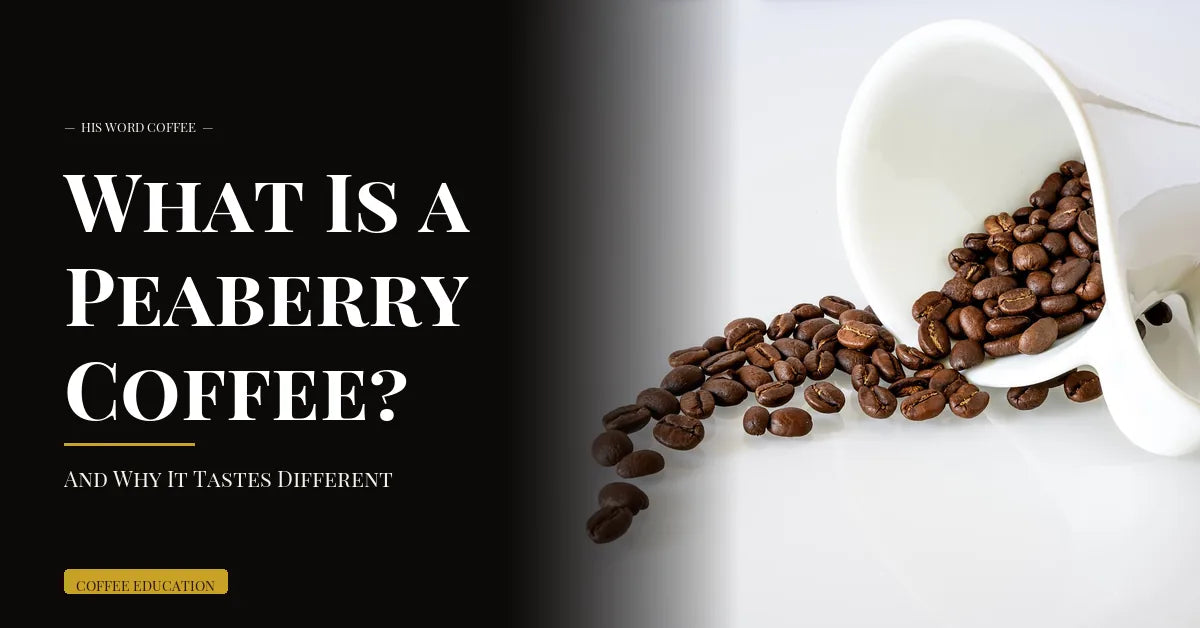
Most coffee beans have a flat side. If you have ever looked closely at a coffee bean and wondered what that flat face is about, the answer involves the inside of a coffee cherry and a small, fairly charming biological accident. Peaberry coffee skips that flat side entirely. Here is what that means, why it matters for flavor, and whether it is actually worth the premium.
- A peaberry forms when only one seed develops inside a coffee cherry instead of the usual two, resulting in a small, fully round bean.
- Peaberries make up roughly 5 to 10 percent of any harvest, and sorting them out is done by hand or specialized machinery.
- The flavor is often described as more concentrated or vibrant than the same origin's flat beans, though this is still debated among coffee scientists.
- Tanzania Peaberry is the most famous and widely available peaberry coffee in the world.
- Peaberry requires no special brewing technique. Use the same grind and method you would for any coffee from that origin.
In this article
What Exactly Is a Peaberry?
To understand a peaberry, you first need a quick look at the inside of a coffee cherry. A coffee cherry is the small, fruit-covered seed pod that grows on the coffee plant. Normally, each cherry contains two seeds nested face-to-face. As those two seeds grow and press against each other, each one develops a flat side. That flat side is the hallmark shape of nearly every coffee bean you have ever seen.
Occasionally, through natural biological variation, only one of those two seeds gets fertilized. With no neighbor to press against, that single seed is free to grow in every direction. It fills the entire interior of the cherry and takes on a fully rounded, oval shape. That rounded bean is called a peaberry, or caracol in Spanish, meaning "snail shell."
A peaberry is not a defect, a disease, or a sign of poor farming. It is simply a genetic quirk that occurs naturally in any coffee-growing region, in any variety, in any year. The plant does not know or care. Some of its cherries will produce two flat beans; a small fraction will produce one round one.
The visual difference is immediately obvious once you know what to look for. A standard flat bean has two faces: one flat and one curved. A peaberry has no flat face at all. It looks a bit like a small, dense pea, which is precisely where the name comes from.
How Common Are Peaberries?
In any given coffee harvest, somewhere between 5 and 10 percent of cherries will produce a peaberry instead of two flat beans. The exact rate depends on the coffee variety, the specific tree genetics, the altitude, and the growing conditions that season. Some farms and some varieties run slightly higher; most cluster in that 5 to 8 percent range.
That might sound like a small number, but across a large coffee farm or a regional cooperative, it adds up to a meaningful quantity of beans, enough to process, sort, and sell as a distinct product category, which is exactly what most specialty coffee regions do with them.
The rate is not artificially increased. Nobody is doing anything to the plants to produce more peaberries. Farmers simply harvest all their cherries together, process the coffee normally, and then separate peaberries from flat beans at the milling stage. The peaberry rate you get is simply the rate nature provides.
How Are Peaberries Sorted?
Peaberry sorting happens after the coffee has been harvested, processed (washed, natural, or honey), and milled to remove the parchment layer. At that point, the green coffee consists of a mix of flat beans and round peaberries, along with the occasional broken fragment or defect.
Sorting peaberries from flat beans is more labor-intensive than it sounds. The primary method uses density and size sorting screens, which are perforated metal or mesh screens with holes sized for specific bean dimensions. A standard flat bean sits differently on a screen than a peaberry does, because the rounded shape interacts with the holes at a different angle. Peaberries tend to roll through or past standard screens in ways that flat beans do not, allowing for a rough mechanical separation.
That mechanical sort is only the first pass. In most quality peaberry lots, hand-sorting follows. Workers on a sorting table remove any remaining flat beans that slipped through, and also remove any peaberries that are discolored, chipped, or otherwise defective. The result is a peaberry lot that is, by necessity, quite clean, because the sorting process that targets shape also catches many defects along the way.
This combination of mechanical separation and hand-sorting is a significant part of why peaberry coffee costs more. It is not just a marketing premium for novelty. The sorting genuinely adds cost, time, and labor that flat bean lots do not require.
Does Peaberry Actually Taste Different?
This is the most interesting and most genuinely contested question in the peaberry conversation. The short answer is: yes, peaberry coffee often tastes noticeably different, but the reason why is not completely settled.
The popular explanation runs as follows. In a normal coffee cherry, the single seed's nutrient budget is shared between two seeds. In a peaberry cherry, one seed receives the entire nutrient supply from that cherry. The single seed should therefore be more nutritionally concentrated, which should translate to more intense or complex flavor compounds in the finished cup.
That logic is appealing, and there is anecdotal support for it. Many experienced cuppers report that peaberry lots from Tanzania, Kenya, or Colombia taste more vibrant, more layered, and more pronounced than the same farm's flat beans at the same roast level. The brightness often seems higher. The fruit or floral notes often seem more defined.
The counterargument is methodological. When cupping peaberry versus flat beans from the same lot, you are almost never comparing beans that received identical sorting treatment. The peaberry lot has been hand-sorted meticulously. The flat bean control lot often has not been sorted to the same standard. A cleaner, lower-defect lot will nearly always taste better, regardless of bean shape, simply because fewer defects means fewer off-flavors dragging down the cup score.
According to research cited by the World Coffee Research, the physical development of a peaberry, including seed size and density, is measurably different from flat beans in the same cherry class. Whether those physical differences translate reliably to flavor differences in blind cupping conditions is a question that has not been definitively answered in controlled, peer-reviewed form.
The practical takeaway for coffee drinkers is this: peaberry lots tend to be excellent, they often show the flavor characteristics of their origin in concentrated form, and they are worth trying if you enjoy the region they come from. Whether that quality comes from the single-seed nutrient theory, the meticulous sorting, or both, the cup result is often genuinely good.
Famous Peaberry Origins
Peaberry coffee is produced in nearly every major coffee-growing country, but a handful of origins have become particularly well known for their peaberry lots. These four are the ones most likely to appear in a specialty coffee menu or single-origin lineup.
Tanzania Peaberry
Tanzania Peaberry is the most famous peaberry coffee in the world, and for good reason. It has been exported and traded as a recognized product for decades. Tanzania's growing conditions, including high altitude on the slopes of Kilimanjaro and the Southern Highlands, and well-established washed processing infrastructure, combine to produce a peaberry with remarkable clarity. Expect bright acidity, a wine-like or fruit-forward depth, and a black tea quality that gives the finish a clean, lingering length. Tanzania Peaberry is often the entry point for coffee drinkers who want to understand what peaberry coffee can taste like at its best.
Kenya Peaberry
Kenya is already famous for some of the most intense and distinct coffees in the world. The hallmark Kenya cup note is a pronounced blackcurrant or black fruit quality that sets it apart from other origins. Kenya Peaberry lots concentrate that characteristic even further. The result is a cup that hits harder in terms of fruit intensity and acidity than a standard Kenya flat bean from a comparable farm. Kenya Peaberry is not always easy to find outside of specialty roasters, but it is worth seeking out if blackcurrant-forward profiles appeal to you.
Colombia Peaberry
Colombia is the world's third-largest coffee producer and one of the most consistent sources of high-quality washed coffee. Colombian Peaberry is less commonly sold as a distinct product category than Tanzania or Kenya peaberry, but it does appear in specialty roaster lineups from time to time. Colombia's flavor profile tends toward milk chocolate, caramel, and medium fruit notes with a clean, balanced body. The peaberry version of a Colombian lot often brings more definition to those flavors, with a slightly lifted brightness compared to the same farm's flat beans.
Brazil Peaberry
Brazil produces a large volume of peaberry coffee, though it is marketed less specifically than Tanzania or Kenya peaberry. Brazil's cup profile leans toward heavy body, low acidity, and chocolate and nut notes. A Brazilian Peaberry tends to retain those characteristics while rounding out the texture. If you enjoy a rich, body-forward cup with minimal brightness, Brazilian Peaberry is a solid and often affordable option.
| Origin | Typical Flavor Notes | Acidity | Availability |
|---|---|---|---|
| Tanzania | Black tea, wine, bright fruit | High | Widely available in specialty |
| Kenya | Blackcurrant, dark fruit, bold | Very high | Specialty roasters, seasonal |
| Colombia | Caramel, chocolate, balanced fruit | Medium | Occasional, specialty roasters |
| Brazil | Chocolate, nuts, heavy body | Low | Moderate, often in blends |
Roasting Peaberry Coffee
Peaberry coffee has a reputation in some roasting communities for being easier to roast evenly. The argument is that the round shape rolls more freely and more uniformly in a drum roaster. Because the bean has no flat face to press against the hot metal drum surface, heat transfer through contact is more consistent. Each bean rotates through the drum with roughly similar exposure to the air and the drum wall, which in theory should lead to a more even roast development inside the bean.
In practice, experienced roasters who have roasted both peaberry and flat beans from the same origin report that this advantage is real but modest. The round shape does roll more freely. Color development does tend to be slightly more uniform. But the difference is not dramatic, and a skilled roaster can produce an excellent roast with either bean shape.
In fluid-bed or air roasting, where beans levitate in a column of hot air and never contact a metal surface, the rolling advantage disappears entirely. Both shapes receive heat primarily through convection, and the round peaberry offers no particular advantage over flat beans. The Specialty Coffee Association (SCA) notes that roast development for peaberry should be approached the same as for any other green coffee from that origin: adjust for bean density, moisture content, and screen size, not just shape.
Peaberry beans are often slightly denser than flat beans from the same crop, which means they may need slightly more time or energy in the early phases of the roast to reach first crack. Roasters who are dialing in a peaberry lot for the first time are advised to track their probe readings carefully through the drying and Maillard phases and not simply apply their existing flat-bean profiles without adjustment.
Brewing Peaberry Coffee
Good news: brewing peaberry requires no special technique, no special equipment, and no adjustment to your existing process. Use the same grind settings you would for flat beans at the same roast level from the same origin. The round shape does not meaningfully change how water extracts from the coffee, because extraction happens through the cell walls and the porous structure of the roasted bean, not primarily through the outer geometry.
For Tanzania Peaberry, which tends to be bright and high in acidity, a pour-over method like a Hario V60 or Chemex will highlight those clean tea-like qualities best. A medium-coarse grind, water around 200 to 205 degrees Fahrenheit, and a 1:16 or 1:15 coffee-to-water ratio is a solid starting point.
For Kenya Peaberry, the same pour-over approach works well, though some drinkers prefer a slightly shorter brew to keep the fruit notes from overwhelming. If you find Kenya peaberry tastes too intense at your standard ratio, try pulling back to a 1:17 ratio before adjusting grind.

For Brazil or Colombia Peaberry, espresso or French press are both excellent choices. The heavier body and lower acidity of these origins translate well to immersion brewing, and the concentration of espresso suits the chocolate and caramel profile.
If you want a complete guide to matching grind size to brew method for any coffee, including peaberry, our coffee grind size chart covers every major brewing method with specific grind recommendations.
Get Fresh Single-Origin Releases First
Tanzania Peaberry and other limited single-origin coffees go fast. Join our list and hear about new arrivals before they sell out.
Is Peaberry Worth the Premium?
Peaberry coffee typically sells for two to five dollars more per pound than the same origin's flat beans. For Tanzania Peaberry, that premium is usually at the lower end of that range. For rarer lots like Kenya Peaberry from a well-known cooperative, it can be higher.
The premium is justified by real costs. Hand-sorting a peaberry lot is time-consuming. Mechanically separating peaberries from flat beans requires equipment investment. And because peaberries are only 5 to 10 percent of any harvest, the total volume available from any farm is inherently limited, which adds a scarcity component that simple economics will price accordingly.
Whether the premium is worth it for you personally depends on two things: how much you enjoy the origin in question, and whether the flavor difference is perceptible in your brewing setup.
If you already love Tanzania as an origin, Tanzania Peaberry is almost certainly worth trying. The majority of people who compare it directly to a standard Tanzania washed lot from a similar elevation report that the peaberry version tastes more defined and vivid. Whether that is the single-seed nutrient concentration or the sorting quality or both, the cup result tends to justify the price.
If you are buying peaberry primarily as a curiosity or as a novelty gift item, it still makes for an excellent cup and a great conversation starter. But you do not need to pay a peaberry premium to get outstanding coffee from any of these origins. The flat beans from the same farms are often excellent as well.
Peaberry at His Word Coffee
Peaberry lots appear in our single-origin rotation when we can source them at the quality level our coffees require. Tanzania Peaberry, in particular, is one of the most interesting coffees we carry when we can get it. We look for lots that have been properly sorted, that show the clean tea-like brightness Tanzania is known for, and that are traceable to specific cooperatives or washing stations in the Kilimanjaro or Mbeya regions.
We do not carry peaberry year-round, because good peaberry lots are not available year-round. When they are in stock, they are worth paying attention to. Our full coffee menu lists what is currently available, and anything labeled peaberry will be clearly noted in the product description with its origin, process, and tasting notes.
We believe in being honest about what makes a coffee worth buying, and peaberry is a case where the explanation actually holds up. The sorting is real, the flavor concentration is often real, and the origins that produce the most well-known peaberry lots, Tanzania especially, have earned their reputation over decades of consistent quality.
Frequently Asked Questions
What does peaberry coffee taste like?
Peaberry coffee tends to taste more concentrated or vibrant than flat beans from the same origin. Tanzania Peaberry is known for bright acidity, a tea-like finish, and wine-like fruit depth. Kenya Peaberry amplifies that origin's signature blackcurrant intensity. The specific flavor depends heavily on the origin, the process (washed, natural, honey), and the roast level, just as it does with any coffee.
Is peaberry coffee better than regular coffee?
Not inherently better, but often excellent. Peaberry coffee from a quality origin that has been well-sorted and roasted with care will typically be a very good cup. Whether it is better than a high-quality flat bean lot from the same region is a matter of personal preference and perception. Many drinkers find the flavor more pronounced and prefer it. Others find the difference subtle once they control for origin and roast level.
Why is peaberry coffee more expensive?
The price premium reflects real costs: hand-sorting or mechanical separation of peaberries from flat beans adds labor and equipment expense. Peaberries are only 5 to 10 percent of any harvest, so the available quantity is inherently limited. Those two factors, sorting cost and limited supply, are what drive the two-to-five-dollar-per-pound premium over the same origin's regular beans.
Which country makes the best peaberry coffee?
Tanzania Peaberry is the most widely recognized and consistently excellent peaberry coffee in the world. Kenya Peaberry is exceptional but harder to find. The best peaberry coffee is ultimately the one from the origin whose flavor profile you like most, since peaberry amplifies rather than transforms an origin's natural characteristics.
How do I brew peaberry coffee?
Exactly as you would brew any other coffee at the same roast level from the same origin. Use your standard grind size, water temperature, and ratio. No special equipment or adjusted technique is needed. If you want guidance on grind settings for different brew methods, see our coffee grind size chart.
Is peaberry a defect in coffee?
No. Peaberry is a natural genetic variation that occurs in 5 to 10 percent of coffee cherries across all varieties and growing regions. It is not caused by disease, poor farming, or any external factor. It is simply one of the normal ways a coffee seed can develop, and it results in a bean that is genuinely different in shape and often in flavor, not defective in any sense.
What is the difference between peaberry and regular coffee beans?
Regular coffee beans are flat on one side because they developed as one of two seeds inside a cherry, pressing against each other as they grew. A peaberry developed as the only seed in its cherry, so it grew into a fully round shape. Flavor-wise, peaberry is often described as more concentrated or vibrant, because the single seed may have received all the nutrients that would normally go to two seeds. The round shape also sorts differently and can roll more evenly in a drum roaster.
Explore Our Single-Origin Coffees
Peaberry is in rotation when we can source it. In the meantime, our full single-origin lineup covers East Africa, Latin America, and beyond, all roasted fresh to order.
Shop Single Origin Browse All CoffeesContent is for educational purposes. Flavor descriptions reflect general tasting notes commonly associated with each origin and may vary by harvest year, processing method, and roast profile.
Sources: Specialty Coffee Association, Brewing Best Practices. Poole et al., Coffee and Health: A Review of Recent Human Research, Crit Rev Food Sci Nutr 2017.



Leave a comment
This site is protected by hCaptcha and the hCaptcha Privacy Policy and Terms of Service apply.