
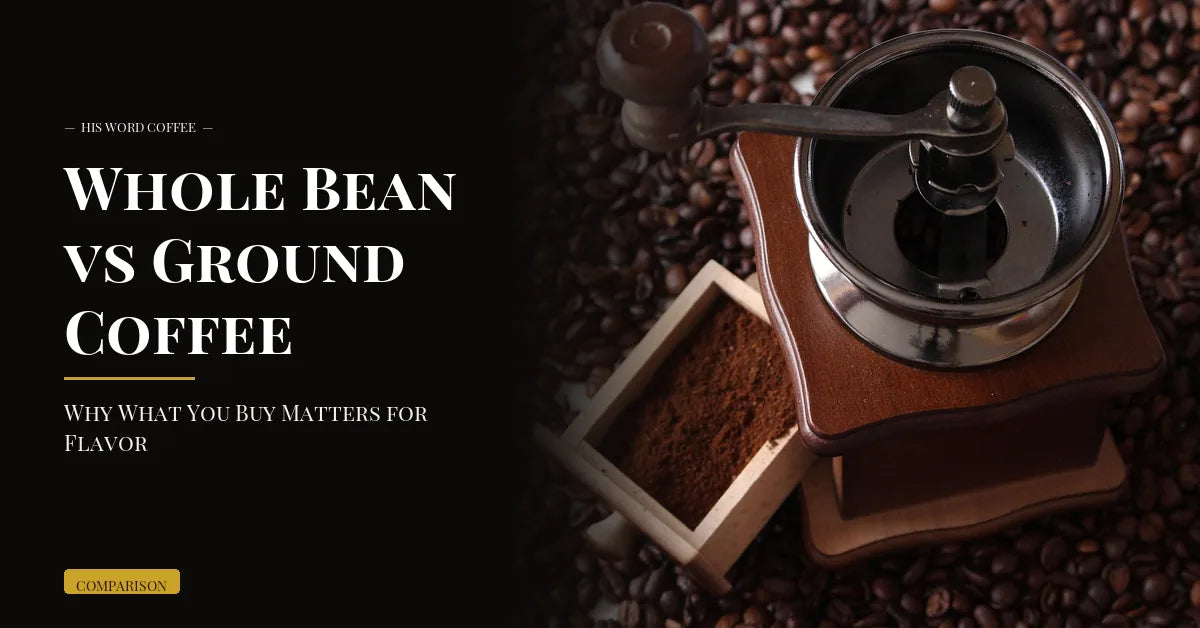
Ground coffee starts losing flavor within 15 to 30 minutes of grinding. Whole bean coffee, stored properly in a sealed bag, stays fresh for two to four weeks after roasting. That gap is not subtle. It shows up in your cup every single morning.
Key Takeaways
- Ground coffee goes stale fast: Once ground, coffee begins oxidizing immediately. Most of the aromatics are gone within 30 minutes, and it tastes noticeably flat within a day or two.
- Whole bean stays fresh longer: Sealed whole beans retain peak flavor for two to four weeks after the roast date, and remain drinkable (though past prime) for up to a month beyond that.
- Flavor compounds are volatile: The oils and acids that make coffee taste bright, sweet, or complex escape the moment you grind. Pre-ground coffee has already lost most of those before it reaches your mug.
- A burr grinder is worth the investment: Even a mid-range burr grinder (around $50 to $100) will produce a more consistent grind and a noticeably better cup than buying pre-ground coffee at any price point.
- Pre-ground has its place: If you travel often, share a household with different preferences, or just want a no-fuss morning, pre-ground is a perfectly reasonable choice. The tradeoff is real but so is the convenience.
- Roasted-to-order is the other half of freshness: Buying whole bean from a bag that has been sitting in a warehouse for months is almost as bad as buying pre-ground. The roast date matters as much as the grind timing.
Why Ground Coffee Goes Stale So Fast
When a coffee bean is roasted, it produces carbon dioxide as a byproduct of the roasting process. That CO2 is actually a good thing in the short term. It forms a kind of protective barrier around the bean, pushing out oxygen and slowing the oxidation that causes staleness. This is why freshly roasted coffee bags have one-way valves: they let CO2 escape without letting oxygen in.
When you grind those beans, you shatter that barrier entirely. The surface area of the coffee expands by hundreds of times. Where a whole bean might have a few square centimeters of exposed surface, a scoop of ground coffee has something closer to several thousand square centimeters. Every one of those surfaces is now exposed to oxygen.
Oxidation then goes to work on two things: the aromatic oils that carry most of the flavor, and the organic acids that give coffee its brightness and complexity. Both break down quickly at room temperature. The aromatic compounds are so volatile that you can literally smell them leaving the bag when you open it for the first time. Within 15 to 30 minutes of grinding, a measurable portion of those aromatics has already escaped into the air around you rather than into your cup.
Here is a rough timeline for what happens to ground coffee after it is opened:
- 0 to 30 minutes: Peak freshness. Grind and brew immediately if possible.
- 30 minutes to 4 hours: Noticeable aroma loss. Still good, not great.
- 4 to 24 hours: Significant flavor degradation. The cup will taste dull compared to freshly ground.
- 1 to 3 days: Stale. Oxidation has worked through much of the bag. Flat, papery notes begin to dominate.
- 1 week or more: The coffee is still drinkable but most of what made it interesting is gone.
Whole bean coffee follows a much slower curve. Because the protective structure of the bean itself limits oxygen exposure, the same compounds that degrade in minutes after grinding take weeks to break down. Store your beans in an airtight container away from light and heat, and you have a two to four week window of genuinely good coffee.
What You Actually Taste in Whole Bean vs Pre-Ground
The flavor difference between freshly ground whole bean and pre-ground coffee is not just a matter of degree. It is often a difference in kind. Pre-ground coffee that has been sitting for a few days does not simply taste "less fresh." It tastes like a different coffee altogether.
Here is what is actually happening chemically. Coffee contains several hundred flavor compounds, but a few categories are responsible for most of what you notice in the cup:
Chlorogenic acids are responsible for a lot of coffee's brightness and the pleasant, mild acidity you get in a well-roasted cup. These begin degrading quickly after grinding and produce bitter, harsh-tasting compounds as they break down. This is a big part of why stale pre-ground coffee often tastes more bitter than it should.
Aromatic oils are what you smell when you open a fresh bag. They carry the fruity, floral, nutty, and chocolatey notes that make specialty coffee interesting. These oils are extremely volatile. They evaporate rapidly after grinding, which is why pre-ground coffee often smells weaker than whole bean even when the bags come from the same roast.
Melanoidins are the compounds created during roasting that give coffee its body and sweetness. These are more stable than the aromatic oils but still degrade with prolonged oxygen exposure. In stale coffee, the sweetness flattens out and the body thins.
What you end up tasting in pre-ground coffee that has been open for a few days is a cup that is flat, slightly papery, and one-dimensional. The brightness is gone. The aromatics are muted. What remains is mostly bitterness and an impression of coffee without much of the character that makes good coffee worth drinking.
| Factor | Whole Bean Coffee | Pre-Ground Coffee |
|---|---|---|
| Fresh after opening | 2 to 4 weeks at peak, 6 weeks drinkable | 15 to 30 minutes at peak, 1 to 3 days drinkable |
| Flavor retention | High. Oils and acids protected inside the bean | Low. Oxidation begins immediately after grinding |
| Convenience | Requires a grinder and 30 extra seconds | Open and brew. No equipment needed. |
| Best for | Anyone who cares about flavor and brews at home daily | Travelers, offices, casual drinkers, households with multiple brew methods |
| Cost | Slightly higher per bag, but often better value per cup | Often slightly cheaper per bag. Grinder is an upfront cost for whole bean. |
Get brewing guides like this weekly.
Fresh roast alerts, grind tips, and 10% off your first order.
When Pre-Ground Coffee Makes Sense
This is an honest section. Pre-ground coffee is not a bad product. It is a tradeoff, and for a lot of people, it is a tradeoff worth making.
If you travel frequently and do not want to pack a grinder, pre-ground makes your morning easier without a second thought. If you share a household where one person prefers drip and another uses a French press, keeping pre-ground for each method avoids having to swap grinder settings every morning. If coffee is just a caffeine delivery system for you and the nuances of flavor are not a priority, pre-ground from a good roaster will do the job just fine.
The case for pre-ground also gets stronger if you drink coffee quickly. A household that goes through a bag in a week or less will see much less degradation than someone who nurses the same bag for a month. The freshness curve is steep at first and then levels off. Day one versus day three matters a lot. Day five versus day ten matters considerably less.
Where pre-ground really falls apart is when you are trying to get the most out of high-quality coffee. If someone has taken care to source good beans, roast them carefully, and ship them fresh, buying their coffee pre-ground and then leaving it on a shelf for two weeks undoes most of that work. The beans were never going to have a chance.
So the honest answer to "should I buy whole bean or ground coffee" is: buy whole bean if you drink coffee every day at home and want the best possible cup. Buy pre-ground if the convenience matters more than the flavor. Both are valid choices. Just know what you are trading off either way.
The Right Grind for Your Brewing Method
Once you decide to go whole bean, the next question is how to grind. Grind size is not a one-size-fits-all setting. Every brewing method extracts coffee differently, and the grind size controls how quickly water moves through the grounds and how much surface area is in contact with the water.

Get it wrong and even excellent, freshly roasted beans will taste off. Too fine for a French press and you get over-extracted, bitter, sludgy coffee. Too coarse for espresso and the shot runs thin and sour. The grind is that important.
As a starting point:
- Extra coarse: cold brew, cowboy coffee
- Coarse: French press, percolator
- Medium-coarse: Chemex, some pour-over methods
- Medium: Drip coffee makers, flat-bottom pour-over
- Medium-fine: Aeropress, siphon
- Fine: Espresso, moka pot
- Extra fine: Turkish coffee
For a full breakdown by brewer with photos and extraction tips, see our coffee grind size chart and guide for every brewing method. It covers everything from French press to espresso with specific settings for popular grinder models.
Quick Tip
Grind size matters as much as freshness. The wrong grind ruins even great beans. If your coffee tastes bitter, try going coarser. If it tastes sour or weak, go finer. Adjust one variable at a time.
Why Fresh Roasted Coffee Matters Too
Here is something that does not always get said clearly: buying whole bean coffee does not automatically mean buying fresh coffee. If your beans were roasted six months ago and shipped through a distribution chain before landing on a grocery store shelf, you are starting with stale coffee regardless of whether you grind it yourself.
The roast date is the other half of the freshness equation. Coffee is at its best within the first two to four weeks after roasting. After about six weeks, even well-stored whole beans start to lose the qualities that make them interesting. After three months, they have gone flat in most of the same ways that pre-ground coffee goes flat in a few days. The mechanism is slower but the outcome is similar.
This is why roasted-to-order coffee is genuinely different from shelf coffee. When a roaster ships beans within a day or two of roasting, you receive them at or very close to their peak. When you grind them fresh each morning, you are getting nearly everything those beans have to offer.
Shelf coffee at a grocery store typically has a "best by" date stamped on it, not a roast date. That best-by date is often six months to a year from roasting. "Best by" is doing a lot of work there. The coffee is not bad in any harmful sense. It is just not going to taste the way it would have a month after roasting.
If you want to go deeper on what to look for on a coffee bag and how to tell whether the coffee you are buying is actually fresh, our article on why fresh roasted coffee tastes better covers that in detail.
The short version: look for a roast date, not a best-by date. Buy from roasters who ship within a few days of roasting. Store in an airtight container at room temperature, away from light. And grind just before you brew.
You can browse our current freshly roasted whole bean coffees, all typically ships in 1, 3 business days of the roast date.
Fresh Beans, Delivered When You Need Them
Our subscription ships whole-bean coffee roasted within 24 hours of your delivery date. 10% off every bag, free to pause or cancel anytime.
Start Your SubscriptionFrequently Asked Questions
How long does whole bean coffee stay fresh?
Whole bean coffee stored in an airtight container at room temperature stays at peak flavor for two to four weeks after the roast date. It remains drinkable (though past its best) for up to six weeks. After that, it will taste noticeably flat. The roast date on the bag matters more than the "best by" date, which is often set six months or more after roasting.
How quickly does ground coffee go stale?
Ground coffee begins losing flavor almost immediately after grinding. Within 15 to 30 minutes, a meaningful portion of the aromatics have already escaped into the air. After 24 hours, the cup will taste noticeably duller than freshly ground coffee from the same beans. After a few days open on the counter, most of what made the coffee interesting is gone. If you buy pre-ground, try to use it within a week of opening and keep the bag sealed tightly between uses.
Is it worth buying a coffee grinder?
Yes, for most home coffee drinkers. A burr grinder in the $50 to $100 range will make a noticeable difference compared to buying pre-ground, even when using the same beans. Blade grinders (the cheap spinning ones) are better than nothing but produce an inconsistent grind that leads to uneven extraction. A decent burr grinder is a one-time purchase that improves every cup for years.
Does pre-ground coffee taste worse?
Compared to coffee ground right before brewing, yes. Pre-ground coffee that has been sitting in a bag for days or weeks has lost much of its aromatic complexity. The cup tends to taste flat, slightly bitter, and one-dimensional compared to the same beans freshly ground. That said, pre-ground coffee from a quality roaster, used quickly after opening, is still a decent cup. The gap matters more the more you care about flavor.
What grind should I use for my coffee maker?
For a standard drip coffee maker, use a medium grind, roughly the texture of dry beach sand with obvious grains. For French press, use a coarse grind. For espresso, use a fine grind. For pour-over, it depends on the brewer: Chemex takes medium-coarse, most V60 and flat-bottom drippers use medium to medium-fine. See our grind size guide for a full chart with specific settings for each brewing method.
Sources: Specialty Coffee Association, Brewing Best Practices. Poole et al., Coffee and Health: A Review of Recent Human Research, Crit Rev Food Sci Nutr 2017Explore More.

Leave a comment
This site is protected by hCaptcha and the hCaptcha Privacy Policy and Terms of Service apply.