
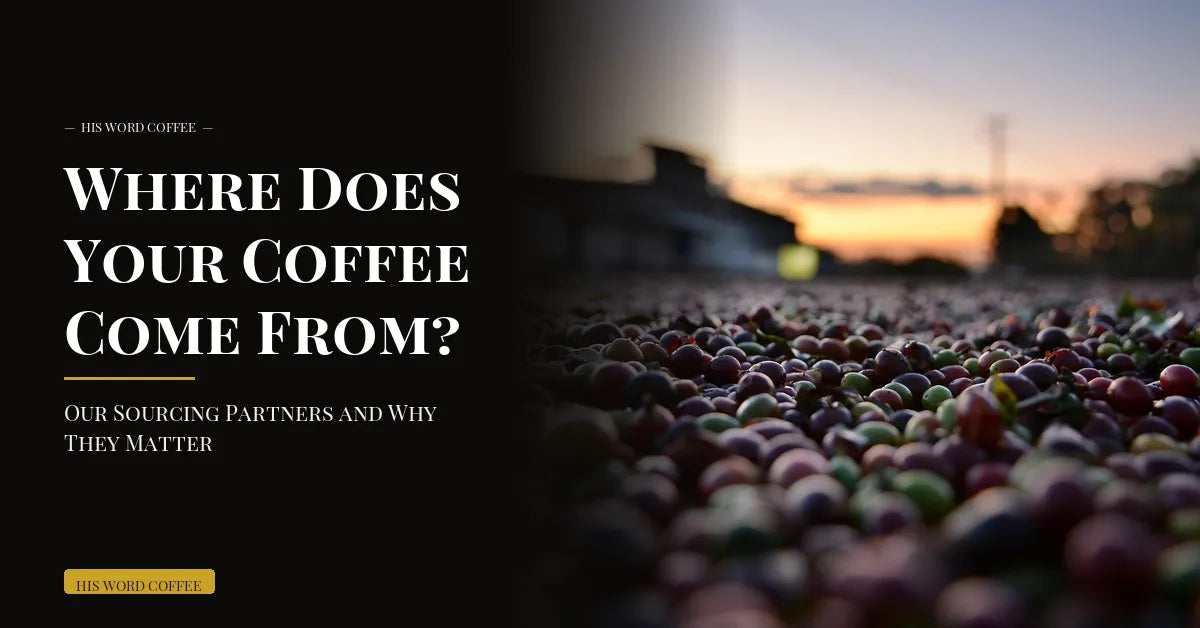
A few years ago, when we started to think about roasting for customers instead of just for friends and family, we drew a strong line in the sand: If we are going to run a ethical business, we need to know that our products are purchased through fair and equatable sources where we can trace our money, and know we are helping the communities we buy from.
Not just the country. Not a vague promise on a label. We wanted names. Cooperatives. Regions. We wanted to know whether the people who woke up before dawn to pick coffee cherries on a mountainside were being treated fairly for that work. And honestly? Finding real answers took longer than we expected. The coffee supply chain is complicated, full of middlemen, and not always built for transparency. But we kept digging, because it mattered to us. It still does.
So today, we want to pull back the curtain. Here is exactly where your coffee comes from, who grows it, and how it gets from a hillside thousands of miles away to a fresh-roasted bag on your doorstep.
What Ethical Sourcing Looks Like at His Word Coffee
- We know our partners by name: Every bean we roast comes through sourcing relationships we have personally chosen and verified
- Farmers are paid well above market rates: Our Haitian coffee partner pays producers up to 300% above fair trade minimums
- Full traceability: Every coffee we have traces back to a specific region, cooperative, or farm
- Quality and ethics go hand in hand: Better-paid farmers produce better coffee, and that difference ends up in your cup, and helps us all sleep a little better at night
What We'll Cover
- Why Does Ethical Sourcing Matter for Your Morning Cup?
- Cafe Kreyol: Direct Trade Coffee From Haiti
- Genuine Origin: Traceable Specialty Coffee (the SCA's standards) From Around the World
- What Is the Difference Between Direct Trade and Fair Trade?
- What Does This Mean for You?
- Our Commitment to Transparency
- Frequently Asked Questions
Why Does Ethical Sourcing Matter for Your Morning Cup?
Coffee is one of the most traded agricultural products on the planet, and the supply chain between a farmer in Colombia and a bag on your counter is long. Between the grower and the roaster, there are often multiple middlemen, each taking their cut. By the time a mass-market roaster buys the beans, the farmer who did the hardest work may have received only a fraction of the final price.
We think that is worth paying attention to. And not just because it is the right thing to do. There is a practical reality here that most people do not talk about: farmers who earn a living wage can afford to pick only the ripest cherries, invest in proper drying beds and fermentation equipment, and take care of the soil that gives specialty coffee its character. When you cut corners on sourcing, you taste it in the cup. Flat. Bitter. Lifeless.
For us, this also connects to something deeper. Colossians 3:23 says to work at everything with your whole heart. We try to honor that in our roastery, and we look for that same care in the people and organizations we partner with. Our sourcing decisions are not just business decisions. They are values decisions.
Cafe Kreyol: Direct Trade Coffee From Haiti
Haiti Hope Rising came from the APCAB cooperative (Association des Planteurs de Cafe de Belle-Anse) in southeastern Haiti. APCAB is a collective of roughly 680 growers working in the Belle-Anse and Thiotte regions of the Sud-Est department. These farmers cultivate Blue Mountain varietal (a sub-variety of Typica) in shade-covered plots at around 1,200 meters elevation. The coffee is washed-processed and naturally low in acidity, with a smooth, creamy body and notes of sweet almond, caramel, and dark chocolate.
What makes Cafe Kreyol stand apart from a standard importer is how they work. They do not buy through a chain of brokers. They sit down with the cooperatives. They invest in the communities where their coffee is grown. And those investments show up in tangible, visible ways. Roads paved so children can walk to school. Farmers saving money, purchasing land, expanding homes. Local trash services starting up in rural villages. None of that is theoretical. It is happening because specialty coffee is giving these communities a real economic foundation.
The bigger story here matters, too. Haiti has a coffee history stretching back over 250 years, but decades of political instability and economic hardship left many farms struggling. Cafe Kreyol has been part of rebuilding that legacy. What started with 200 producers in 2012 has expanded to roughly 2,800 coffee professionals across the country. They train farmers in post-harvest processing, cupping, pH testing, and acidity balancing. Their Zombie Desert lot once scored 92 points from the Specialty Coffee Association, placing it among the highest-scoring Haitian coffees on record. (That is a different lot than what we carry, but it tells you about the caliber of coffee these farmers are producing with the right support.)
When we cup our Haiti Hope Rising, we taste all of that work. A clean, sweet, approachable cup with chocolate depth and a smooth finish. It is one of the most meaningful coffees in our lineup, and one of the gentlest on your stomach.
Haiti Hope Rising sourcing profile
Haiti Hope Rising is preserved here as historical sourcing context for His Word Coffee: a Haitian Blue Mountain profile sourced through Cafe Kreyol from the APCAB cooperative.
- Origin: Haiti, APCAB Cooperative (Belle-Anse/Thiotte region)
- Elevation: 1,200 meters
- Varietal: Blue Mountain (Typica family)
- Process: Washed
- Tasting Notes: Sweet almond, caramel, dark chocolate, clean finish
- Acidity: Naturally low and gentle on the stomach
Genuine Origin: Traceable Specialty Coffee From Around the World
The majority of our single-origin coffees arrive through Genuine Origin. Our Colombia El Tiple from the Huila region. Our Guatemala Los Huipiles from Huehuetenango. Our Costa Rica Tarrazu. Each of these can be traced to a specific growing region, altitude range, and processing method.
Here is something most people have never seen: what green coffee actually looks like before roasting. Picture dense, pale green beans with a faintly grassy, almost tea-like smell. When a new shipment from Genuine Origin arrives, we cup the coffee before we commit to offering it. We compare our tasting notes against what the Q graders documented at origin. (A Q grader, in case you are wondering, is a certified professional coffee taster who has passed an intensive series of sensory evaluations. They are basically the sommeliers of the coffee world.) If the cup does not meet our standard, we do not roast it for you. Simple as that.
Behind the sourcing, Genuine Origin runs a program called The Volcafe Way. It is a farmer support initiative that puts field teams on the ground in producing countries, working alongside tens of thousands of coffee growers. Those teams provide hands-on help with agricultural best practices, climate risk management, and post-harvest processing techniques. The point is not just buying good coffee today. It is making sure those farming communities can produce great coffee ten, twenty, fifty years from now.
That long-term thinking resonates with us. We want to be roasting beans from these same origins for years to come, and that only works if the people growing our coffee have a future they can count on.
Colombia El Tiple: Our Signature Single Origin
Sourced through Genuine Origin from small family farms in Pitalito, Huila, Colombia. Named for the tiple, a traditional Colombian string instrument, this coffee reflects the care and tradition of the families who grow it. Our Colombia El Tiple is one of our most popular offerings for good reason.
Tasting Notes: Dark chocolate, caramel, cherry, vanilla, roasted almond
What Is the Difference Between Direct Trade and Fair Trade?
Fair trade is probably the sourcing model most people recognize. It guarantees farmers a minimum price per pound, and it requires farms to meet certain environmental and labor standards. That safety net matters, especially when global commodity prices crash.
Direct trade takes a different approach. There is no official certification body. No fees to pay a third-party auditor. Instead, the importer builds a direct, personal relationship with the farming community. They visit the farms, negotiate prices based on the quality of the harvest, and cut out the middlemen who siphon money along the way. Because specialty-grade coffee commands higher prices than commodity-grade, direct trade farmers frequently earn far more than what fair trade requires.
Our partner Cafe Kreyol is a clear example. They pay APCAB cooperative farmers up to 300% above fair trade minimums. That is not charity. It is a reflection of the quality those farmers are producing. And because Cafe Kreyol works face-to-face with the cooperatives, a larger share of that payment reaches the people who actually picked, processed, and prepared the coffee.

| Factor | Fair Trade | Direct Trade |
|---|---|---|
| Price Structure | Guaranteed minimum floor price ($1.80/lb washed Arabica) | Negotiated based on quality (often much higher) |
| Certification | Third-party certified (fees required) | No formal certification; built on trust and direct relationships |
| Relationship | Can be transactional; middlemen often involved | Personal partnership between importer and cooperative |
| Transparency | Audited standards with some supply chain visibility | Full traceability; the importer knows the farmers directly |
| Quality Focus | Meets minimum quality standards | Rewards higher quality with higher payment |
| Community Impact | Fair trade premium funds community projects | Higher income lets farmers invest in their own priorities |
A Note on Honesty
We want to be straightforward about our role in this chain. We are a small family roastery, and we do not travel to origin farms ourselves. Not yet, anyway. What we do is carefully choose sourcing partners whose practices we trust and can verify. Both Cafe Kreyol and Genuine Origin have established track records, transparent operations, and values that line up with ours. We believe that choosing your partners well is itself an act of stewardship.
Taste the Difference Sourcing Makes
Every product page on our site lists the origin, region, processing method, and tasting notes so you always know exactly what is in your bag. No vague labels. No guesswork.
Explore Our CoffeesWhat Does This Mean for You?
We realize that not everyone thinks about sourcing when they grab a bag of coffee. And honestly, you should not have to. That is our job. We do the research, vet the partners, and verify the quality so that you can just enjoy a great cup of coffee and know that it was done right.
But if you are the kind of person who reads ingredient labels, who asks where your food comes from, who pays a little more because you care about how it was made, then you are exactly who we roast for. And we want you to know that your choice genuinely matters.
The Haiti Hope Rising sourcing story connected coffee dollars to a Haitian farmer's ability to send their child to school on a newly paved road. When you choose our Colombia El Tiple, you are supporting a system that trains farmers in better processing methods so they can earn more for better coffee, year after year. These are not marketing stories. They are real outcomes that we can trace back through our supply chain.
The taste matters, too. Ethically sourced specialty coffee is not just a feel-good purchase. It genuinely tastes better, because the people who grew and processed it had the resources and the motivation to do their best work. You will notice the difference in your first cup.
Our Commitment to Transparency
Here is what we promise you, plainly:
We will always tell you where your coffee comes from. Every product page lists the origin country, growing region, elevation, processing method, and tasting notes. If we change a sourcing partner or an origin, we will update that information.
If we are not proud of it, we will not sell it. Every coffee goes through cupping before we offer it. We have turned down lots that did not meet our standards, even when it meant an empty spot on the shelf for a few weeks. Consistency matters more to us than always having everything in stock.
We choose partners who share our values. Cafe Kreyol and Genuine Origin are not the cheapest ways to source green coffee. We work with them because they treat farmers fairly, maintain real traceability, and operate with a level of integrity we can stand behind.
We are a small family business in Vancouver, Washington. We do not have the buying power of a national brand. But what we do have is the ability to choose carefully, roast with attention, and be honest with you about every step. That is worth something to us, and we hope it is worth something to you, too.
Frequently Asked Questions
What is direct trade coffee and how is it different from fair trade?
Direct trade means the importer or roaster works directly with farming cooperatives, cutting out middlemen and paying prices based on actual coffee quality rather than a fixed minimum. Fair trade sets a guaranteed price floor (currently $1.80 per pound for washed Arabica, plus a $0.20 social premium) and requires third-party certification with associated fees. Direct trade relationships are built on personal partnerships and often result in significantly higher pay for farmers. Our partner Cafe Kreyol, for example, pays farmers up to 300% above fair trade minimums.
Where does His Word Coffee source its beans?
We source our green coffee through two primary partners. Cafe Kreyol provides our Haitian Blue Mountain beans from the APCAB cooperative in southeastern Haiti. Genuine Origin, part of the global Volcafe network, supplies our coffees from Colombia, Guatemala, Costa Rica, Ethiopia, Kenya, and other origins across nearly 20 countries. Both partners prioritize traceability, quality, and fair treatment of farming communities.
How do I know my coffee was ethically sourced?
Every coffee we offer can be traced back to a specific region, cooperative, or farm. We publish origin details, processing methods, and elevation data on each product page. Our sourcing partners maintain direct relationships with producers and provide full supply chain transparency from harvest through export. If you ever have a question about a specific coffee's origins, just reach out to us and we will tell you everything we know.
Does His Word Coffee pay farmers fairly?
We work with sourcing partners who prioritize fair compensation. Cafe Kreyol pays Haitian farmers up to 300% above fair trade minimums through their direct trade model. Genuine Origin operates The Volcafe Way, a farmer support program that provides hands-on technical assistance and sustainable pricing to tens of thousands of coffee producers across nearly 20 countries. We believe fair pay and great coffee quality are directly connected.
Can I visit the farms where my coffee is grown?
We do not currently offer farm visits, but both of our sourcing partners maintain transparent operations. Cafe Kreyol shares detailed information about their cooperatives in Haiti, and Genuine Origin provides traceability data for every lot they ship. We publish the origin, region, processing method, and elevation for every coffee on our product pages so you always know where your beans come from.
What does specialty-grade coffee mean?
Specialty-grade coffee scores 80 or above on a 100-point scale as evaluated by certified Q graders (professionally trained and tested coffee tasters who are essentially the sommeliers of the coffee world). Less than 5% of the world's coffee meets this threshold. All of our coffees are specialty-grade, which means they have been evaluated for flavor clarity, balance, sweetness, and the absence of defects before we ever roast them.
Taste the Difference Transparency Makes
Every bag of His Word Coffee comes with a story worth knowing. From the hillsides of Haiti to the highlands of Colombia, our beans are grown by people we trust, sourced through partners we believe in, and roasted fresh in our Vancouver, Washington roastery. We think simple things carry meaning, and a good cup of coffee is no exception.
We would love for you to taste the difference.
Explore Our CoffeesWant to stay connected? Reach out to us or follow along on Instagram for behind-the-scenes looks at our roastery and sourcing updates.

Leave a comment
This site is protected by hCaptcha and the hCaptcha Privacy Policy and Terms of Service apply.